
SITREP 10

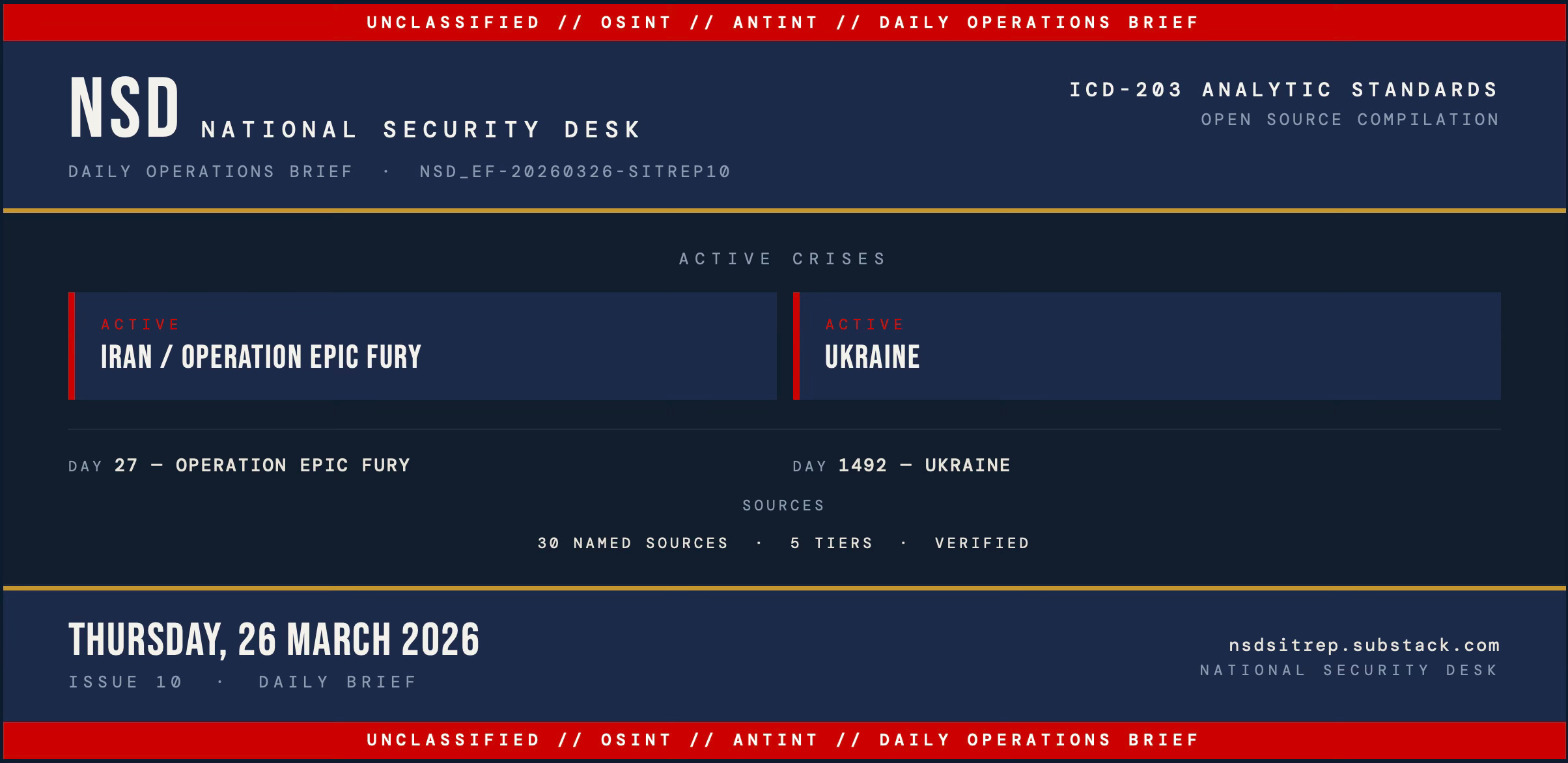

WASHINGTON DC 26MAR2025
UPDATE SUMMARY
The United States is preparing to put ground troops on Iranian territory. The deployment of the Eighty-Second Airborne Division and two Marine Expeditionary Units, the five-day postponement of strikes on Iranian energy infrastructure, and the fifteen-point ceasefire proposal that Iran was always going to reject are not three separate stories. They are one story. The pause is not about diplomacy. It is about getting the assault force into position.
President Trump wants an Inchon — a single dramatic stroke that breaks the strategic deadlock, reopens the Strait of Hormuz, and gives him the victory footage his two-minute daily briefings are designed to deliver. Three island-seizure concepts are now under active discussion in Washington: Kharg Island in the northern Gulf, the Hormuz Strait islands of Abu Musa and the Tunbs, or both simultaneously. Senator Lindsey Graham told Fox News: “He who controls Kharg Island controls the destiny of this war. Semper Fi.” Trump himself told reporters he is “not afraid” to send troops into Iran.
NSD assesses the simultaneous option — Kharg by air, Hormuz islands by Marines — is operationally the strongest concept on the table and could succeed as an initial seizure, provided IRGC offensive capabilities have been degraded enough that Iran cannot mount a concentrated response against both operations at once. That is the critical unknown.
The harder question is not the landing. It is the hold — and what the temptation of a successful hold produces. When Trump tells reporters that Iran wants a deal “so badly,” he is describing himself. Iran’s Foreign Minister Araghchi said on state television that no negotiations are taking place. The IRGC’s military spokesman mocked Washington for “negotiating with itself.” Every signal from this administration — the ceasefire plan, the “winding down” language, the social media attacks on oil price reporting, the five-day strike postponement — reads as a president desperate for an exit he cannot find. The IRGC reads these signals and is calibrating its operational tempo to exploit them. Meanwhile, Admiral Brad Cooper reported that US forces have struck more than ten thousand military targets and destroyed two-thirds of Iran’s production capacity. Iranian drones hit Kuwait International Airport for the fourth time. A strike near an Iraqi army medical center killed seven soldiers and prompted Baghdad to summon the American diplomat. Brent crude trades in the mid-nineties on ceasefire volatility while markets price in a resolution that NSD assesses is not coming. The clock that matters is not on the battlefield.
KEY DEVELOPMENTS
· Iran rejected the US fifteen-point ceasefire proposal as “maximalist and unreasonable” and issued a five-point counterproposal demanding war reparations, sovereignty over the Strait of Hormuz, and an end to all operations against resistance groups — terms Washington cannot accept. [1]
· Trump told reporters Iran wants a deal “so badly” while Araghchi said on Iranian state TV that no negotiations are taking place; mediators are pushing for possible in-person talks in Pakistan as early as Friday. [2]
· Admiral Brad Cooper reported in a March 25 video update that US forces have struck more than 10,000 military targets and destroyed two-thirds of Iran’s missile, drone, and naval production facilities since February 28. [3]
· Cooper stated 92% of Iran’s largest naval vessels have been destroyed; JINSA assessed Iran has “largely lost the ability to operate blue-water surface combatants,” with remaining threats concentrated in small boats, mines, and coastal missiles. [3][4]
· The Pentagon confirmed deployment of the 82nd Airborne Division headquarters, division enablers, and 1st Brigade Combat Team to the CENTCOM area of operations; combined with two Marine Expeditionary Units en route, 6,000 to 8,000 ground-capable troops are moving into proximity to Iran on top of 50,000 already in theater. [5]
· Iran’s IRGC launched missiles and drones at US installations in Kuwait, Jordan, and Bahrain and targets in Israel; Iranian drones struck a fuel tank at Kuwait International Airport sparking a major fire — the fourth airport attack since February 28. [6]
· A strike near an Iraqi army medical center in Anbar province killed at least seven Iraqi soldiers; Iraq summoned the top US diplomat to formally protest what it called a breach of international law — a significant friction point with a nominal US partner. [7]
· An AP-NORC poll found 59% of Americans say military action has gone too far, 61% disapprove of Trump’s handling, and a Pew survey found only 25% say the action is going well; views are sharply polarized with 92% of Democrats and 64% of independents opposed. [8]
· The Soufan Center warned that the war is disrupting global supplies of helium and sulfur — critical inputs for semiconductor fabrication and defense manufacturing — with downstream effects on both US and Chinese technology supply chains. [9]
· Brent crude settled at approximately $97 on March 25 before rebounding; European TTF gas closed at €52.82/MWh, down from €56.68 on March 23 but still elevated well above pre-war levels. [10]
· CNN reported Iran is laying traps around Kharg Island — which handles 90% of Iranian crude exports — in anticipation of a possible US amphibious or strike operation. [11]
· In Ukraine, Russian forces launched nearly 1,000 drones and missiles on March 23-24 in one of the war’s largest combined strikes; Ukrainian forces responded with deep strikes on a Russian shipbuilding plant in Leningrad Oblast and the Ust-Luga oil hub on the Baltic Sea. [12]
CRISIS MODULE — ACTIVE: IRAN / OPERATION EPIC FURY
Day 27 (28 February – 26 March 2026)
SITUATION SUMMARY
The diplomatic track and the force buildup are not contradictions. They are sequential. Iran’s rejection of the fifteen-point ceasefire plan — covering sanctions relief, nuclear rollback, missile limits, IAEA monitoring, and Hormuz access — serves Washington’s escalation logic as much as Tehran’s. The administration can now tell Congress, allies, and markets that it tried diplomacy and Iran refused. The five-day postponement of energy infrastructure strikes, announced as a diplomatic gesture, simultaneously provided the time needed to position the 82nd Airborne, accelerate the MEU deployments, and degrade Iranian coastal defenses around Kharg and the Strait islands. Israeli officials were surprised by the ceasefire submission; NPR reported Israel aims to continue combat operations for several more weeks. Iran’s five-point counter demanded sovereignty over Hormuz, reparations, and cessation of all proxy operations — terms that function as a public refusal while leaving back-channel message exchanges intact via Pakistan, Egypt, and Oman. ISW’s March 25 Iran Update assessed the full proposal in detail, noting that several provisions — zero enrichment, handover of advanced weapons systems, IRGC withdrawal from Syria and Iraq — were nonstarters before the war and are categorically less achievable now. The gap between Washington’s desire for a dramatic resolution and Jerusalem’s desire for continued degradation is widening into a second structural fissure alongside the Trump-IRGC time horizon asymmetry.
AIR OPERATIONS
Cooper’s March 25 update moved the cumulative target count from 9,000 as of Day 24 to over 10,000 — a thousand aimpoints added in approximately 48 hours. Israeli air attacks continued striking central Tehran and Qazvin. CENTCOM previously confirmed employment of multiple 5,000-lb bombs against underground coastal facilities tied to maritime targeting infrastructure. The March 18 strike on South Pars caused an approximately 12% reduction in Iranian gas production and halted output at two refineries. No new major strike packages against Iranian nuclear infrastructure were reported in the last 24 hours, though IAEA access to struck facilities remains constrained.
MARITIME / STRAIT OF HORMUZ
The Strait remains effectively closed to most international commercial traffic. Iran continues selective passage for neutral-flag vessels — ships linked to Pakistan, India, China, Japan, and South Korea have been permitted through with coordination and transit fees. US intelligence assessments confirmed to CBS News that at least a dozen Iranian underwater mines are present in Hormuz shipping channels, specifically Maham 3 moored mines and Maham 7 limpet mines. The US Navy’s 5th Fleet reports “persistent drifting mine threats” in primary channels. CNN reported Iran is constructing new trench networks and deploying additional coastal defense cruise missile batteries on the southern tip of Kharg Island — which handles 90% of Iranian crude exports — in anticipation of a potential US amphibious operation.
GROUND FORCES / ISLAND OPERATIONS — NSD ANTICIPATORY ASSESSMENT
The Pentagon confirmed deployment of the 82nd Airborne Division headquarters, division enablers, and 1st BCT to the CENTCOM AOR. White House Press Secretary Leavitt framed the deployment as giving Trump “options” to bring the war to an end “expeditiously.” The 31st MEU aboard USS Tripoli (arriving Friday) and 11th MEU aboard USS Boxer are both en route. Combined with forces already in theater, 6,000 to 8,000 ground-capable troops are converging on the Persian Gulf. Secretary of State Rubio told a Congressional briefing that the US may need to physically secure nuclear material inside Iran: “People are going to have to go and get it.” The convergence of Marine amphibious forces, elite Army paratroopers, and a division-level command structure is not posturing. It is preparation.
Trump wants an Inchon — a single, dramatic master stroke that breaks the Hormuz deadlock, produces a victory narrative, and ends the war on his terms before the midterm clock runs out. The five-day strike postponement and the ceasefire proposal were not diplomatic gestures. They were operational preparation and political prerequisites for what comes next. Iran’s rejection was anticipated and may have been desired.
Three operational concepts are now under active discussion. NSD assesses each below.
OPTION A — KHARG ISLAND SEIZURE (Marine amphibious + 82nd Airborne)
Concept: 31st MEU conducts amphibious assault or MV-22 air landing to seize Kharg’s 1.8-km runway and oil terminal infrastructure. 82nd Airborne provides airborne reinforcement or initial seizure via parachute assault. Goal: capture Iran’s oil export chokepoint as coercive leverage to force Hormuz reopening.
The trap: Kharg sits 15 miles off the Iranian mainland in the northern Gulf — deep inside Iran’s anti-access envelope. Iran’s defensive buildup on the island (detailed in Maritime above) includes layered air defense, trench networks, and coastal missile batteries. Analysts warn the Gulf is too dangerous for amphibious shipping due to Iran’s drone swarms and unmanned attack boats, forcing reliance on a vulnerable airbridge. Former DIA analyst Harrison Mann assessed it as “close to a suicide mission.” Once troops are on the island, they are within range of everything Iran has — short-range rockets, artillery, drones, coastal missiles, fast-attack craft — and they cannot leave without the same contested airbridge or maritime corridor they used to arrive. The force is light: no armor, limited ammunition depth. If Iran concentrates its remaining missile inventory on a static, 8-square-mile target full of American troops, the scenario is not leverage. It is Dien Bien Phu.
Gulf allies are privately urging against it. The concern: occupation triggers Iranian retaliation against Gulf infrastructure — specifically desalination — and prolongs the war rather than ending it. Graham’s invocation of Iwo Jima is revealing: Iwo Jima cost 6,821 American dead and 19,217 wounded. That is not the casualty profile of a war the president is simultaneously calling finished. [37][38]
OPTION B — HORMUZ STRAIT ISLANDS (Abu Musa, Greater Tunb, Lesser Tunb)
Concept: Marines seize the three Iranian-controlled islands at the mouth of the Strait of Hormuz. These islands dominate the shipping channel approaches and house IRGC fast-attack craft, mine-laying assets, and anti-ship missile positions. Goal: suppress coastal threats to shipping and enable convoy escort operations through the Strait itself.
Why this makes more operational sense: It addresses the actual problem — Hormuz is closed because Iranian coastal assets threaten every vessel in transit. Seizing the islands that host those assets suppresses the threat at its source. The UAE claims sovereignty over all three (seized by Iran in 1971, still contested at the UN), providing a legal framework: the operation can be framed as restoring allied sovereignty rather than invading Iranian territory. The islands are smaller, closer to allied support in the UAE and Oman, and further from Bandar Abbas than Kharg. The operational payoff is direct and immediate — cleared approaches for convoy escort — rather than the abstract “leverage” theory behind Kharg.
The problems: Abu Musa is heavily fortified. Iran has built a multilayered defense over decades — coastal missiles, mines, fast-attack craft, drones, dispersed launchers. The mine problem is circular: you need the islands to clear the mines, but you need to clear the mines to take the islands. Bandar Abbas, Iran’s main naval base, is close. And the operation will not be casualty-free. But the risk-to-reward ratio is fundamentally better than Kharg: you are taking terrain that directly enables the strategic objective (reopening Hormuz) rather than terrain that merely threatens Iran’s revenue.
NSD assessment: Operationally the most coherent of the single-target options. Carries real risk but addresses the right problem. The desalination escalation trigger still applies but the escalation pathway is less direct than seizing Iran’s primary oil export terminal. [39]
OPTION D — SIMULTANEOUS ASSAULT: KHARG + HORMUZ ISLANDS (Keane Concept)
Concept: Retired four-star Gen. Jack Keane, Fox News senior strategic analyst and close to the administration, laid out on March 25 what amounts to the emerging operational plan: simultaneous seizure of Kharg Island by the 82nd Airborne (air assault, bypassing the maritime mine gauntlet) and Marine seizure of Abu Musa, Greater Tunb, and Lesser Tunb at the Strait mouth. Objective as Keane stated it: forcibly open and keep open the Strait of Hormuz. Keane described Kharg as “checkmate” — 50% of Iran’s budget, 60% of revenue, 80-90% of oil distribution — and stressed timing remains in American hands: “at a time of our choosing.” Washington Institute analyst Michael Eisenstadt confirmed the 82nd “could work with the 11th and 31st MEUs, or independently, to seize and hold terrain — such as Kharg Island.” [40]
Why this is operationally superior to any single-target option: It imposes simultaneous decision-making stress on a fragmented Iranian command (see Leadership/Command below). It forces Iran to defend in two directions — northern Gulf and Strait mouth — simultaneously. It addresses the actual strategic problem (Hormuz closure) at the Strait islands while threatening Iran’s economic lifeline (Kharg oil exports) as coercive leverage. The 82nd takes Kharg by air, dodging the mine gauntlet entirely. Marines take the Strait islands, suppressing the coastal threat at its source. An adversary under this kind of simultaneous stress — operating on propaganda-inflated self-image, without confirmed central command authority, and potentially riven by internal fissures — is likely to make mistakes. The IRGC is not invincible. They are masters of information warfare, but their actual combat performance has been significantly degraded over 27 days.
Above the waterline, NSD assesses the US prevails in both seizures. Air superiority is established. DDGs with SPY radar can track and engage multiple drone and ballistic missile targets simultaneously — against the attrited threat level Iran can currently generate. That caveat matters: this assessment holds against Iran’s current degraded launch rate, not against a sudden all-out salvo of conserved inventory. If Iran has been rationing rather than depleting — the campaign’s most consequential unknown — a concentrated salvo timed to the moment of maximum US exposure on both islands could overwhelm defensive capacity.
Where the assessment pivots — the seizure is not the test, the hold is. If IRGC capabilities are sufficiently degraded, the simultaneous seizure succeeds. NSD tracking suggests degraded but not out. The critical question is what Iran can muster against both operations simultaneously. If the answer is “not enough to prevent the landings” — which is plausible given 27 days of sustained degradation — then the US holds both island groups and the Strait begins reopening. That is not the end of the analysis. It is where the analysis begins. Four problems follow even a successful seizure:
Sub-surface: The mine threat is the vulnerability air power cannot solve. An estimated 5,000-6,000 mines in inventory, at least a dozen confirmed in the Strait channels. MCM capacity is inadequate for the scale. Above the waterline the US wins. Below it, the problem persists regardless of which islands are held.
Sustainment — Chronos and Kairos: What is operationally achievable today may work brilliantly in the short term — or it may turn into Khe Sanh on the water. The airbridge to Kharg is contestable. Maritime resupply to the Hormuz islands requires the very Strait clearance the operation is supposed to achieve. The force is light and its ammunition depth is limited. Keane’s stated objective — keep the Strait open “as long as it takes” — is the unsolved variable. Short-term seizure is plausible. Medium-term sustainment is the unknown. Long-term is where it breaks.
Kharg — the attrition question: If IRGC fires are degraded enough, the 82nd can be well defended on Kharg — DDGs offshore, continuous air cover hunting launchers opposite the island, combat air patrols suppressing drone threats. In that scenario, the hold succeeds and Iran’s remaining oil leverage evaporates. But if Iran has conserved sufficient inventory to sustain fires against an 8-square-mile island full of American paratroopers, the dynamic inverts. Iran can accept losses to impose casualties on the 82nd that produce images and body counts — and for a president with 59% disapproval and only 7% public support for boots on the ground, even modest casualties on Iranian soil become politically explosive. Iran’s objective on Kharg is not to retake it. It is to make holding it politically unbearable. Whether they retain the capability to do so is the campaign’s most consequential unknown.
Mission creep — success is more dangerous than failure: If the seizure works and the hold succeeds, the most dangerous phase begins. The islands are secured. Hormuz is reopening. The missile and drone threat is mostly silenced. But the IRGC is still in charge in Tehran. And now the voices that drove this war from the beginning — Graham, Netanyahu, MBS, the Gulf states — say finish the job. The regime is hated. Break the IRGC’s back and you “win.” But then you occupy — and the choice of what comes next becomes Trump’s choice, not the Iranian people’s. Liberators become occupiers. The IRGC melts into the population with its weapons. Iran is not Iraq. It is 1.6 million square kilometers of mountain and desert — three times Iraq’s size — with 90 million people and a resistance ideology hardened by 47 years of revolutionary identity. This is Iraq 2003 on categorically harder terrain. The mission creep pathway: islands → silence fires → IRGC still in charge → “finish the job” → occupation → Iraq 2.0. A critical unknown unknown is the IRGC’s resilience to hold onto power under simultaneous assault. If it fragments, the operation succeeds faster than expected — but fragmentation also means uncontrolled escalation by rogue commanders who may trigger desalination attacks without political authorization. The IRGC breaking is as dangerous as the IRGC holding.
NSD assessment: Operationally the strongest concept on the table and genuinely achievable if IRGC fires have been degraded to the degree CENTCOM reporting suggests. The seizure phase could produce the Inchon this president is seeking. The question NSD is tracking is not whether the US can take these islands. It is what the success produces: a defensible position that reopens Hormuz and forces Iranian capitulation, or a lodgment that succeeds tactically and then draws the United States into the mission creep pathway that every regional ally is privately urging and every historical precedent warns against. NSD will publish a full operational analysis of the simultaneous assault concept and its strategic consequences separately. [40]
OPTION C — STAND-OFF CONTINUATION (No ground operation)
Concept: Continue the air and maritime campaign. Degrade Iranian coastal defenses from the air using A-10s, Apaches, and stand-off munitions. Expand the mine countermeasure campaign. Wait for diplomatic track to produce results or for Iranian capability to attrite below the threshold where convoy escorts can operate safely.
Why it may be insufficient: This is the current approach and it has not reopened Hormuz in 27 days. Iran’s mine inventory vastly exceeds available MCM capacity. The drone and small-boat threat regenerates faster than air strikes can suppress it. And the economic clock — oil above $95, fertilizer shortages, USPS fuel surcharges, recession warnings — is running against Washington, not Tehran.
Why Trump may reject it: It produces no dramatic moment and no victory footage. A president receiving two-minute highlight reels instead of comprehensive intelligence briefings is a president who wants action, not patience. The stand-off approach is analytically correct but politically incompatible with this commander-in-chief’s decision-making architecture.
THE DESALINATION RED LINE — ALL OPTIONS
Any island seizure — Kharg, Abu Musa, or the Tunbs — risks tipping the conflict into its most extreme non-nuclear escalation phase: systematic targeting of Gulf desalination infrastructure. This threshold has already been crossed in both directions. On March 7, Iran accused the US of striking a freshwater desalination plant on Qeshm Island, disrupting water to 30 villages. On March 8, Bahrain accused Iran of retaliatory drone strikes on one of its desalination plants. Kuwait’s Doha West plant and the UAE’s Fujairah F1 complex sustained collateral damage. Parliamentary Speaker Qalibaf warned that “critical infrastructure, energy, and oil across the region will be irreversibly destroyed” if Iran’s power grid is attacked. UN water expert Kaveh Madani warned desalination plants “across the region could be hit within the next few days.” [34][35][36]
GCC states account for 60% of global desalination capacity. Kuwait depends on desalination for 90% of its drinking water, Bahrain for 85%, Saudi Arabia for 70%. Saudi Arabia’s Jubail complex feeds Riyadh via a 500-kilometer pipeline — a successful strike could force millions to evacuate within a week. A deliberate campaign against Gulf desalination is, short of a nuclear weapon, the most extreme escalation available to Iran. And it is the logical response to any operation that threatens the regime’s economic survival. The question is not whether the US can take an island. It is whether the administration has gamed what happens the morning after.
DRONE / MISSILE
JINSA’s cumulative totals as of March 23: over 3,580 drones, 1,510 ballistic missiles, and 28 cruise missiles launched since February 28 — with roughly 42% of projectiles targeting Israel. Daily BM counts: 26 on March 22, 21 on March 23 (a 19% decline), with six projectile hits on March 24 including five missiles on Israel and two drones on Gulf fuel infrastructure. JINSA’s March 25 update noted a 15% increase in one-way attack drone launches targeting US facilities in Erbil and Al-Asad — suggesting Iran is shifting to drone-heavy operations as ballistic missile stocks decline. Launch rates remain down more than 90% from Day 3 onwards — measuring from the opening-day surge of 504 ballistic missiles is analytically meaningless as a baseline, since no sustained campaign operates at sprint rate. Saudi Arabia intercepted a ballistic missile on March 25 with shrapnel falling on residential rooftops in the Eastern Province. A March 24 targeted airstrike in Baghdad killed four individuals “reported to be Iranian,” though none were identified as senior leaders. Iran’s missile campaign now includes cluster submunition warheads — JINSA’s March 26 “Eroding Shield” report noted a 27% hit rate for cluster-adapted ballistic missiles, a significant tactical adaptation.
IRANIAN LEADERSHIP / COMMAND
ISW’s March 25 Iran Update confirmed Mojtaba Khamenei has not appeared publicly since before the war began — 27 days without verified video or audio. ISW assessed that SNSC Secretary Ali Akbar Ahmadian — not Zolghadr as previously referenced in some reporting — has been chairing wartime security meetings in Tehran. President Pezeshkian is making wartime statements broadly consistent with IRGC hard-line positions, with no visible divergence. Qalibaf is being positioned by Washington as a potential negotiating partner while the IRGC drives preconditions that undercut any diplomatic opening. The gap between political positioning and IRGC operational authority is itself a fragmentation indicator.
REGIONAL THREAT / LEBANON FRONT
ISW-CTP reporting recorded Hezbollah claiming 54 attacks on Israeli forces and positions in 24 hours (March 23-24), including strikes on Kiryat Shmona. A March 24 rocket attack on the Upper Galilee killed 27-year-old Nuriel Dubin near Mahanayim Junction and wounded two civilians. Lebanese Health Ministry figures as of March 19 showed 1,001 killed and 2,584 wounded, including 79 women, 118 children, and 40 health workers — subsequent Israeli operations through March 26 have pushed the toll higher. Israel is preparing a major ground operation south of the Litani River. JINSA’s March 25 update reported projectile impacts near the US diplomatic facility at Baghdad International Airport and continued sporadic militia fire toward US and partner sites in Iraq and Syria.
ECONOMIC / ENERGY
Brent’s March 25 settlement at ~$97 represents a ~24% decline from the campaign peak of $126 but remains roughly $30 above pre-war levels. European TTF gas has eased from €56.68 on March 23 to €52.82 on March 25 — still well above pre-war levels and reflecting the structural LNG deficit created by the Ras Laffan damage. Goldman Sachs assessed crude is trading on geopolitical risk premium rather than fundamentals, with the base case assuming Hormuz flows normalize in April.
The market reaction reveals a persistent analytical failure. Traders continue to take Trump’s ceasefire rhetoric at face value — Brent dropped 7% on the March 25 proposal before rebounding when Iran rejected it. Each “talks are productive” statement generates a dip; each Iranian rejection generates a spike. Markets appear to have no structural model for the possibility that this war does not end quickly — specifically, that Iran’s strategy is to keep fighting precisely because Trump’s desperation to exit is visible and exploitable. Trump’s vulnerability to energy prices is not a secret. His social media attacks on oil reporting, his five-day postponement of energy infrastructure strikes, and the simultaneous ceasefire-plus-deployment posture all signal a president who understands that $100+ oil is a political liability he cannot sustain through a midterm cycle. The IRGC understands this too. Every time the market rallies on peace hopes and then reverses, the economic pressure on Washington resets — and Iran’s leverage increases. The market is pricing in resolution. NSD assesses mission creep.
CRISIS MODULE — ELEVATED: UKRAINE
Day 1492 (24 February 2022 – 26 March 2026)
The Ukrainian General Staff reported 158 combat engagements in the past 24 hours, with Russian forces conducting 70 airstrikes deploying 231 guided aerial bombs, 9,414 kamikaze drones, and 4,184 shelling attacks. ISW’s March 24-25 assessments confirmed Russia launched a strike wave of nearly 1,000 drones and missiles on March 23-24 targeting energy, industrial, and military infrastructure nationwide — one of the largest combined strikes of the entire war. Targets included power substations in Kyiv, Kharkiv, Dnipro, and Odesa oblasts with widespread outages. Tit-for-tat energy attacks left 450,000 without electricity in Russia’s Belgorod region and 150,000 in Ukraine’s Chernihiv.
Ukrainian forces struck a Russian shipbuilding plant in Leningrad Oblast on the night of March 24-25, reportedly hitting a ship, and targeted the Ust-Luga oil export hub on the Baltic Sea. ISW confirmed broader Ukrainian deep strikes on refineries in Ryazan, Nizhny Novgorod, and Krasnodar Krai causing temporary shutdowns. The Kyiv Independent reported the worst oil supply disruption in modern Russian history has halted approximately 40% of Russian oil export capacity. Russia struck SBU facilities in Lviv, Vinnytsia, Zhytomyr, and Ivano-Frankivsk. ISW reported a Russian tactical advance of 1.2 km near Chasiv Yar supported by sustained artillery density not seen since early 2025. Russian territorial gains have decelerated sharply: 560 km² in January, 254 km² in February, 104 km² in March — with a net loss of 4 square miles over the past four weeks.
UK Prime Minister Keir Starmer authorized British military personnel to interdict Russian shadow fleet vessels in UK waters. Sanctioned Russian lawmakers led by Vyacheslav Nikonov — grandson of Soviet Foreign Minister Molotov — are scheduled to visit Washington. President Zelensky stated the US is proposing security guarantees to Kyiv in exchange for withdrawal of Ukrainian forces from unoccupied Donbas territory. G7 foreign ministers meet in France on March 26-27 with Ukraine support as a central agenda item. No credible reporting indicates active Ukraine-Russia negotiations.
WATCH ITEMS
TAIWAN STRAIT / INDO-PACIFIC — Trump-Xi summit confirmed for Beijing, May 14-15, postponed from earlier date due to Iran war. PLA air activity into Taiwan’s ADIZ remains near-zero since January 2026. Chinese commercial satellite firms continue providing what amounts to a targeting architecture for Iran’s campaign against US forces — the MizarVision and Jingan Technology incidents constitute a new intelligence layer that blurs the line between commercial activity and state-enabled targeting. Defense News reported China is running a vast seabed-mapping and undersea-sensor campaign across the Pacific, Indian, and Arctic oceans, deploying hundreds of sensors around Taiwan, Guam, Hawaii, and Malacca Strait approaches — strategic preparation operating under cover of the global focus on Epic Fury.
KOREAN PENINSULA — No confirmed Kim Jong-un appearance via KCNA. No significant escalatory indicators.
ANALYSIS & OPINION
NSD Prior Analysis (72-hour rule)
▸ HEGSETH IS LYING — SO IS THE AYATOLLAH — MILab · 23 March 2026 · milab.substack.com/p/hegseth-is-lying-so-is-the-ayatollah
NSD analysis using JINSA data to argue both the White House “8% residual capability” claim and Iran’s narrative of undiminished capacity are false. Approximately 70% of Iranian launchers destroyed but drone production assessed as sustainable indefinitely. Directly relevant today: Cooper’s 10,000-target and 2/3 production-destroyed figures are consistent with NSD’s assessed 70% launcher destruction; JINSA’s 15% drone increase at Erbil/Al-Asad confirms the shift from missile exchange to drone attrition campaign.
▸ THE PREDICTABLE PEARL HARBOR — MILab · 22 March 2026 · milab.substack.com/p/the-predictable-pearl-harbor
Full OSINT synthesis of the Barksdale AFB drone swarms (March 9-15) and Fort McNair overflights. No arrests, no drones recovered, no attribution. Directly relevant as 82nd Airborne deploys and Kharg planning proceeds against a CONUS force protection backdrop that remains unremediated.
▸ US GLOBAL SANCTUARY IS OVER — MILab · 23 March 2026 · milab.substack.com/p/us-global-sanctuary-is-over
Analysis of the Diego Garcia IRBM strike. Iran’s first operational demonstration of a ballistic trajectory at 3,800-4,000 km. Every NATO installation from Ramstein to Lakenheath to Incirlik falls within the demonstrated range ring.
External Analysis
The Soufan Center’s March 25 IntelBrief — “The Iran War: A Crisis for the Defense Industrial Base Now Too” — widened the war’s economic consequences beyond energy into semiconductor and defense technology supply chains (see Key Developments above). JINSA published “The Eroding Shield” on March 26, tracking Iranian cluster munition adaptation with a 27% hit rate — a significant tactical evolution in Iran’s ballistic campaign.
NSD ANALYTICAL ASSESSMENT
KEY DRIVING ASSUMPTION: The campaign’s decisive terrain remains the asymmetry between two structurally irreconcilable time horizons — but the character of the asymmetry is shifting. Trump is no longer merely seeking an exit. He is seeking a stroke — a single dramatic operation that transforms the narrative from “war the president cannot end” to “war the president won with a masterstroke.” The Kharg/island planning, the 82nd Airborne deployment, and Graham’s Iwo Jima rhetoric all point to an administration that believes a bold ground operation can produce the Inchon moment this president craves. NSD assesses: he may get it. If IRGC offensive capabilities are sufficiently degraded, the simultaneous seizure of Kharg and the Hormuz islands is operationally achievable. The IRGC’s counter-strategy — deny Trump a clean victory by producing costs, complications, and images that make success undeclarable — depends on retaining enough firepower to contest the hold. Whether they can is the war’s central unknown. But NSD’s deeper concern is not that the operation fails. It is that it succeeds — and that success produces the mission creep temptation that turns a four-week air campaign into a years-long ground occupation of a country three times the size of Iraq.
Standing reference: “The ‘Leaked’ Document: Tehran’s War Plan for Regime Change in Washington” — NSD/MILab, 11 March 2026. milab.substack.com/p/leaked-document-tehrans-war-plan
72-HOUR TRAJECTORY: The 31st MEU aboard USS Tripoli arrives in theater Friday. If the Pakistan diplomatic track collapses or fails to materialize over the weekend — and NSD assesses it will — the next decision point is which option the president authorizes. The Keane simultaneous concept (Option D) is assessed as the emerging operational plan: 82nd Airborne air assault on Kharg combined with Marine seizure of the Hormuz Strait islands. It is operationally the strongest concept on the table and the one most consistent with the force now converging on the Gulf. NSD assesses the probability of an island-focused US ground operation being authorized within 14 days as LIKELY (55-70%) — elevated from ROUGHLY EVEN in the prior assessment based on the force convergence timeline, the ceasefire rejection, and the Keane public signaling. Probability of a genuine ceasefire within 72 hours: REMOTE (<10%). Oil prices likely (55-70%) to spike sharply if ground operations are confirmed.
ANTICIPATORY WORST-CASE SCENARIO UPDATES:
Scenario 1 — Drone Strike on CONUS Principal: Fort McNair drone activity confirmed within the past ten days. No arrests, no attribution, no remediation. PROBABILITY: LOW. CONSEQUENCE: CATASTROPHIC. WATCH STATUS: ACTIVE.
Scenario 2 — Carrier Mission-Kill: The 82nd Airborne deployment and MEU surge may signal a transition from carrier-centric to ground-centric force posture — which would begin the drawdown conditions the red-team exercise identified as Iran’s optimal trigger for “Option X.” The NBC video montage briefing format reported in SITREP 9 heightens this risk: a president who believes the war is nearly won is more likely to begin visible drawdown. PROBABILITY: LOW-MEDIUM and rising if naval drawdown signals emerge. CONSEQUENCE: CATASTROPHIC. WATCH STATUS: ACTIVE.
Scenario 3 — Radiological Incident at Natanz: No new reporting on IAEA access or post-strike damage assessment. IAEA remains unable to verify since June 2025 strikes. PROBABILITY: LOW. CONSEQUENCE: EXISTENTIAL. WATCH STATUS: ACTIVE.
Scenario 4 — IRGC Command Fragmentation: The command picture detailed in Leadership/Command above — Mojtaba absent, Ahmadian chairing, Pezeshkian aligned with IRGC, Qalibaf as Washington’s preferred but possibly powerless interlocutor — describes a fragmented authority structure. JINSA reported a March 24 Baghdad airstrike killed four individuals “reported to be Iranian” — identity and rank unconfirmed. PROBABILITY: LOW-MEDIUM and rising. CONSEQUENCE: CATASTROPHIC. WATCH STATUS: ACTIVE.
CRITICAL UNKNOWNS:
1. Who is in charge in Tehran, and who can negotiate for the regime? The fractured command picture in Leadership/Command above points to a structure with no single addressee for diplomacy — and no clear authority capable of committing Iran to terms the Guards will enforce.
2. What is the actual state of Iran’s ballistic missile inventory? JINSA data shows daily BM launches fluctuating between 1 and 26 in the past week, down from 504 on Day 1. The 15% increase in drone launches at Erbil and Al-Asad suggests compensatory shift — but whether Iran is conserving a residual missile salvo for a concentrated strike on a high-value target remains the campaign’s most consequential unknown.
3. Is anyone telling the president what a successful island operation leads to? The video montage briefing format reported in SITREP 9, the Venezuela-template thinking visible in Rubio’s “people are going to have to go and get it,” and the Iwo Jima rhetoric from Congressional hawks all suggest a decision-making environment focused on the seizure, not the hold or the aftermath. The seizure may produce an Inchon. The hold may succeed. But what follows a successful hold — the pressure to go to Tehran, the occupation, the IRGC melting into a country of 90 million — is the question no one in Washington appears to be asking out loud.
Standing reference: “A Hybrid World War” — NSD/MILab, 23 October 2023. milab.substack.com. The Soufan Center’s identification of cross-theater supply chain disruption affecting both US and Chinese technology manufacturing is a textbook HWW effect. Iran’s strikes are degrading the defense industrial capacity of both the United States and its principal strategic competitor simultaneously — a dynamic that serves Russian interests without Russian direction. The Axis of Revanchism operates by structural convergence, not centralized command.
LEADER LOCATOR — Confirmed Locations as of 26 March 2026
U.S. PRINCIPALS
▸ Donald Trump · President · Washington, D.C. (White House) · Oval Office remarks to reporters on Iran talks, March 25 · CONFIRMED
▸ Steve Witkoff · Special Envoy · UNKNOWN · Named by Trump as involved in talks; no confirmed location
▸ Marco Rubio · Secretary of State · Washington, D.C. (assessed) · Reported leading negotiations per Trump · ASSESSED
▸ Pete Hegseth · Secretary of Defense · Washington, D.C. / Fort McNair · No travel reported · ASSESSED
ADVERSARY PRINCIPALS
▸ Ali Khamenei · Supreme Leader, Iran · DECEASED · Killed 28 February 2026 · CONFIRMED
▸ Mojtaba Khamenei · Son of Supreme Leader / power broker · UNKNOWN · No video or audio confirmed in 27 days. Written statements only. Command authority unconfirmed.
▸ Abbas Araghchi · Foreign Minister, Iran · Tehran (assessed) · State TV interview broadcast March 25 denying negotiations · ASSESSED
▸ Mohammad Baqer Qalibaf · Parliament Speaker · Tehran (assessed) · Reportedly in contact with US envoys via intermediaries · ASSESSED
▸ Vladimir Putin · President, Russia · Moscow area (assessed) · Kremlin working meetings · ASSESSED
▸ Xi Jinping · General Secretary, China · Beijing (assessed) · Xinhua domestic coverage · ASSESSED
▸ Kim Jong-un · Supreme Leader, DPRK · UNKNOWN · No KCNA-confirmed appearance
EUROPEAN / ALLIED PRINCIPALS
▸ Emmanuel Macron · President, France · Paris (assessed) · G7 foreign ministers meeting in France, March 26-27 · ASSESSED
▸ Friedrich Merz · Chancellor, Germany · Berlin (assessed) · Chancellery meetings · ASSESSED
▸ Kaja Kallas · EU High Representative · Brussels (assessed) · EEAS meetings · ASSESSED
▸ Ursula von der Leyen · President, European Commission · Brussels (assessed) · Commission engagements · ASSESSED
▸ Mark Rutte · NATO Secretary General · Brussels (assessed) · Alliance consultations · ASSESSED
▸ Keir Starmer · Prime Minister, United Kingdom · London (assessed) · Authorized shadow fleet interdiction and additional naval/air deployments · ASSESSED
ISRAELI PRINCIPALS
▸ Benjamin Netanyahu · Prime Minister, Israel · Israel · Overseeing war cabinet; officials surprised by US ceasefire submission · CONFIRMED in Israel
The National Security Desk offers these posts freely, but your support is necessary and appreciated. Please subscribe, paid if you’re able, or leave a tip.
Thank you

ENDNOTES
ENDNOTES
[1] Associated Press · “Iran rejects US ceasefire plan, issues its own demands as strikes land across the Mideast” · March 25, 2026 · via PBS, NPR, OPB
[2] Al Jazeera · “Iran calls US proposal to end war ‘maximalist, unreasonable’” · March 25, 2026 · aljazeera.com
[3] Iran International · “US hit over 10,000 targets in Iran, CENTCOM commander says” · March 25, 2026 · iranintl.com/en/202603251291
[4] JINSA · “Operations Epic Fury and Roaring Lion: 3/25/26 Update” · March 25, 2026 · jinsa.org/wp-content/uploads/2026/03/Operations-Epic-Fury-and-Roaring-Lion-03-25-26.pdf
[5] Military Times · “Pentagon confirms elements from the 82nd Airborne Division to deploy to the Middle East” · March 25, 2026 · militarytimes.com
[6] Gulf News · “Iranian drone strikes hit fuel depot at Kuwait airport” · March 25, 2026 · gulfnews.com
[7] NPR · “Iran rejects Trump’s proposal to end the war and lays out 5 conditions” · March 25, 2026 · npr.org
[8] CNN · “Day 26 of Middle East conflict — polling data” · March 25, 2026 · cnn.com
[9] Soufan Center · “The Iran War: A Crisis for the Defense Industrial Base Now Too” · March 25, 2026 · thesoufancenter.org/intelbrief-2026-march-25/
[10] Investing.com · Brent Oil Futures Historical Prices / Dutch TTF Gas Futures · March 25, 2026 · investing.com
[11] CNN · “Sources: Iran laying traps for potential U.S. attack on Kharg Island” · March 25, 2026 · cnn.com
[12] EMPR Media · “Russia-Ukraine War Updates: Key Developments as of March 26, 2026” · empr.media; ISW · “Russian Offensive Campaign Assessment, March 25, 2026” · understandingwar.org
[13] Times of Israel · “CENTCOM chief says US has destroyed 2/3s of Iran’s arms manufacturing facilities” · March 25, 2026 · timesofisrael.com
[14] ISW / Critical Threats · “Iran Update Special Report, March 25, 2026” · criticalthreats.org/analysis/iran-update-march-25-2026
[15] JINSA · “Operations Epic Fury and Roaring Lion: 3/23/26 Update” · March 23, 2026 · jinsa.org
[16] JINSA · “Operations Epic Fury and Roaring Lion: 3/24/26 Update” · March 24, 2026 · jinsa.org
[17] CBS News · “Amid Iran talks, Strait of Hormuz dotted with about a dozen Iranian mines” · March 22, 2026 · cbsnews.com
[18] Al Jazeera · “Russia, Ukraine tit-for-tat attacks knock out power for over half a million” · March 25, 2026 · aljazeera.com
[19] Kyiv Independent · “Worst oil supply disruption in modern Russian history halts about 40% of export capacity” · March 25, 2026 · kyivindependent.com
[20] Ukrinform · “UK PM Starmer authorizes British military to interdict Russian shadow fleet vessels” · March 26, 2026 · ukrinform.net
[21] Russia Matters · “The Russia-Ukraine War Report Card, March 25, 2026” · russiamatters.org
[22] IEA · “Oil Market Report — March 2026” · iea.org
[23] NSD/MILab · “Hegseth Is Lying — So Is the Ayatollah” · 23 March 2026 · milab.substack.com/p/hegseth-is-lying-so-is-the-ayatollah
[24] NSD/MILab · “The Predictable Pearl Harbor” · 22 March 2026 · milab.substack.com/p/the-predictable-pearl-harbor
[25] NSD/MILab · “US Global Sanctuary Is Over” · 23 March 2026 · milab.substack.com/p/us-global-sanctuary-is-over
[26] NSD/MILab · “The ‘Leaked’ Document: Tehran’s War Plan for Regime Change in Washington” · 11 March 2026 · milab.substack.com/p/leaked-document-tehrans-war-plan [Standing Reference]
[27] NSD/MILab · “A Hybrid World War” · 23 October 2023 · milab.substack.com [Standing Reference]
[28] JINSA · “The Eroding Shield” · March 26, 2026 · jinsa.org
[29] Wikipedia · “2026 South Pars field attack” · en.wikipedia.org
[30] JNS · “One killed, two wounded in Hezbollah rocket assault on Galilee” · March 24, 2026 · jns.org
[31] ISW / Critical Threats · “Iran Update Evening Special Report: March 24, 2026” · criticalthreats.org
[32] ISW · “Russian Offensive Campaign Assessment, March 24, 2026” · understandingwar.org
[33] Facebook/Newsweek · Leavitt remarks on 82nd Airborne deployment · March 25, 2026
[34] Al Jazeera · “Bahrain says water desalination plant damaged in Iranian drone attack” · March 8, 2026 · aljazeera.com; Stars and Stripes · “Bahrain desalination plant struck as water infrastructure becomes latest front in Iran war” · March 8, 2026 · stripes.com
[35] Foreign Policy · “U.S. Strike on Qeshm Island Desalination Plant Risks Spiral of Retaliation” · March 9, 2026 · foreignpolicy.com; CNN · “Water is even more vital than oil and gas in the Middle East — and it’s at risk” · March 11, 2026 · cnn.com
[36] Responsible Statecraft · “How targeting water changes the entire face of the war” · March 2026 · responsiblestatecraft.org; CSIS · Gulf desalination vulnerability analysis · March 2026 · csis.org
[37] CNN · “Iran building up defenses of Kharg Island to protect against potential US ground attack” · March 25, 2026 · cnn.com
[38] Time · “The U.S. Is Deploying Thousands of Marines to the Middle East. Here’s What They Could Be Used For” · March 25, 2026 · time.com; Military.com · “Senator References Bloodiest Battle in USMC History While Urging Attack on Kharg Island” · March 23, 2026 · military.com; Democracy Now · “Ground Invasion of Iran Could Be ‘Suicide Mission’” · March 2026 · democracynow.org
[39] Axios · “Trump mulls risky Kharg Island takeover to force Iran to open strait” · March 20, 2026 · axios.com; Bloomberg · “Iran War: Taking Kharg Island Is a Big Risk for Little Reward” · March 24, 2026 · bloomberg.com; Al Jazeera · “War on Iran: What troops is the US moving to the Gulf?” · March 25, 2026 · aljazeera.com; Chosun · “US Marines Face Hell to Hold Iran’s Kharg Island” · March 23, 2026 · chosun.com
[40] Fox News · Gen. Jack Keane on Kharg Island and Strait of Hormuz operations · March 25, 2026 · foxnews.com; Fox News · “Keane says US could seize Iran’s key oil hub ‘at a time of our choosing’” · March 15, 2026 · foxnews.com; Fox News · “Keane warns ceasefire would play right into Iran’s hands” · March 24, 2026 · wfin.com/fox-world-news; Zambian Observer · “Keane: Seizing Kharg Island Would Be Checkmate for Iran’s Regime” · March 15, 2026 · zambianobserver.com
NSD SITREP is published by the National Security Desk. All sources open-source.
ICD-203 analytic standards applied throughout.
National Security Desk · https://substack.com/@milab
Great stuff as per. I feel I know what is coming. All over Substack posters are claiming this eventuality or that but NSD seems to have ''worked the oracle" as London slang puts it, and it shows in your even handed analysis.