
SITREP 12


WASHINGTON DC 28MAR2026
NSD SUMMARY VERDICT
On the one-month anniversary of Operation Epic Fury, the war is widening, not concluding. The Houthis entered the conflict today with ballistic missiles targeting southern Israel — threatening not just a second maritime chokepoint but the Hormuz bypass itself, the Saudi Red Sea rerouting that keeps any oil flowing at all. Iran rejected the U.S. fifteen-point ceasefire proposal, offered counter-terms Washington cannot accept, seized three container ships including two Chinese-flagged vessels near Larak Island, and threatened to mine the entire Persian Gulf if American ground troops deploy. Trump extended his energy-infrastructure strike deadline to April 6 while claiming talks are going “very well.” Iran says no talks exist. Brent crude is above $113. Middle East oil exports are down 61 percent from pre-war levels. The IEA has released the largest emergency stockpile in history. The IRGC does not need to defeat the United States military. It needs to ensure Trump cannot credibly claim to have won. On Day 29, with the Houthis joining, the war cost running at $1-2 billion per day, and 850-plus Tomahawks expended against annual production of a few hundred, that strategy is working.
UPDATE SUMMARY
Operation Epic Fury marks its one-month anniversary today with a major escalation: Yemen’s Houthi rebels launched their first ballistic missile strike against Israel since the war began, targeting what they described as sensitive military sites near Beersheba. Israeli air defenses intercepted the projectile, but the Houthis’ entry into the conflict now threatens the Hormuz bypass — the Saudi Red Sea rerouting through ports like Yanbu that keeps any oil moving — compounding a Strait closure that has already driven Brent crude above one hundred and thirteen dollars a barrel. Iran rejected the United States’ fifteen-point ceasefire proposal as “maximalist and unreasonable,” submitted a five-point counterproposal demanding sovereignty over Hormuz and war reparations, and seized three container ships near Larak Island — including two Chinese-flagged vessels — while Tehran’s Defense Council warned it would mine the entire Persian Gulf if the United States deploys ground forces. Trump extended his deadline to strike Iranian energy plants to April 6 while simultaneously telling reporters he “doesn’t care” about a deal and has “another 3,554 targets” remaining. Israel struck the Arak heavy water complex and the Ardakan yellowcake plant, killed IRGC Navy commander Alireza Tangsiri, and vowed to “escalate and expand.” More than two dozen American troops were wounded in Iranian attacks on Prince Sultan Air Base in Saudi Arabia this past week alone — fifteen in a single Friday strike involving six ballistic missiles and twenty-nine drones that also damaged KC-135 aerial refueling aircraft. Russia is completing deliveries of drones, medical supplies, and satellite imagery to Iran. The war Trump declared already won is still receiving reinforcements — and now has a new front.
KEY DEVELOPMENTS
· Houthi rebels launched ballistic missiles at Israel for the first time since the war began, targeting sites near Beersheba and formally entering the conflict; their deputy information minister stated that closing the Bab al-Mandeb Strait — the Red Sea route now functioning as the Hormuz bypass for rerouted Saudi oil exports — is “among our options.” [1]
· Iran rejected the U.S. fifteen-point ceasefire proposal as “maximalist and unreasonable” and submitted a five-point counterproposal demanding war reparations and sovereignty over the Strait of Hormuz — terms Washington cannot accept. [2]
· IRGC seized three container ships near Larak Island on March 27 — CSCL Indian Ocean, CSCL Arctic Ocean (Chinese-flagged), and SAPHIRA (Antigua and Barbuda-flagged) — and Iran’s Defense Council threatened to mine the “entire Persian Gulf” if the U.S. deploys ground troops. [3]
· President Trump extended the deadline for strikes on Iranian energy infrastructure by ten days to April 6, claiming talks are going “very well” while Iran denies any direct negotiations are taking place. [4]
· Israel struck the Shahid Khondab heavy water complex at Arak and the Ardakan yellowcake production plant — Iran’s only uranium processing facility — alongside Mobarekeh Steel Company and Khuzestan Steel Company, both partially IRGC-owned. [5]
· Fifteen U.S. service members were wounded — five seriously — in an Iranian attack on Prince Sultan Air Base in Saudi Arabia on Friday involving six ballistic missiles and twenty-nine drones; KC-135 aerial refueling aircraft and an E-3 Sentry were damaged; more than two dozen U.S. troops wounded at that base in the past week. [6]
· Middle East oil exports have fallen to 9.71 million barrels per day — a 61 percent reduction from the pre-war 25.13 million bpd — while the IEA has authorized the largest-ever emergency release of 400-412 million barrels from strategic reserves across 32 nations. [7]
· Brent crude closed at $113.39 per barrel on Friday; the S&P 500 posted its biggest single-day loss since the war began, dropping 1.7 percent in its fifth straight losing week; U.S. gasoline national average hit $3.98 per gallon, up $1.00 in one month. [8]
· Russia is completing phased deliveries of drones, medical supplies, food, modified Shahed components, and satellite imagery to Iran; Moscow offered to end intelligence sharing with Iran in exchange for the U.S. halting Ukraine support — Washington rejected the offer. [9]
· More than 850 Tomahawk cruise missiles have been expended — the most in any single U.S. campaign in history — against annual production capacity of a few hundred, with pre-war stocks estimated at 3,000 to 4,500. [10]
· Kuwait International Airport’s radar system was severely damaged by drone attacks; Shuwaikh Port and Mubarak Al Kabeer Port sustained material damage; an Oman port was targeted by two UAVs; Bahrain intercepted 20 missiles and 23 drones in 24 hours, bringing total projectiles fired at the country to 174 missiles and 385 drones since February 28. [11]
· Ukraine struck a Russian oil refinery in Yaroslavl on March 28 — the fourth strike in five days against Russian oil infrastructure in Leningrad Oblast — knocking out approximately 40 percent of Russia’s oil export capacity; Russia launched nearly 1,000 drones and missiles at Ukraine March 23-24 in one of the war’s largest aerial assaults. [12]
CRISIS MODULE — ACTIVE: IRAN / OPERATION EPIC FURY (Day 29)
Situation Summary
Operation Epic Fury enters its second month with tactical degradation continuing alongside strategic deterioration. Admiral Brad Cooper stated on March 25 that the operation is “on plan or ahead of plan,” with 10,000-plus military targets struck, 10,000-plus combat flights flown, and 92 percent of Iran’s largest naval vessels destroyed. Over two-thirds of Iran’s drone, missile, and naval production facilities have been destroyed. Nearly 300 U.S. service members have been wounded since February 28. Thirteen have been killed. [13]
The gap between operational success and strategic clarity is now the defining feature of the campaign. The Foreign Affairs assessment published March 26 — “Iran’s Long Game: Decades of Preparation Are Paying Off” — advances the argument that Iran may be losing the conventional military fight but gaining strategically through resilient command structures, adaptable asymmetric methods, and economic warfare centered on Hormuz. [14] The Soufan Center’s March 26 IntelBrief assessed that decimating Iranian leadership has paradoxically fueled a tilt toward hardline figures who will insist on major U.S. concessions for ending the war. [15] The SOF News weekly assessment published today states it directly: from an operational perspective, the Iran War has been a resounding success; from a strategic perspective, it may very well end up with a different storyline. [8]
Diplomatic Activity and Ceasefire Dynamics
The diplomatic picture hardened this week. The fifteen-point proposal [2] covered missile programs, nuclear rollback, IAEA access, proxy restrictions, sanctions relief, and Hormuz reopening — essentially the complete American and Israeli war-aim list repackaged as a peace framework. Iran’s five-point counter included a demand for cessation of hostilities on all fronts including Lebanon — structurally broadening the conflict’s diplomatic footprint by making any ceasefire conditional on ending the separate Israeli campaign against Hezbollah. Araghchi’s statement “We do not want a ceasefire” because it would produce a “vicious cycle of repeated war” is the most analytically significant Iranian statement since the campaign began. Tehran is not seeking an exit from this war. It is seeking a settlement that forecloses the next American military action. [2]
Trump extended the energy-infrastructure strike deadline to April 6, posting on Truth Social that the pause came “as per Iranian Government request.” Iran denied making any such request. Within 24 hours Trump told reporters “I don’t care” about reaching a deal and that 3,554 targets remain. Iran’s military spokesperson responded: “Have your internal conflicts reached the point of you negotiating with yourselves?” [4]
Israeli officials were reportedly surprised by the ceasefire submission. Israel Defense Minister Katz publicly vowed to “intensify and expand.” Sources confirmed a deliberate Israeli acceleration of targeting over the next 48 hours to destroy as much launcher and factory capacity as possible before any ceasefire window opens. [5]
Gulf states told the U.S. on March 27 that “ending the war is not enough — Iran’s capabilities must be destroyed” before any ceasefire — a position that could embolden continued strikes but makes diplomatic resolution more distant. [16] Pakistan confirmed it will host a meeting of foreign ministers from Turkey, Egypt, and Saudi Arabia beginning March 29 to discuss regional developments. [17]
Air Operations and Strikes
U.S. and Israeli strikes maintained high operational tempo. Israel focused Friday’s strikes on sites “in the heart of Tehran” where ballistic missiles and other weapons are produced, missile launchers and storage sites in western Iran, and the underwater research center in Isfahan — described by the IDF as Iran’s only facility for submarine design and development, making this a mission-kill on naval reconstitution capacity. Strikes reached Mashhad in Khorasan Razavi Province — the northeastern-most strikes of the campaign. [5]
The strikes on Arak and Ardakan mark a renewed focus on residual nuclear infrastructure. The Ardakan yellowcake plant is Iran’s only uranium processing facility. The Israeli military characterized the strike as a major blow to Iran’s nuclear program. Iran reported no casualties and no contamination risk at either site. Also struck: Mobarekeh Steel Company and Khuzestan Steel Company, both partially IRGC-owned — an economic warfare targeting expansion. [5]
CENTCOM released footage on March 27 showing strikes on bulldozers and loaders Iran was using to clear debris and reopen tunnel entrances to underground missile facilities — indicating Iranian reconstitution efforts are underway and being actively suppressed. B-52 bombers are executing strikes carrying up to 70,000 pounds of munitions per mission. [18]
The Tomahawk expenditure rate [10] is the clearest indicator of the campaign’s sustainability problem. At current tempo, the U.S. will exhaust its operationally available TLAM inventory before any realistic ceasefire timeline. The war is costing an estimated $1-2 billion per day. The $200 billion supplemental has not been formally submitted to Congress. [10]
Maritime Domain
Iran’s control of the Strait of Hormuz is tightening, not loosening. AIS-visible crossings stand at only 4-5 vessels per day with standard commercial lanes empty. The seizure of two Chinese-flagged vessels [3] introduces direct friction with Beijing at a moment when Chinese commercial ISR is supporting Iranian targeting — the IRGC is simultaneously using and antagonizing its most important external patron. Iran is imposing a $2 million transit fee per vessel. Approximately 2,000 vessels remain stranded in the Gulf with 20,000-40,000 seafarers stranded. [3]
Iran agreed to allow humanitarian aid and agricultural shipments through the strait — a concession insufficient to alter the fundamental economic leverage Tehran retains. COSCO, China’s state shipping company, resumed commercial deliveries to the Persian Gulf on March 25 with IRGC approval — the first major shipping company to do so — often transiting without AIS. [19]
The USS Gerald R. Ford departed for Souda Bay, Crete after a March 12 fire; the Navy states it “remains fully mission capable” but it has been on deployment for 258-plus days. The USS George H.W. Bush departed Norfolk and is transiting with Air Wing 7 (~80 aircraft). [20]
Drone and Missile Operations
Cumulative Iranian launches through March 27 per JINSA: approximately 1,650 ballistic missiles, 3,900 drones, and 28 cruise missiles. The missile launch rate is down roughly 90 percent from the February 28 peak but remains sufficient to impose persistent costs. Approximately 70 percent of Iranian missiles now carry cluster munitions, up from 50 percent at Day 10, as precision-guided stocks deplete. [21]
The Friday Prince Sultan attack [6] was notable not just for casualties but for what it struck: KC-135 tankers and an E-3 Sentry AWACS are force-multiplier platforms whose loss degrades the entire operational architecture, not just one base. The pattern of repeated strikes on a single installation — more than two dozen wounded in one week — indicates Iranian targeting intelligence on Prince Sultan is current and precise.
Gulf state air defenses are under cumulative strain. Bahrain’s total of 559 projectiles absorbed since February 28 is unsustainable without resupply of high-end interceptors — the same PAC-3 and THAAD rounds the U.S. itself is consuming at accelerating rates. [11]
Houthi Entry into the War
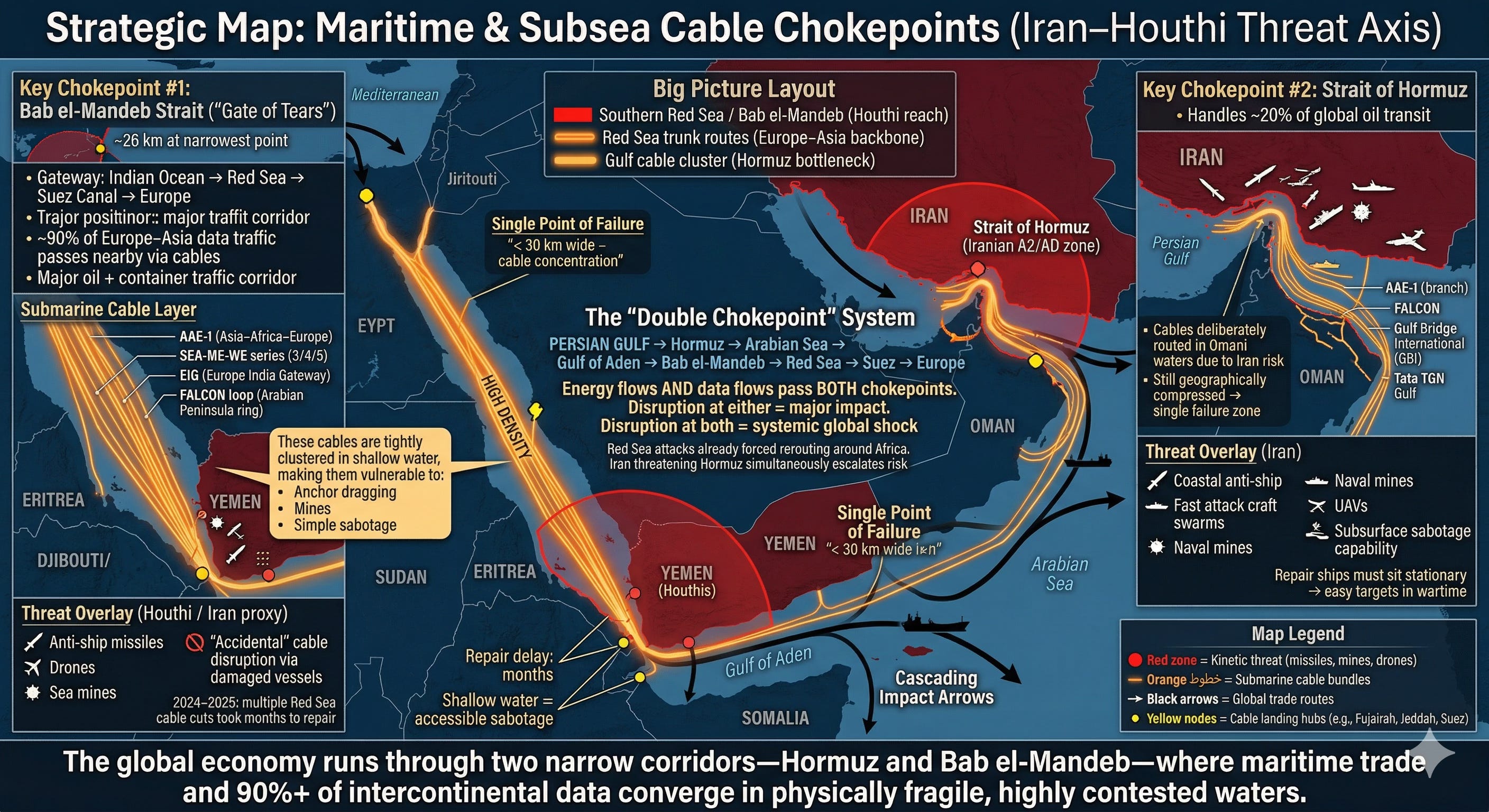
The Houthi strike [1] carries strategic consequences beyond its kinetic effect. The group had stayed out of the war until today despite being a core component of Iran’s “axis of resistance.” Their Red Sea campaign during the Israel-Gaza war attacked over 100 merchant vessels and shipping volumes only began recovering in December 2025. If the Houthis resume commercial targeting, the war would choke two of the world’s three critical maritime chokepoints simultaneously — Hormuz and Bab al-Mandeb — affecting approximately 30 percent of global seaborne trade.
The Ford’s position in Crete complicates any Red Sea naval response. Sending the carrier back risks drawing it into the same high-tempo attacks the USS Dwight D. Eisenhower faced in 2024 and the USS Harry S. Truman in 2025. [1]
Force Posture and Ground Force Developments
U.S. force posture continued expanding. The USS Tripoli, USS New Orleans, and the 31st Marine Expeditionary Unit (~2,200 Marines) are entering the CENTCOM area of operations. The USS Boxer ARG with the 11th MEU (~2,500 Marines) departed San Diego March 19-20 and is in 3rd Fleet AOR but has not yet entered CENTCOM. Elements of the 82nd Airborne Division’s 1st Brigade Combat Team (~2,000 soldiers) have deployed to the Middle East. Over 50,000 U.S. troops are now in the CENTCOM AOR. [22]
Four military options reportedly remain on the table per Axios: blockade or invasion of Kharg Island; invasion of Larak Island; mining of Iranian ports; expanded airstrikes on Iranian energy infrastructure. Kharg has not been seized. NSD’s March 26 assessment “The Inchon Trap” assessed that a simultaneous island assault is operationally viable but strategically a trap that risks open-ended ground commitment. [23]
THAAD components have been redeployed from South Korea to the Middle East — South Korea’s president opposed the removal but said it would “not significantly affect deterrence.” [24]
Iranian Command Authority
Mojtaba Khamenei has made no confirmed live video or audio appearance in 29 days. His Nowruz address on March 20 was text-only. An undated archival video of him teaching at seminary was released the same day — clearly not live. He did not appear at his own allegiance ceremony — a cardboard cutout was reportedly used. JINSA reported on March 24 that Mojtaba is “not responding to messages sent to him by other Iranian leaders and has yet to hold face-to-face meetings with any subordinates.” U.S. intelligence assesses he is “severely injured.” [25]
General Mohammad Bagher Zolghadr was appointed SNSC Secretary on March 24, succeeding Ali Larijani (killed March 17). Zolghadr — an IRGC co-founder of the Ramezan Garrison, UN-sanctioned since 2007 — was reportedly targeted by an Israeli airstrike on March 25. His status is unconfirmed as of March 28. If killed, it would eliminate the third consecutive holder of Iran’s top security coordination role. [26]
A critical command coherence indicator: President Pezeshkian on March 7 pledged Iran would halt Gulf state strikes if not attacked from those countries. Hours later, the IRGC launched 16 ballistic missiles and 121 drones at the UAE. Araghchi acknowledged that military units had become “independent and somewhat isolated,” acting on pre-delegated orders under the IRGC’s mosaic defense doctrine — 31 provincial commands with pre-delegated launch authority. [27]
The IRGC lowered its minimum recruitment age to 12, signaling severe personnel depletion. Iranian missile crews reportedly “afraid to go out” with desertions and refusals to follow orders. Reserve mobilization attempts have largely failed. [28]
Russia-Iran Nexus
The Russian deliveries to Iran [9] include modified Shahed drone components — meaning Moscow is not merely sharing intelligence but supplying the weapons Iran is firing at American forces. Russia declined Iran’s request for S-400 air defense systems, indicating a calibrated level of support designed to sustain the war without triggering a direct U.S.-Russia confrontation.
This is the HWW axis in operational motion. Russia is materially sustaining Iran’s war while simultaneously profiting from it — Russian oil export revenue has doubled to approximately $270 million per day — and leveraging it as a bargaining chip against Ukraine. The Dmitriev offer (end Iran intel sharing in exchange for halting Ukraine support) made the trade explicit. The Russia-Iran-Ukraine triangle is producing operationally connected effects across three theaters simultaneously.
Regional Activity
Hezbollah claimed 99 attacks targeting Israeli forces in 24 hours on March 27 — the highest daily total since March 1 — including 36 rocket attacks, 12 drone strikes, and 2 mortar attacks. Israel plans to control larger parts of southern Lebanon up to the Litani River. An Israeli soldier was killed and four wounded by a Hezbollah anti-tank missile. The IDF discovered a Hezbollah tunnel beneath a church in Khiam and raided a school seizing anti-tank missiles and mines. [29]
Iran has now attacked all six members of the Gulf Cooperation Council. In Iraq, the IDF struck the 13th PMF Brigade base (Kataib Hezbollah-linked) in al-Qaim, Anbar Province. Iran struck the Kurdistan Region’s Ministry of Peshmerga building on March 24 with six ballistic missiles, killing six and wounding thirty. [30]
Casualty Summary (as of March 28)
Iran: More than 1,750 killed including 217 children and 1,167-plus military personnel. 70-plus senior officials killed since February 28. [31]
U.S.: 13 killed, approximately 300 wounded (255 of 290 as of March 24 returned to duty; additional casualties from Friday’s Prince Sultan strike pending update). [31]
Lebanon: 1,116 killed and 3,229 wounded since March 2. [31]
Iraq: At least 96 killed. [31]
Gulf states: More than 30 killed, predominantly migrant workers. [31]
CRISIS MODULE — ELEVATED: UKRAINE (Day 1494)
Russia launched one of the largest aerial assaults of the full-scale war — nearly 1,000 drones and missiles over March 23-24 — followed by 273 drones overnight March 27-28, of which 252 were shot down. A maternity hospital roof was struck in Odesa. Five killed and thirteen injured across Ukraine. A Russian drone debris fell into Romania (NATO member) on March 26. EU High Representative Kallas called it “another intolerable violation.” [12]
Ukraine’s deep strike campaign against Russian oil infrastructure is producing strategic-level effects. Ukrainian forces have struck Baltic oil terminals four consecutive nights, knocking out approximately 40 percent of Russia’s oil export capacity — roughly 2 million barrels per day — in what Reuters described as the most severe oil supply disruption in modern Russian history. The Kirishi refinery in Leningrad Oblast, processing 7 percent of Russia’s total refining volume, was struck March 25-26. Zelenskyy stated the strikes are intended to “offset Trump’s easing of Russian oil sanctions.” [12]
Russia’s fiscal position is deteriorating despite the Iran war oil windfall. Russia’s January-February 2026 federal deficit reached 3.449 trillion rubles — already 91 percent of the full-year planned deficit. Oil and gas revenues fell 50 percent year-on-year in January and 44 percent in February. Putin reportedly requested Russia’s top businessmen to provide funding for the government — threatening a promise he made to oligarchs not to nationalize their assets. The ruble weakened 5.2 percent over the past month. [32]
The Pentagon is evaluating whether to shift Ukraine military assistance toward the Middle East. Patriot systems have moved from Europe toward the Middle East. Hungary is blocking a 90-billion-euro EU loan for Ukraine. Russia’s spring offensive against the Fortress Belt cities (Kostyantynivka, Druzhkivka, Kramatorsk, Slovyansk) launched approximately March 17 with 619 assaults in four days. ISW assessed Russian forces are “unlikely to capture the Fortress Belt in 2026.” [33]
Ukraine and Saudi Arabia signed a defense cooperation agreement on March 27 covering air defense capabilities and technological partnerships. Approximately 200 Ukrainian counter-drone personnel are deployed across the Middle East. The UK pledged $133 million in additional air defense support for Ukraine. [34]
WATCH ITEMS
TAIWAN STRAIT / INDO-PACIFIC — PLA Taiwan ADIZ flights dropped sharply since January: 166 flights in January, approximately 161 in February, versus 248 and 362 in the same months of 2025. After a seven-day complete absence (February 27 through March 7 — the longest since Taiwan began tracking), flights resumed March 7 with two aircraft. ISW assessed on March 13 that China is “conspicuously restraining ADIZ pressure while the Iran war occupies US attention” — the reduced tempo is strategic signaling, not capability reduction. The force diversions documented above — THAAD from South Korea, 31st MEU from the Indo-Pacific, Patriot from Europe — are cumulatively degrading the credible deterrence architecture in the Western Pacific. The Soufan Center assessed on March 25 that the Iran war is directly affecting the U.S.-China technological competition through disrupted supply chains for critical minerals and rare earth elements. [35]
KOREAN PENINSULA — Kim Jong-un addressed North Korea’s Supreme People’s Assembly on March 24 vowing to “strengthen nuclear forces” — widely interpreted as a lesson drawn from Iran’s vulnerability without a nuclear deterrent. KCNA-confirmed meeting with Belarusian President Lukashenko on March 26. No new missile tests. North Korea expressed support for Mojtaba Khamenei’s appointment. Iran was paying North Korea approximately $3 billion per year for missile technology; Russia now pays approximately $20 billion per year for Ukraine war materiel. Standing indicators monitored. [36]
CUBA — No change. Standing indicators monitored. No administration rhetoric beyond existing framing.
ANALYSIS & OPINION
NSD Prior Analysis (72-hour window)
▸ “The Inchon Trap” — MILab · 26 March 2026 · milab.substack.com/p/the-inchon-trap
Assessed that simultaneous island assault on Kharg and Hormuz Strait islands is operationally viable but strategically risks open-ended ground commitment. Directly relevant as 82nd Airborne and MEU assets arrive in theater with amphibious capability and four military options reportedly remain on the table including Kharg and Larak island seizures.
▸ SITREP 11 — NSD SITREP · 27 March 2026 · nsdsitrep.substack.com/p/sitrep-11
▸ SITREP 10 — NSD SITREP · 26 March 2026 · nsdsitrep.substack.com/p/sitrep-10
▸ PODCAST DISCUSSION: The Inchon Trap — NSD Podcasts · 26 March 2026 · nsdpodcasts.substack.com/p/podcast-discussion-the-inchon-trap
▸ SITREP 11 (Podcast) — NSD Podcasts · 27 March 2026 · nsdpodcasts.substack.com/p/sitrep-11
External Analysis
The Foreign Affairs piece by Narges Bajoghli, “Iran’s Long Game” (March 26), is structurally aligned with NSD’s time horizon asymmetry framework — the most significant external validation of the red-team exercise’s core finding published to date. [14] War on the Rocks published “The Promise and Pitfalls of Arming the Kurds” (March 25), assessing that the administration has abandoned plans to leverage Kurdish resistance — removing what had been the only visible ground-force option short of direct U.S. commitment. [37] The Soufan Center’s March 25 IntelBrief assessed the Iran war is creating a crisis for the U.S. defense industrial base, with disrupted supply chains for helium, sulfur, and critical minerals having downstream effects on technologies defining military supremacy in the U.S.-China competition. [38] War on the Rocks published “Don’t Count Launches: Misreading Iran’s Drone Capacity” (March 16), warning that Iranian drone production operates from a dispersed, low-cost industrial base that BDA metrics systematically undercount. [39]
NSD Track Record
▸ TR-002: Time horizon asymmetry as decisive terrain (1 March / 11 March 2026) — STRENGTHENED. Iran’s rejection of the 15-point ceasefire, Trump’s third deadline extension (now April 6), Iran’s five-point counter-terms designed to be unacceptable, the simultaneous “talks going very well” / “I don’t care” signaling, and the Houthi entry widening the war all confirm the IRGC delay strategy is working. The clock is running and it is running against Washington. milab.substack.com/p/leaked-document-tehrans-war-plan
▸ TR-003: Death of the safe rear area (1 March 2026) — FURTHER CONFIRMED by Friday’s Prince Sultan Air Base attack wounding 15 U.S. troops and damaging KC-135 tankers, Kuwait airport radar destruction, and cumulative Bahrain total of 559 projectiles. milab.substack.com
▸ TR-004: MizarVision commercial AI-ISR providing Iranian targeting (20 March 2026) — STRENGTHENED. Russia confirmed completing deliveries of satellite imagery to support Iranian attacks. Chinese commercial satellite companies Chang Guang Satellite Technology (Jilin-1) confirmed providing imagery supporting Houthi targeting. The two-source problem (Chinese commercial + Russian military) is now a three-source problem with the Houthi dimension. milab.substack.com/p/americas-satellites-helped-iran-target
▸ TR-005: CONUS drone incursion vulnerability (21 March 2026) — NO CHANGE. No arrests, no recovered drones, no attribution. B-52s remain on open flight line. NORTHCOM’s Flyaway Kit counter-UAS system has a ~25 percent defeat rate. One system operational; two more expected April 2026. milab.substack.com/p/the-predictable-pearl-harbor
▸ TR-008: Inchon Trap — simultaneous island assault as strategic trap (26 March 2026) — STANDING. Four military options including Kharg and Larak island seizures confirmed on the table per Axios. 82nd Airborne and 31st MEU arrival increases capability. Iran’s threat to mine the entire Persian Gulf if ground troops deploy is a direct counter-escalation signal against the island assault option. milab.substack.com/p/the-inchon-trap
NSD ANALYTICAL ASSESSMENT
Key Driving Assumption — Epic Fury (Standing)
The campaign’s decisive terrain remains the asymmetry between two incompatible time horizons. Trump requires a short, concludable war. The IRGC requires the opposite. Today’s evidence is comprehensive: Iran rejected the ceasefire, the Houthis entered the war opening a second front, the deadline was extended a third time, the S&P posted its longest losing streak in four years, 850-plus irreplaceable Tomahawks have been fired, and the IRGC is seizing Chinese-flagged ships — daring Beijing to choose sides. The structural irreconcilability of these objectives is not a prediction. It is the condition the war now operates within.
Standing reference: “The ‘Leaked’ Document: Tehran’s War Plan for Regime Change in Washington” — NSD/MILab, 11 March 2026. milab.substack.com/p/leaked-document-tehrans-war-plan
72-Hour Trajectory
The Houthi entry into the war is the dominant variable. If the Houthis resume targeting Red Sea commercial shipping — which their deputy information minister stated is “among our options” — global economic consequences will compound dramatically. Two maritime chokepoints closed simultaneously would affect approximately 30 percent of global seaborne trade. This is LIKELY (55-70%).
The Pakistan-hosted foreign ministers meeting beginning tomorrow (Turkey, Egypt, Saudi Arabia) is the most significant multilateral diplomatic effort of the war. A unified regional position — or the absence of one — will shape whether the April 6 deadline produces escalation or negotiation.
Israel’s accelerated targeting of Iranian arms factories in the next 48 hours — specifically to maximize destruction before any ceasefire window — creates a period of intensified strikes that Iran will interpret as escalatory and that may complicate any diplomatic momentum from the Pakistan summit.
Iran’s threat to mine the entire Persian Gulf if U.S. ground troops deploy is a direct counter-signal to the four military options reportedly under consideration. Any movement toward Kharg or Larak now carries an explicit mine-warfare escalation risk.
Anticipatory Worst-Case Scenario Updates
SCENARIO 1 — DRONE STRIKE ON CONUS PRINCIPAL: No new indicators in the past 24 hours. Barksdale AFB drone incursions: no arrests, no attribution, no recovered drones. NORTHCOM’s counter-UAS capability remains minimal — one Flyaway Kit operational with a 25 percent defeat rate. Probability: LOW. Watch status: ACTIVE.
SCENARIO 2 — SUCCESSFUL CARRIER MISSION-KILL: The Ford’s departure for Crete reduces carrier exposure temporarily. The Bush transiting to theater creates a vulnerability window. Chinese ISR architecture — MizarVision commercial imagery, Chang Guang Satellite Technology (Jilin-1), and PLAN intelligence vessels — provides persistent targeting support. The Lincoln reportedly targeted by 101 missiles March 24-25 (all intercepted per Trump). The exchange ratio question — how many irreplaceable interceptors per Iranian missile — remains the critical sustainability variable. Probability: LOW-MEDIUM. Watch status: ACTIVE.
SCENARIO 3 — RADIOLOGICAL OR ENVIRONMENTAL INCIDENT AT NATANZ: Israeli strikes on Arak heavy water complex and Ardakan yellowcake plant on March 27-28 are the most significant nuclear-adjacent strikes since the campaign’s early days. Ardakan is Iran’s only uranium processing facility. Iran reported no contamination. IAEA access remains constrained. Each additional strike on nuclear infrastructure raises the probability of an incident. Probability: LOW but rising. Watch status: ACTIVE.
SCENARIO 4 — IRGC COMMAND FRAGMENTATION PRODUCING UNCONTROLLED ESCALATION: The killing of IRGC Navy commander Tangsiri and Intelligence Deputy Rezaei, the possible targeting of newly appointed SNSC Secretary Zolghadr (status unconfirmed), and the continued absence of Mojtaba Khamenei from any confirmed communication for 29 days collectively represent the most severe command authority degradation of the campaign. The Pezeshkian-IRGC divergence is documented: Pezeshkian pledged to halt Gulf strikes, the IRGC launched 137 projectiles at the UAE hours later. The IRGC’s mosaic defense doctrine — 31 provincial commands with pre-delegated launch authority — is designed for decentralized operations but not for political restraint. The Houthi entry may or may not have been centrally authorized. That uncertainty is itself the indicator. IRGC recruitment age lowered to 12. Probability: LOW-MEDIUM and rising. Watch status: ACTIVE.
Critical Unknowns
1. Mojtaba Khamenei’s physical condition and command authority. No confirmed video or audio in 29 days. Cardboard cutout used at his own allegiance ceremony. Not responding to messages from other Iranian leaders. Not holding face-to-face meetings with subordinates. This is the single most consequential unknown in the theater.
2. Whether the Houthi entry includes resumption of Red Sea commercial shipping attacks. The Bab al-Mandeb threat is declared but not executed. The gap between declaratory posture and operational decision is the unknown.
3. Whether the April 6 energy-infrastructure strike deadline represents a genuine decision point or another extension in a series that serves Iranian delay strategy. Each extension erodes deterrent credibility while simultaneously demonstrating the political constraints the IRGC’s time horizon asymmetry is designed to exploit.
Closing Analytical Note
One month in. The regime is intact. The Strait of Hormuz is under Iranian control — and Iran is now seizing Chinese ships transiting it. The nuclear enrichment program persists. The proxies are damaged but operational — and the Houthis just joined. Oil is above $113. Middle East exports are down 61 percent. The IEA has authorized the largest emergency stockpile release in history. Ras Laffan’s damaged LNG trains will be offline for three to five years. EU gas storage is at 28 percent with the Netherlands at its lowest level in a decade. Brent’s war premium is $35 per barrel. American gasoline is up a dollar. The S&P is in its longest losing streak in four years. Russia is supplying drones and satellite imagery to Iran while its own oil revenue has doubled. 850 irreplaceable Tomahawks are gone. The IRGC has lowered its recruitment age to 12.
Twenty-nine days of the most intensive American air campaign since Iraq 2003 have degraded Iranian military capability but produced no credible pathway to a political endstate. The reinforcements are still flowing east. The Houthis have joined. And Tehran is not looking for an off-ramp — it is looking for a settlement that ensures Washington never does this again.
Standing references:
“The ‘Leaked’ Document: Tehran’s War Plan for Regime Change in Washington” — NSD/MILab, 11 March 2026. milab.substack.com/p/leaked-document-tehrans-war-plan
“A Hybrid World War” — NSD/MILab, 23 October 2023. milab.substack.com
LEADER LOCATOR — Confirmed Locations as of 28 March 2026
U.S. PRINCIPALS
▸ DONALD TRUMP · President · Miami Beach, Florida — Future Investment Initiative summit, March 27; stated war “not finished yet” with 3,554 targets remaining. · CONFIRMED
▸ STEVE WITKOFF · Special Envoy · Washington, D.C. — Cabinet meeting March 27, confirmed 15-point action list. · CONFIRMED
▸ MARCO RUBIO · Secretary of State · France — attended G7 Foreign Ministers meeting at Abbaye des Vaux-de-Cernay, Cernay-la-Ville, March 26-27. · CONFIRMED
▸ PETE HEGSETH · Secretary of Defense · Washington, D.C. area — Pentagon press conference this week. · ASSESSED
ADVERSARY PRINCIPALS
▸ VLADIMIR PUTIN · President, Russia · Moscow — requested oligarch funding; Kremlin readouts active. · ASSESSED. Body double concern standing.
▸ XI JINPING · General Secretary / President, China · UNKNOWN · No confirmed location signal in last 24 hours. NOTE: IRGC seizure of two Chinese-flagged ships near Larak may force a public Chinese response — track Xinhua/MFA.
▸ MOJTABA KHAMENEI · Supreme Leader, Iran · UNKNOWN · No confirmed video or audio in 29 days. Cardboard cutout at allegiance ceremony. Not responding to messages from other leaders. Not holding face-to-face meetings. U.S. intelligence: “severely injured.” Absence of confirmation is the analytical indicator.
▸ ABBAS ARAGHCHI · Foreign Minister, Iran · Tehran — state TV interview March 25-26 denying negotiations. · CONFIRMED
▸ KIM JONG-UN · Supreme Leader, DPRK · Pyongyang area — KCNA-confirmed meeting with Lukashenko March 26; SPA address March 24. · CONFIRMED
EUROPEAN / ALLIED PRINCIPALS
▸ EMMANUEL MACRON · President, France · Paris area — hosted G7 at Abbaye des Vaux-de-Cernay. · ASSESSED
▸ FRIEDRICH MERZ · Chancellor, Germany · Berlin area — sharply criticized Trump’s Iran strategy as “massive escalation with uncertain outcome.” · ASSESSED
▸ KAJA KALLAS · EU High Representative · Brussels area — condemned Russian drone debris falling in Romania as “intolerable violation.” · ASSESSED
▸ URSULA VON DER LEYEN · President, European Commission · UNKNOWN · No confirmed location signal in last 24 hours.
▸ MARK RUTTE · NATO Secretary General · UNKNOWN · No confirmed location signal in last 24 hours.
▸ KEIR STARMER · Prime Minister, United Kingdom · London area — pledged $133 million in additional air defense support for Ukraine. · ASSESSED
▸ VOLODYMYR ZELENSKYY · President, Ukraine · UAE — visited Abu Dhabi, met Mohamed bin Zayed Al Nahyan to discuss regional security. · CONFIRMED
ISRAELI PRINCIPALS
▸ BENJAMIN NETANYAHU · Prime Minister, Israel · Israel — PMO active on strike authorization; Israeli military accelerating targeting in next 48 hours. · ASSESSED
WATCHLIST A — DUAL CULMINATION TRACKER
Tracks mutual attrition: Iranian capability degradation vs. U.S./allied interceptor and munitions depletion.
Iranian launcher status: ~330 of 470 pre-war launchers neutralized (~70%) per JINSA March 24 citing Israel. ~140 operational. Status of underground “missile city” stockpiles at depth remains the critical unknown — surface BDA does not reliably assess weapons at 500m depth. [40]
U.S. interceptor production expansion ordered: THAAD 96→400/yr; PAC-3 MSE 620→2,000/yr (7-year ramp); SM-3 2x-4x existing rates; SM-6 125→500+/yr. None of these expanded rates are yet online — the gap between current stocks and future production is the vulnerability window. [41]
War cost: Estimated $1-2B/day. $11.3B first 6 days (Pentagon); CSIS estimate $16.5B in first 12 days. $200B supplemental not formally submitted to Congress. House Budget Committee Chairman Arrington announced March 26 a second reconciliation bill markup to fund the campaign. [42]
CENTCOM milestone: 10,000+ Iranian military targets struck; 10,000+ combat flights (March 25-26). [13]
WATCHLIST B — ENERGY / ECONOMIC PRESSURE
Tracks oil, gas, and downstream economic effects of Hormuz closure and Gulf strikes.
Brent peak (conflict): $113.40/bbl (March 19); March 27 intraday: $107.81. WTI: ~$93.52. Brent-WTI spread ~$11.50-14 (historical norm $3-5) — spread itself is an indicator of Gulf-specific risk premium. [8]
Urals crude: ~$105.91/bbl — crossed to $4 premium above Brent at Indian ports (first time in history, March 10). Russian oil revenue ~$270M/day (doubled from January). [43]
U.S. SPR: ~415 million barrels remaining (64 days import cover) after 172M barrel contribution to IEA emergency release. [44]
Goldman Sachs (March 22): 2026 Brent average raised to $85; near-term $110; Q4 base case $71; extended disruption $93. [45]
Sanctions waivers: Russia 30-day general license (expires ~April 12) for crude already at sea. Venezuela: sweeping PDVSA authorization + 60-day Jones Act suspension. [46]
NEW: Middle East oil exports: 9.71M bpd (Kpler, week of March 15) vs. 25.13M pre-war — 61% reduction. Iraq down 70%, UAE down 50%+, Saudi down 20%. [7]
WATCHLIST C — CONUS / OCONUS DRONE INCURSIONS
Tracks unresolved drone penetrations at strategic U.S. installations.
Barksdale/Fort McNair: No change since last SITREP. No arrests, no attribution, no recovered drones. [47]
NEW: NORTHCOM Flyaway Kit counter-UAS: 1 operational, 2 more expected April. ~25% defeat rate. NORTHCOM refuses to name the base where it was deployed. [48]
NEW: JIATF-401 procurement: $20B Anduril Lattice C2 enterprise contract (March 16); $6.1M Domestic Shield contracts — 210x SmartShooter Smash 2000LE + Titan Cerberus XL systems (March 24); 2 radar systems assigned to National Capital Region. [49]
WATCHLIST D — CARRIER / NAVAL / GROUND FORCE DISPOSITION
Tracks U.S. force posture and Iranian naval status.
Key update: USS Boxer ARG / 11th MEU (~2,500 Marines) departed San Diego March 19-20; in 3rd Fleet AOR as of March 26 — has NOT yet entered CENTCOM AOR. This is the second MEU wave; arrival timing matters for any Kharg/Larak option. [50]
Iranian Navy: 92% of large vessels destroyed or combat-ineffective; 100+ naval vessels destroyed. IRGC Navy Commander Tangsiri and Intelligence Deputy Rezaei killed March 25-26. Despite this, Hormuz blockade enforcement continued. [13][6]
Remaining data points covered in Force Posture section of Crisis Module.
WATCHLIST E — IRANIAN COMMAND AUTHORITY
Tracks Mojtaba Khamenei status, command coherence, and leadership decapitation effects.
NEW: Gen. Zolghadr (SNSC Secretary, appointed March 24) — reportedly targeted by IDF airstrike March 25, status unconfirmed. If killed: third consecutive holder of Iran’s top security coordination role eliminated. [26]
NEW: Pezeshkian-IRGC divergence now documented in specific operational terms: Pezeshkian pledged halt to Gulf strikes March 7 → IRGC launched 137 projectiles at UAE hours later. Araghchi acknowledged units became “independent and somewhat isolated.” [27]
NEW: IRGC recruitment age lowered to 12 (Critical Threats, March 26). Missile crews reportedly refusing orders; reserve mobilization largely failed. [28]
Mojtaba status: No change. 29 days without confirmed live appearance. Covered in Iranian Command Authority section.
WATCHLIST F — CIVILIAN IMPACT / POLITICAL SUSTAINABILITY
Tracks casualties, displacement, domestic polling, and Congressional dynamics.
NEW: Iranian displacement: 1.9-3.2 million individuals displaced (UNHCR, March 24). [51]
NEW: U.S. domestic polling — opposition to the war is majority across every major poll:
Reuters/Ipsos (March 20-22): 61% oppose / 35% support.
Fox News (March 20-23): 58% oppose / 42% support.
AP/NORC (March 19-23): ~60% “gone too far.”
Pew (March 16-22): 61% disapprove of Trump’s handling. [52]
NEW: Senate rejected Iran war powers resolution 53-47 (March 25, nearly party-line). [53]
NEW: IRGC issued direct civilian warning to evacuate any location housing U.S. forces, explicitly naming hotels — soft-target escalation signal. [54]
WATCHLIST G — HWW CROSS-THEATER CONNECTIVITY
Tracks Russia-Iran-China-DPRK operational linkages and domestic-external axis convergence.
NEW: Belarus drone stations — 4 Shahed control stations to be deployed in Belarus (Zelenskyy, March 23); Russia-Belarus military agreement (February 5, 2026) allowing Russian “military objects” in Belarus; ~2,100 Russian troops in Belarus. [55]
NEW: Chang Guang Satellite Technology (Jilin-1, 300 satellites, 0.5m resolution) confirmed providing imagery supporting Houthi targeting — adds a third ISR source to MizarVision (commercial) and Russian military feeds. [56]
NEW: NK technicians were on-site rebuilding Iranian missile facilities until fighting started. [57]
Russia-Iran deliveries and Dmitriev offer covered in Russia-Iran Nexus section.
WATCHLIST H — RUSSIAN ECONOMIC COLLAPSE TRACKER
Tracks Russian fiscal, monetary, and real-economy indicators.
NEW: Russia Jan-Feb 2026 federal deficit: 3.449 trillion rubles — already 91% of full-year planned deficit of 3.786 trillion. [32]
NEW: Oil/gas revenues: Jan -50.2% YoY, Feb -44% YoY, March forecast -52% YoY — despite war-driven price increases, sanctioned volumes are collapsing. [58]
NEW: NWF liquid assets: 4.23 trillion rubles ($55.1B), 1.8% of GDP. January drawdown: 154.6B rubles sold. Gold reserves fell to 74.3M troy ounces (lowest since March 2022). [59]
NEW: Business Climate Indicator crossed to -0.1 in March — first contraction reading. [60]
NEW: Ruble: 81.50 USD/RUB (March 27 close), weakened 5.2% in one month. OFZ bond yield: 14.70%. Key rate: 15.00% (cut 50bp March 20). [61]
Counter-offset: Ukrainian strikes knocked ~40% of Russia’s oil export capacity offline (~2M bpd), largely erasing the windfall at the margin. [12]
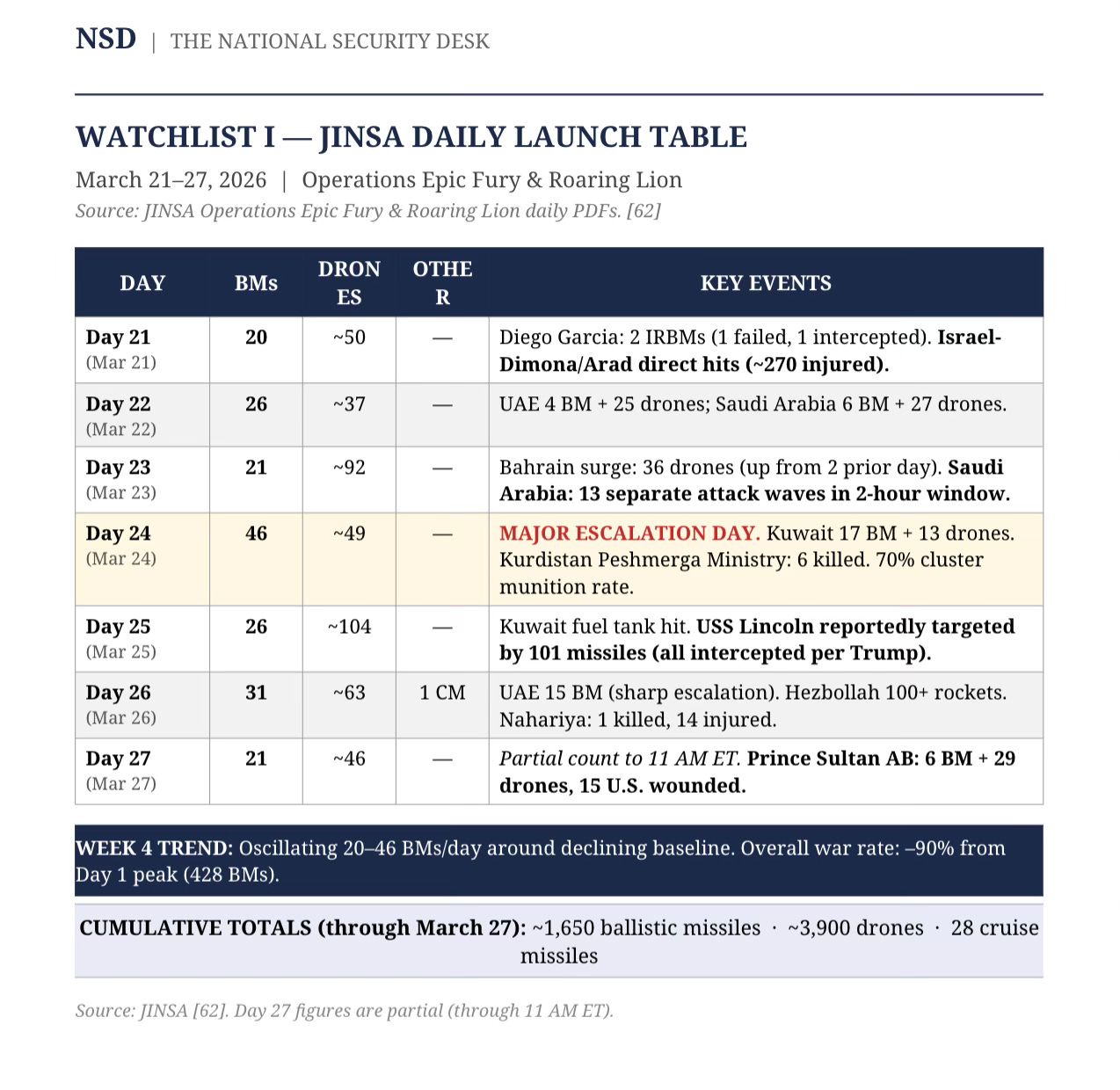
WATCHLIST I — JINSA DAILY LAUNCH TABLE (March 21-27)
Day-by-day Iranian launch data. Source: JINSA Operations Epic Fury & Roaring Lion daily PDFs. [62]
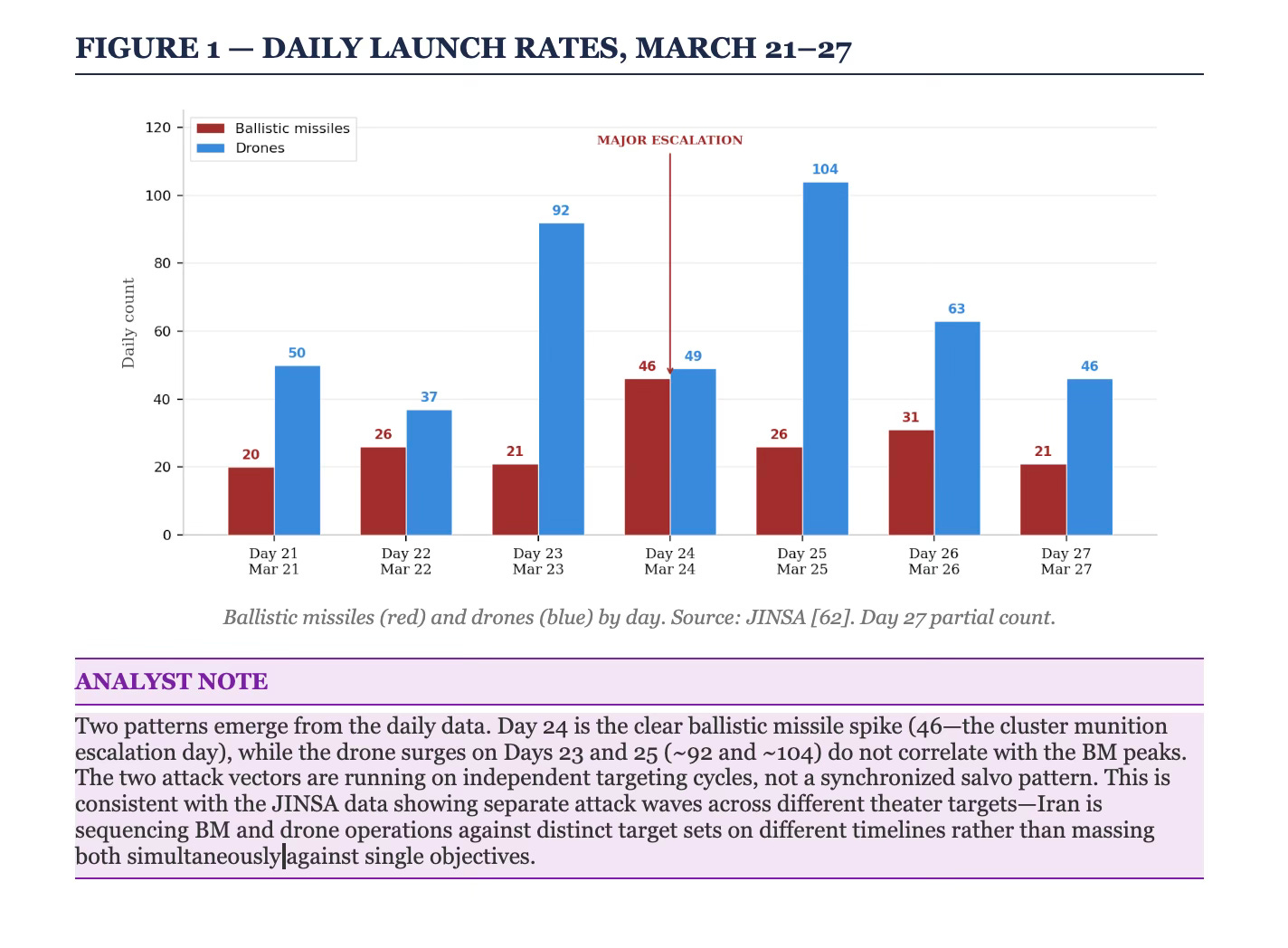
Day 21 (Mar 21): 20 BM + ~50 drones. Diego Garcia: 2 IRBMs (1 failed, 1 intercepted). Israel-Dimona/Arad direct hits (~270 injured).
Day 22 (Mar 22): 26 BM + ~37 drones. UAE 4BM+25 drones; Saudi Arabia 6BM+27 drones.
Day 23 (Mar 23): 21 BM + ~92 drones. Bahrain surge: 36 drones (up from 2 prior day). Saudi Arabia: 13 separate attack waves in 2-hour window.
Day 24 (Mar 24): 46 BM + ~49 drones. MAJOR ESCALATION DAY. Kuwait 17BM+13 drones. Kurdistan Peshmerga Ministry: 6 killed. 70% cluster munition rate.
Day 25 (Mar 25): 26 BM + ~104 drones. Kuwait fuel tank hit. USS Lincoln reportedly targeted by 101 missiles (all intercepted per Trump).
Day 26 (Mar 26): 31 BM + ~63 drones + 1 cruise missile. UAE 15BM (sharp escalation). Hezbollah 100+ rockets. Nahariya: 1 killed, 14 injured.
Day 27 (Mar 27): 21 BM + ~46 drones (partial count to 11 AM ET). Prince Sultan AB: 6BM+29 drones, 15 U.S. wounded.
Week 4 trend: Oscillating 20-46 BMs/day around declining baseline. Overall war rate: -90% from Day 1 peak (428 BMs).
Cumulative totals (through March 27): ~1,650 ballistic missiles · ~3,900 drones · 28 cruise missiles. [62]
WATCHLIST J — LNG / GAS CRISIS
Tracks Ras Laffan status, global LNG supply, gas prices, and downstream effects.
Ras Laffan: EFFECTIVELY OFFLINE. LNG Trains S4 and S6 damaged: 12.8 Mtpa offline for 3-5 years. Pearl GTL train: 140,000 bbl/day offline, minimum 1 year repair. Revenue loss: ~$20B/year. North Field East expansion delayed over 1 year. [63]
Global LNG supply cut: ~35 Mtpa. Qatar = 20% of global LNG supply; zero exports currently. Each additional month removes ~1.5% of annual global LNG availability. [64]
NEW: EU gas storage: ~28% full (March 25) — 18.5% below same period last year. Netherlands: 5.8% full — lowest in at least a decade. [65]
NEW: Asian LNG prices surged 143% since conflict onset; JKM at $22.73/MMBtu (three-year peak). JKM-Henry Hub spread: ~$19.66 — the arbitrage signal driving every available LNG cargo to Asia. [66]
NEW: Fertilizer impact: 86% of Gulf-East Africa fertilizer route bulk carriers have stopped sailing. Urea prices up 50%+ in three weeks. U.S. corn — one-third of global production — will see significant price increases. [67]
WATCHLIST K — EXCHANGE RATIO & INTERCEPTOR ECONOMICS
Tracks cost-per-kill ratios and production replenishment timelines.
Core data: PAC-3 MSE $4.2M/shot vs. Shahed $35-70K. THAAD $12.7M/shot vs. Emad MRBM $250K. SM-3 IIA ~$15M/shot. The exchange ratio structurally favors Iran in a war of attrition. [68]
NEW: CENTCOM doctrinal shift underway to cheaper interceptors: Coyote Block 2 ($125K) replacing THAAD for drone defense; APKWS laser-guided rockets on F-15s replacing AMRAAM ($1.8M) against Shaheds; B-52 JDAMs (<$100K/bomb) replacing JASSM/Tomahawk (~$1-1.3M) — 10-13x cost reduction per target. [69]
NEW: Tomahawk replenishment: Navy to receive only 110 new TLAMs in FY2026 vs. 850+ expended. [10]
NEW: South Korea’s Cheongung-II (deployed by UAE): 96% interception rate against Iranian missiles “at 1/3 the cost of Patriot.” [70]
WATCHLIST L — MINE COUNTERMEASURES & STRAIT REOPENING
Tracks MCM capability, mine threat, and Hormuz reopening timeline.
CRITICAL CAPABILITY GAP: Only 3 MCM-configured LCS ships exist. One (USS Canberra) in Indian Ocean. Two (USS Santa Barbara, USS Tulsa) in Singapore/Malaysia — NOT in Gulf theater. No active minesweeping operations confirmed in the Strait as of March 27. [71]
All 4 Bahrain-homeported Avenger-class minesweepers (Devastator, Dextrous, Gladiator, Sentry) decommissioned in 2025 after 30+ years. Total U.S. Navy MCM vessels: 7. Clearing Hormuz requires up to 16. [72]
~12+ mines confirmed in Strait (CBS/CNN). Iranian mine inventory: 2,000-6,000 (Stimson Center). CENTCOM destroyed 16 minelayer vessels March 10, but 80-90% of Iran’s small boat fleet remains. [73]
LCS MCM package: Pentagon “unable to determine operational effectiveness” (DOT&E FY2025). UISS declared “not operationally suitable” — 29% operational availability. LCS MCM potentially only 10% as effective as decommissioned Avenger-class. [74]
Raytheon Barracuda autonomous MCM: first demo July 2025; LRIP not before 2027-2030; NOT combat deployable. [75]
Reopening timeline: Stimson Center (March 25): “weeks or months” even if IRGCN threat neutralized. [76]
WATCHLIST M — IRANIAN DRONE PRODUCTION SUSTAINABILITY
Tracks dispersed production, remaining capacity, and replenishment dynamics.
Iran currently producing estimated 80-150 drones/month at remaining dispersed facilities. 30+ known production locations across 12+ provinces. Decentralized facilities are harder to target — BDA metrics systematically undercount capacity. [39]
Tom Karako (CSIS, March 5): Iran producing “over 100 missiles a month” vs. “6 or 7 interceptors built a month” — 15:1 production ratio in Iran’s favor. [77]
Pre-war drone stockpile: several thousand to 10,000+. Through March 27: ~3,900 expended. Implied remaining: 3,000-7,000 depending on production damage assessment accuracy. [62]
Russia supplying modified Shahed components to offset production line destruction. [9]
The National Security Desk offers these posts freely, but your support is necessary and appreciated. Please subscribe, paid if you’re able, or leave a tip.
Thank you

ENDNOTES
[1] Al Jazeera · “Yemen’s Houthis launch missile attack on Israel” · https://www.aljazeera.com/news/2026/3/28/yemens-houthis-claim-responsibility-for-a-missile-attack-on-israel-2 · 28 March 2026; Euronews · “Houthis first military operation targeting Israel” · https://www.euronews.com/2026/03/28/yemens-houthis-say-they-carried-out-their-first-military-operation-targeting-israel-succes · 28 March 2026
[2] Al Jazeera · “Iran calls US proposal to end war ‘maximalist, unreasonable’” · https://www.aljazeera.com/news/2026/3/25/iran-calls-us-proposal-to-end-war-maximalist-unreasonable · 25 March 2026; AP via CNBC · Iran response to ceasefire · https://www.cnbc.com/2026/03/25/iran-war-us-trump.html · 25 March 2026
[3] Perplexity/JINSA: IRGC seizure of 3 container ships near Larak Island, March 27; Iran Defense Council mining threat · March 27, 2026
[4] NPR · “Trump grants Iran another extension” · https://www.npr.org/2026/03/26/nx-s1-5761882/iran-war-peace-conditions · 27 March 2026; CNN · Day 27 live updates · https://www.cnn.com/2026/03/26/world/live-news/iran-war-us-israel-trump · 27 March 2026
[5] PBS NewsHour · “Iran says nuclear facilities attacked” · https://www.pbs.org/newshour/world/israel-warns-attacks-on-iran-will-escalate-and-expand-as-trump-says-ceasefire-talks-are-going-very-well · 28 March 2026; Times of Israel · 15-point proposal details · https://www.timesofisrael.com/liveblog_entry/report-lays-out-trumps-conditions-for-ending-war-but-says-israel-fears-hell-instead-push-for-a-monthlong-ceasefire/ · 27 March 2026
[6] AP via multiple outlets · Prince Sultan Air Base attack, 15 wounded including 5 seriously, KC-135 and E-3 damaged · 28 March 2026
[7] Kpler via Perplexity · Middle East oil exports 9.71M bpd vs 25.13M pre-war · March 2026; IEA emergency release 400-412M barrels · March 11, 2026
[8] SOF News · “Iran War Weekly Update — 28 Mar 2026” · https://sof.news/middle-east/iran-war-weekly-update-28-mar-2026/ · 28 March 2026; AAA gasoline average · March 26, 2026
[9] ISW · Russian deliveries to Iran, satellite imagery, Dmitriev offer rejected · March 26, 2026; Moscow Times · Russia-Iran intelligence trade offer · March 20, 2026
[10] CSIS · “The 850 Tomahawks Launched in Operation Epic Fury Is the Most Fired in a Single Campaign” · https://www.csis.org/analysis/850-tomahawks-launched-operation-epic-fury-most-fired-single-campaign · 27 March 2026; Washington Post · Tomahawk expenditure · https://www.washingtonpost.com/national-security/2026/03/27/iran-war-tomahawk-missiles/ · 27 March 2026; Small Wars Journal · “Magazine Depth” · https://smallwarsjournal.com/2026/03/27/magazine-depth-iran-missiles-stockpile-readiness/ · 27 March 2026
[11] CNN · “Live updates: Houthis enter conflict” · https://www.cnn.com/2026/03/28/world/live-news/iran-war-us-israel-trump · 28 March 2026; Boston Globe/AP · Bahrain interception data · 28 March 2026
[12] Kyiv Independent · Ukraine war latest · https://kyivindependent.com/ · 27-28 March 2026; PBS · “Iran war deflects attention from Ukraine” · https://www.pbs.org/newshour/world/iran-war-deflects-attention-from-ukraine-as-an-emboldened-russia-starts-spring-offensive · 26 March 2026; Reuters · 40% Russian oil export capacity offline · March 2026
[13] CENTCOM · Admiral Cooper briefing, 25 March 2026 · https://www.dvidshub.net/video/1000878/centcom-commander-provides-update-operation-epic-fury
[14] Foreign Affairs · “Iran’s Long Game: Decades of Preparation Are Paying Off” by Narges Bajoghli · 26 March 2026
[15] The Soufan Center · “Iran’s Power Structure Adapts to War” · https://thesoufancenter.org/intelbrief-2026-march-26/ · 26 March 2026
[16] Perplexity/Gulf state sources · Gulf states demand capability destruction before ceasefire · March 27, 2026
[17] CNN · Pakistan hosting foreign ministers meeting · 28 March 2026
[18] CENTCOM footage of strikes on tunnel clearance equipment · March 27, 2026; Admiral Cooper on B-52 munitions loadout · March 25, 2026
[19] Perplexity/Kpler · COSCO resumed Gulf deliveries with IRGC approval, March 25 · March 2026
[20] SOF News · Ford at Souda Bay, Bush departed Norfolk · March 28, 2026
[21] JINSA Iran Projectile Tracker · March 27 update · https://jinsa.org/iran-projectile-tracker/ · March 27, 2026; JINSA · “The Eroding Shield” · https://jinsa.org/wp-content/uploads/2026/03/The-Eroding-Shield-3.26-1.pdf · 26 March 2026
[22] Stars & Stripes · 82nd ABN 1st BCT deployment · March 25, 2026; NYT · 31st MEU arrival · March 24, 2026
[23] Axios · Four military options on the table · March 26, 2026
[24] Stars & Stripes · THAAD redeployed from South Korea · March 25, 2026
[25] JINSA · Mojtaba not responding to messages · March 24, 2026; Perplexity/Critical Threats · Cardboard cutout, seminary video · March 2026
[26] Critical Threats/Perplexity · Zolghadr appointment and targeting · March 24-25, 2026
[27] Perplexity/ISW · Pezeshkian-IRGC divergence, mosaic defense pre-delegation · March 2026
[28] Critical Threats · IRGC recruitment age lowered to 12 · March 26, 2026
[29] Perplexity/JINSA · Hezbollah 99 attacks in 24 hours · March 27, 2026
[30] Perplexity · IDF strike on 13th PMF Brigade, Iraq; Kurdistan Peshmerga Ministry strike · March 24-27, 2026
[31] CNN / HRANA / Lebanese Ministry of Health / CENTCOM · Casualty compilation · March 27-28, 2026
[32] Perplexity/Moscow Times · Russia Jan-Feb deficit 91% of full-year plan; Bloomberg · Russia oil revenue doubled · March 2026
[33] Kyiv Independent · Pentagon evaluating Ukraine aid shift; ISW · Fortress Belt assessment · March 26, 2026
[34] Zelenskyy Telegram / Kyiv Independent · Ukraine-Saudi defense agreement · March 27-28, 2026
[35] Perplexity/ISW · PLA ADIZ data, THAAD redeployment · March 2026; Soufan Center · DIB crisis assessment · March 25, 2026
[36] Perplexity/Iran International · Kim SPA address · March 24, 2026; Al Jazeera · Kim-Lukashenko meeting · March 26, 2026
[37] War on the Rocks · “The Promise and Pitfalls of Arming the Kurds” · https://warontherocks.com/2026/03/proxy-pressure-on-iran-the-promise-and-pitfalls-of-arming-the-kurds/ · 25 March 2026
[38] The Soufan Center · “The Iran War: A Crisis for the Defense Industrial Base” · https://thesoufancenter.org/intelbrief-2026-march-25/ · 25 March 2026
[39] War on the Rocks · “Don’t Count Launches: Misreading Iran’s Drone Capacity” · https://warontherocks.com/2026/03/dont-count-launches-misreading-irans-drone-capacity/ · 16 March 2026
[40] JINSA · Operations Epic Fury & Roaring Lion daily update · https://jinsa.org/wp-content/uploads/2026/03/Operations-Epic-Fury-and-Roaring-Lion-03-27-26.pdf · 27 March 2026; Bloomberg · “Two-thirds destroyed” assessment · 25 March 2026
[41] Business Insider · Interceptor production expansion · 26 March 2026; Defense Post · THAAD/PAC-3 production rates · 7 January 2026; BAE Systems · THAAD seeker deal · 25 March 2026
[42] CSIS · War cost estimates · March 2026; Reuters · “$200B supplemental faces stiff opposition” · https://www.reuters.com/world/us/huge-trump-iran-war-funding-request-faces-stiff-opposition-congress-2026-03-19/ · 19 March 2026; Fox News · House Budget Committee markup · 26 March 2026
[43] Trading Economics · Urals crude benchmark · March 27, 2026; Bloomberg · Russia oil revenue data · March 2026
[44] IEA · Emergency stockpile release (largest in history) · 11 March 2026
[45] Goldman Sachs · 2026 Brent forecast revision · 22 March 2026
[46] U.S. Treasury · Russia 30-day general license, March 12; Venezuela PDVSA authorization, March 18 · March 2026
[47] ABC News · “Multiple Waves of Unauthorized Drones Over Strategic US Air Force Base” · https://abcnews.com/International/multiple-waves-unauthorized-drones-spotted-strategic-us-air/story?id=131245527 · 20 March 2026; Newsweek · “Mystery Drones Take Evasive Action” · https://www.newsweek.com/mystery-drones-take-evasive-action-over-major-louisiana-air-force-base-11747030 · 27 March 2026
[48] Air & Space Forces Magazine · “Drone Incursions at B-52 Base” · https://www.airandspaceforces.com/drone-incursions-b-52-base-strategic-installations/ · 24 March 2026
[49] JBSA.mil · JIATF-401 counter-UAS contract · https://www.jbsa.mil/News/News/Article/4435109/ · 16 March 2026; DoW · JIATF awards critical C-UAS contract · https://www.war.gov/News/News-Stories/Article/Article/4443046/ · 24 March 2026
[50] NYT · Boxer ARG / 11th MEU departure · March 2026; SOF News · 3rd Fleet AOR status · 28 March 2026
[51] UNHCR · Iranian displacement estimate · 24 March 2026
[52] Reuters/Ipsos poll · March 20-22, 2026; Fox News poll · March 20-23, 2026; AP/NORC poll · March 19-23, 2026; Pew Research · March 16-22, 2026
[53] Senate vote on Iran war powers resolution · 25 March 2026
[54] IRGC civilian warning to evacuate locations housing U.S. forces · March 27, 2026
[55] Zelenskyy · Belarus Shahed drone stations · 23 March 2026; RFERL/ISANS · Russian troops in Belarus · March 2026
[56] Kharon · Chang Guang Satellite Technology / Jilin-1 imagery supporting Houthi targeting · 24 March 2026
[57] Perplexity/ISW · NK technicians at Iranian missile facilities pre-war · March 2026
[58] Moscow Times · Russia oil/gas revenue decline YoY · March 2026; Rosstat via Perplexity · Fiscal data
[59] Bank of Russia · NWF assets, gold reserves data · February-March 2026
[60] Bank of Russia · Business Climate Indicator -0.1 March 2026 · March 2026
[61] Trading Economics · Ruble 81.50, OFZ yield 14.70%, key rate 15.00% · March 27, 2026
[62] JINSA · Operations Epic Fury & Roaring Lion daily PDFs · https://jinsa.org/iran-projectile-tracker/ · March 21-27, 2026
[63] QatarEnergy CEO Saad al-Kaabi to Reuters · Ras Laffan damage assessment · 19 March 2026; Rystad Energy · Repair cost estimates · March 2026
[64] Wood Mackenzie / Daniel Toleman · LNG supply impact · March 2026; S&P Global · North Field expansion delay · March 2026
[65] Reuters/Gasunie · Netherlands gas storage 5.8% · 25 March 2026; AGSI · EU average 28% · March 2026
[66] LNGPriceIndex.com · JKM $22.73/MMBtu settlement · 21 March 2026
[67] Atlantic Council · “The Iran War’s Economic Fallout Won’t Stop at Oil: Agriculture and Aluminum Are Next” · https://www.atlanticcouncil.org/blogs/econographics/the-iran-wars-economic-fallout-wont-stop-at-oil-agriculture-and-aluminum-are-next/ · 27 March 2026
[68] JINSA · “Costs of Operation Epic Fury / Roaring Lion” · https://jinsa.org/wp-content/uploads/2025/07/Costs-of-a-War-with-Iran.pdf · July 2025 (updated March 2026)
[69] CSIS · “Assessing the Air Campaign After Three Weeks” · https://www.csis.org/analysis/assessing-air-campaign-after-three-weeks-iran-war-numbers · 25 March 2026
[70] SCMP · South Korea Cheongung-II performance in UAE · 21 March 2026
[71] Hunterbrook · “Demining Hormuz” · https://hntrbrk.com/demining-hormuz/ · 13 March 2026; Washington Institute · MCM assessment · March 2026
[72] Washington Institute · Hormuz MCM vessel requirement · March 2026
[73] CBS News/CNN · Confirmed mines in Strait · March 2026; Stimson Center · “Five Things to Know About Iranian Minelaying” · https://www.stimson.org/2026/five-things-to-know-about-iranian-minelaying/ · 25 March 2026
[74] DOT&E FY2025 Annual Report · LCS MCM package assessment · 2025; Hunterbrook · “Demining Hormuz” · https://hntrbrk.com/demining-hormuz/ · 13 March 2026
[75] Raytheon / Defense Post · “Barracuda Autonomous MCM Demo” · https://thedefensepost.com/2025/07/09/raytheon-barracuda-autonomous-demo/ · July 2025
[76] Stimson Center · MCM timeline estimate · 25 March 2026
[77] CSIS · Tom Karako, missile-to-interceptor production ratio · 5 March 2026
[RT-1] NSD/MILab · “The ‘Leaked’ Document: Tehran’s War Plan for Regime Change in Washington” · milab.substack.com/p/leaked-document-tehrans-war-plan · 11 March 2026
[HWW-1] NSD/MILab · “A Hybrid World War” · milab.substack.com · 23 October 2023
[TR-INCHON] NSD/MILab · “The Inchon Trap” · milab.substack.com/p/the-inchon-trap · 26 March 2026
NSD SITREP is published by the National Security Desk. All sources open-source. ICD-203 analytic standards applied throughout.
National Security Desk · https://substack.com/@milab