
SITREP 13

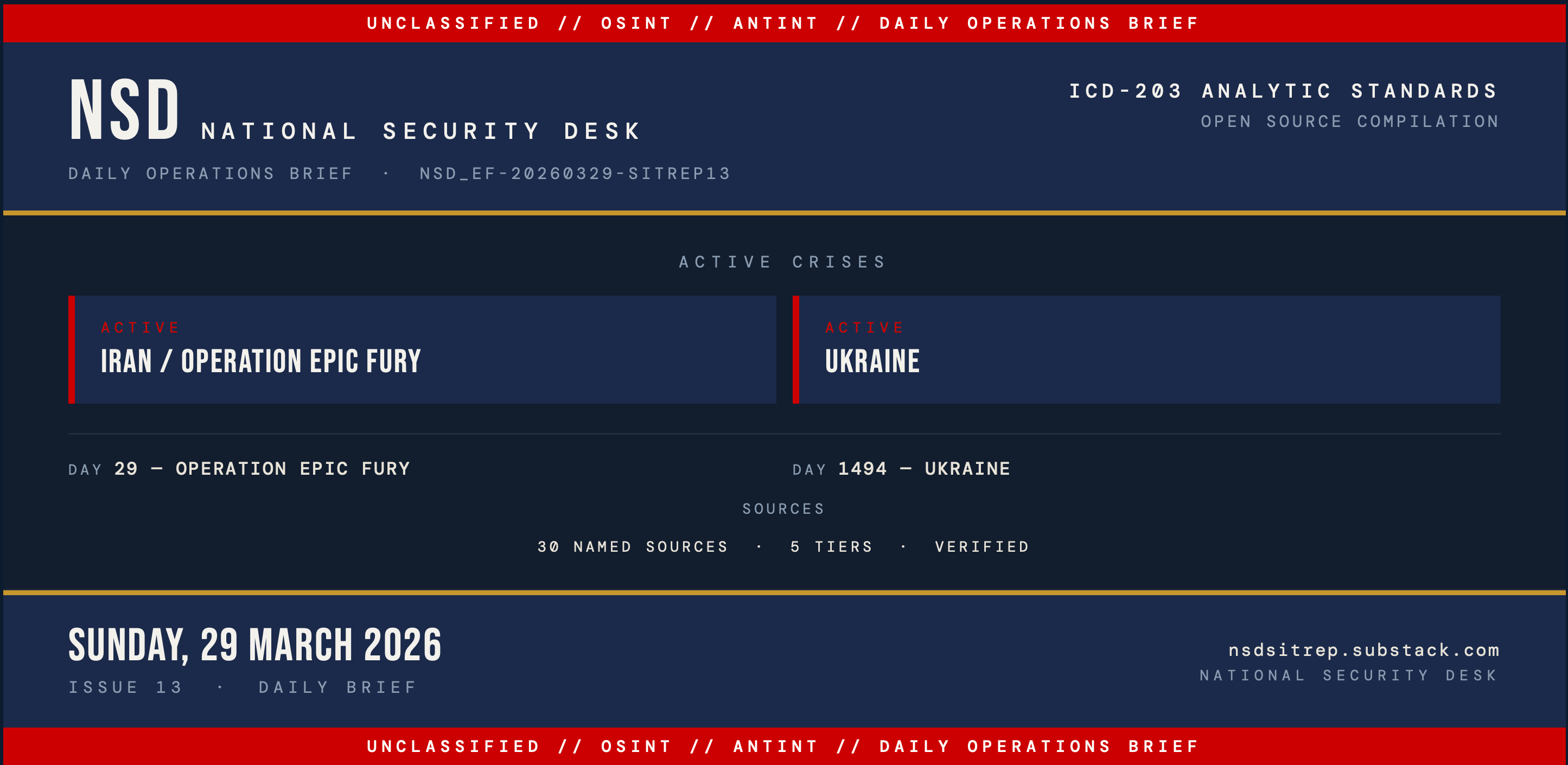
WASHINGTON DC 29MAR2026
NSD SUMMARY VERDICT
On Day 30 of Operation Epic Fury, the central contradiction of the campaign is now visible in real time. Trump extended his energy-strike pause to April 6, citing talks Iran formally denies are happening, while simultaneously the Pentagon leaked ground operation planning, Iran’s parliament speaker accused Washington of preparing invasion under diplomatic cover, the Houthis launched a second wave of strikes against Israel, and the IRGC threatened to target US and Israeli university campuses in the Gulf by Monday noon. Trump applied the Venezuela playbook to Persia — assumed that decapitating the leadership would produce popular uprising. It was a culturally illiterate assumption. The people of Iran have repeatedly and at enormous personal cost demonstrated their rejection of the IRGC and the clerical state; what they have never had is what the 1979 revolutionaries did have: a unified opposition, a recognized leader, a coherent plan, and a shadow government already embedded in every village waiting to move. Khomeini spent decades building that infrastructure from exile. The current Iranian opposition has none of those things. The regime is not loved. It has guns. Those are not the same condition, and any strategist who cannot distinguish between them should not be trusted to start a war, let alone run one. Instead it has produced the opposite: IRGC hardliners have consolidated power, appointed a former IRGC general as National Security Council secretary, and are now issuing operational threats from a position of reduced central political oversight. Mojtaba Khamenei remains absent from confirmed video or audio on Day 30 — the single most consequential intelligence gap in the theater. The war Trump declared won on multiple occasions is now receiving Houthi reinforcements, threatening both chokepoints simultaneously, and generating domestic protests across American cities. That asymmetry of desired outcomes — Trump needing an exit that looks like victory, the IRGC needing a war that stays unresolvable — is the decisive terrain. On Day 30, the IRGC is winning on that terrain.
────────────────────────────────────────────────────────────────────────
UPDATE SUMMARY
Thirty days into Operation Epic Fury, the diplomatic and military tracks are moving in directly opposite directions simultaneously, and the gap between them is itself the story. President Trump extended his pause on strikes against Iranian energy infrastructure by ten more days to April 6, citing ongoing talks that Tehran publicly and categorically denies are taking place. Within the same 48-hour window, the Pentagon briefed the Washington Post on ground operation planning targeting Kharg Island and Hormuz coastal sites; a 3,500-strong Marine Expeditionary Unit arrived on the USS Tripoli; Iran’s parliament speaker Ghalibaf accused the United States of planning a ground invasion while publicly feigning diplomacy; and the Houthi movement launched a second wave of strikes against Israel — threatening not just a new front but the Hormuz bypass itself, the Saudi Red Sea rerouting through Yanbu that currently keeps any oil moving at all. Brent crude settled at $112.57 on Friday and energy analysts are now identifying mid-April as the price-cliff inflection point when reserve drawdowns and Russian oil waivers exhaust their buffering capacity. The HWW cross-theater picture sharpened further: Zelensky confirmed Russian satellites imaged Prince Sultan Air Base on March 25, the day before Iran’s attack that wounded fifteen American troops — the most direct open-source confirmation yet of an active Russian ISR-to-Iranian-targeting pipeline. Inside Iran, IRGC hardliners have tightened their grip: a former IRGC general replaced the killed Ali Larijani at the National Security Council, the IRGC lowered its recruitment age to 12, and Iranian state media acknowledged “anti-regime gatherings” for the first time since the war began — a telling concession to reality.
────────────────────────────────────────────────────────────────────────
KEY DEVELOPMENTS
· Brent crude settled at $112.57 on Friday — highest since July 2022 — with WTI briefly crossing $100 intraday; Middle East oil exports have fallen to 9.71 million barrels per day, a 61 percent reduction from pre-war levels; energy analysts identify mid-April as the cliff point when emergency reserves and Russian oil waivers exhaust their buffering capacity. [1][2]
· The Pentagon is preparing weeks-long ground operation plans including potential raids on Kharg Island and coastal Hormuz sites; the USS Tripoli amphibious ready group (3,500 Marines and sailors) arrived in-theater; Trump has not approved deployment. [3][4]
· Houthis launched a second wave of strikes against Israel on Day 30, compounding their Day 29 entry into the conflict; their deputy information minister confirmed closing the Bab el-Mandeb Strait — the Saudi Red Sea rerouting that currently substitutes for closed Hormuz — is “among our options,” threatening both chokepoints simultaneously. [5][6]
· Iran’s parliament speaker Ghalibaf declared Iran is “waiting for American soldiers on the ground to set fire to them,” directly accusing Washington of planning invasion under diplomatic cover; the IRGC issued a Monday noon deadline for a US condemnation of strikes on Iranian universities or it will target US and Israeli Gulf campuses — Texas A&M Qatar and NYU Abu Dhabi cited by name. [7][8]
· NSD CALLED THIS IN ADVANCE [TR-004]: Zelensky confirmed Russian satellites imaged Prince Sultan Air Base on March 20, 23, and 25 — immediately preceding Iran’s March 26 attack that wounded fifteen US troops — providing direct open-source confirmation of the Russian ISR-to-Iranian-targeting pipeline NSD assessed on 20 March 2026; the two-source problem (Chinese commercial + Russian military ISR) is now confirmed from Ukrainian military intelligence as a three-source architecture. [9]
· IRGC hardliners are consolidating control of Iranian governance: former IRGC general Mohammad Bagher Zolghadr was appointed SNSC secretary replacing the killed Ali Larijani; the IRGC lowered its recruitment age to 12; Iranian state media acknowledged “anti-regime gatherings” for the first time since the war began — a concession that domestic resistance exists. [10][11]
· Islamabad multilateral (Pakistan, Turkey, Egypt, Saudi Arabia) convened on Day 30 to coordinate de-escalation without US or Iranian participation; Pakistan’s foreign minister confirmed the forum is relaying messages between Washington and Tehran. [12]
· US-Israeli strikes on Days 29-30 targeted a Tehran naval weapons research complex (surface/sub-surface production), Bandar Khamir port (five killed), and continued tempo across Tehran, Mashhad, and western provinces; CENTCOM footage released March 27 showed strikes on bulldozers Iran was using to reopen tunnel entrances — active Iranian reconstitution being suppressed in real time. [13][14]
· E-3G Sentry AWACS 81-0005 “Captain Planet” was destroyed on the ground at Prince Sultan Air Base in the March 27 Iranian strike — assessed as a total loss by multiple specialist outlets after imagery showed the rotodome support area burned out and tail collapsed; with the operational E-3 fleet down to approximately 16 aircraft before this war, this single loss removes roughly 6-7 percent of total US airborne battle management and long-range surveillance capacity; at least one KC-135R was also confirmed destroyed in the same strike, with multiple others damaged whose true repair status remains unverified. [38][39][40]
· The Pickaxe Mountain tunnel complex — assessed by weapons experts to contain enriched uranium sufficient for approximately eleven nuclear devices — has not yet been struck; the IAEA confirmed a third incident “in the vicinity of” Bushehr Nuclear Power Plant within ten days, with no radiation release but with the Director General expressing “deep concern.” [15][16]
· Russia announced a gasoline export ban effective April 1, a domestic response to Ukrainian drone strikes that have degraded approximately 40 percent of Russia’s oil export capacity; Zelensky signed ten-year defense cooperation agreements with Saudi Arabia and Qatar, with UAE imminent — co-production of drone interceptors and counter-UAS expertise in exchange for high-end air defense interceptors and Gulf financial resources. [17][18]
· Russia’s spring-summer offensive is underway in Ukraine; Ukrainian forces downed 252 of 273 Russian drones in an overnight attack described as “pure terror”; ISW confirmed Ukrainian advances in the Slovyansk direction and western Zaporizhia. [19]
· Massive domestic anti-war protests erupted across the United States on Day 29 with organizers claiming over eight million participants at 3,300-plus events across all fifty states — the largest single-day domestic protest of the Trump presidency. [20]
────────────────────────────────────────────────────────────────────────
CRISIS MODULE — ACTIVE: IRAN / OPERATION EPIC FURY
Day 30 · War began 28 February 2026
**Situation Summary**
Day 30 marks the transition from the campaign’s first full month to a phase in which first-tier options on both sides are exhausted. CENTCOM has struck over 11,000 targets since Day 1. Over 1,900 Iranians are dead per Iranian health figures; 13 US service members killed, over 300 wounded. CENTCOM publicly claims to have destroyed over two-thirds of Iran’s drone, missile, and naval production facilities — a figure NSD treats with the same skepticism applied to all official damage assessments in this campaign. The same institutional that did not brief Trump on the tanker strikes at Prince Sultan, that described a destroyed AWACS as “damaged,” and that feeds a president a curated daily highlight reel of successful strikes rather than a complete operational picture is not a reliable source for production facility destruction claims. The 90 percent decline in Iranian ballistic missile launches is real and verifiable through independent tracking. The production facility figure is a Pentagon assertion with no independent verification. [21]
The gap between operational success and strategic clarity is now the defining feature of the campaign. Iran’s daily ballistic missile launches at Israel have declined from 90 on Day 1 to approximately 10 — but Iran has adapted by spacing launches throughout the day to maximize civilian shelter frequency while conserving inventory. Approximately 70 percent of Iranian missiles now carry cluster munitions, up from 50 percent on March 10, reflecting both inventory constraints and a deliberate shift toward maximizing disruption rather than precision. [22]
The regime-change assumption has not produced its intended effect. The IRGC lowering its recruitment age to 12 is the data point that settles the argument: a regime facing imminent popular overthrow does not mobilise children — it fights for institutional survival using the only tool it has always had, which is coercive control of the population rather than its consent. Iranian state media’s acknowledgment of “anti-regime gatherings” is a concession to observable reality, not the beginning of a regime-threatening uprising. The IRGC internal security architecture — designed precisely for this scenario — remains intact and operational. [11]
**Diplomatic Activity and Ceasefire Dynamics**
The Islamabad multilateral (Pakistan, Turkey, Egypt, Saudi Arabia) is the most structurally serious de-escalation mechanism currently active. Witkoff has confirmed message-passing through these intermediaries. Iran submitted a five-point counterproposal to the US fifteen-point proposal — the counter demands sovereignty over the Strait of Hormuz and war reparations, terms Washington cannot accept. Araghchi’s statement that Iran does not want a ceasefire because it would produce a “vicious cycle of repeated war” is the most analytically significant Iranian public statement since Day 1: Tehran is not seeking an exit. It is seeking a settlement that forecloses the next American military action. [12][23]
Gulf states told the US on March 27 that “ending the war is not enough — Iran’s capabilities must be destroyed” before any ceasefire. This position could embolden continued strikes but makes diplomatic resolution structurally more distant.
**Air Operations and Strikes**
CENTCOM footage released March 27 showed active suppression of Iranian tunnel reconstitution — US and Israeli strikes are now targeting bulldozers and loaders at tunnel entrances as Iran attempts to clear debris and restore access to underground missile and nuclear storage. This is a second-order operational priority that would not exist if Iran’s reconstitution capacity had been fully destroyed. It confirms that dispersed underground storage remains partially viable for Iran. [14]
The strikes on the Arak heavy water reactor (plutonium pathway) and the Ardakan yellowcake plant — Iran’s only uranium processing facility — struck in the past 48-72 hours represent a renewed push against residual nuclear infrastructure. The Pickaxe Mountain tunnel complex, assessed to contain enriched uranium for approximately eleven devices, has not yet been struck. [15]
**Coalition Aircraft Attrition — AWACS and Tanker Fleet**
The March 27 Iranian strike on Prince Sultan Air Base produced the campaign’s most consequential single airframe loss: E-3G Sentry 81-0005 “Captain Planet,” assessed as a total loss after imagery showed the rotodome support area burned out and the tail section collapsed. The aircraft was on the ground, not in a hardened shelter, at the time of impact — the same vulnerability profile as the five KC-135 Stratotankers damaged in the March 1 strike at the same base. [38][39]
The fleet-level implications are disproportionate to the single-airframe count. The US operational E-3 fleet stood at approximately 16 aircraft before this war. This single loss reduces that to approximately 15 — meaning one airframe represents roughly 6-7 percent of total US AWACS capacity. The Atlantic Council’s tracker had already assessed 66-75 percent of available AWACS were committed to the theater before this strike. Losing one E-3G from that forward package does not merely reduce surveillance range — it removes a node in the battle management architecture that coordinates the entire multi-domain air campaign and cannot be replaced by another platform on a same-day basis.
On tankers: the March 27 strike confirmed at least one KC-135R destroyed on the ground. Multiple others were damaged in the same salvo and their true repair status is unverified. The Pentagon’s public characterization of the March 1 strike tankers as “damaged but repairable” and Trump’s claim that four were “lightly hit and already back” are not supported by any released imagery detailed enough to show structural write-off versus patch-and-fly. USTRANSCOM has previously described the KC-135 as the most stressed fleet in the force. Battle-damage “repairable” can range from replacing a skin panel to multi-year depot work on spars and frames that will never be prioritized at surge tempo.
NSD assessment: The analytically appropriate planning assumption is that a significant fraction of the “damaged but repairable” tankers at PSAB will not return to meaningful operational service within the campaign’s active timeframe. The AWACS loss is not repairable at any timeline. This matters directly for Scenario 2: the ISR and battle management architecture enabling carrier strike group operations is being degraded at the same moment the carrier environment is receiving reinforcement. [40]

**Maritime Domain**
The Strait of Hormuz remains effectively closed to US, Israeli, and allied commercial traffic. Iran is operating a yuan-denominated toll system for approved vessels and on March 27 formally declared the strait closed to any vessel going to or from US, Israeli, or allied ports. [24] Maham-3 and Maham-7 naval mines are deployed at fixed positions in the strait — a targeting architecture Iran controls the keys to, not a random denial measure. The US mine countermeasures (MCM) capability in-theater is acutely thin: only three Littoral Combat Ships outfitted with MCM packages are present, and two were in Singapore for maintenance as of mid-March. Clearing a mined strait under fire against a force that can reseed mines indefinitely is not an option that the current MCM posture makes viable. [25]
The Houthi entry into the conflict on Day 29-30 structurally changes the maritime picture. The Saudi Red Sea rerouting through Yanbu to the Suez Canal — the only functioning Hormuz bypass for significant volumes — is now threatened by a force that demonstrated sustained maritime interdiction capacity through the 2023-2025 Gaza conflict. If the Houthis close the Bab el-Mandeb, the bypass closes. There is no third chokepoint workaround. [5][6]
IRGC seized three container ships near Larak Island on March 27 — CSCL Indian Ocean, CSCL Arctic Ocean (Chinese-flagged), and the Antigua-flagged SAPHIRA. The seizure of Chinese-flagged vessels, nominally friendly traffic, is itself an indicator of operational friction at the IRGC Navy level. Iran’s Defense Council has threatened to mine the entire Persian Gulf if US ground troops deploy. [26]
**Iranian Command and Leadership Crisis**
Mojtaba Khamenei has not appeared in confirmed video or audio in thirty days. His only outputs are written statements and a March 28 Telegram infographic on “resistance economy.” ISW assessed the Telegram post as possibly designed to portray an active leader “amid reports that he is seriously wounded.” Araghchi told Al-Araby Al-Jadeed that Khamenei is in “excellent health and in control of the situation” — an unverified verbal claim. [27][28]
The power vacuum is producing measurable effects. Former IRGC general Zolghadr’s appointment to the SNSC — replacing the killed Larijani, described by ISW as one of the IRGC’s hardest hardliners — signals that IRGC operational figures are consolidating political authority. Ghalibaf’s increasingly independent public posture — issuing ground-force retaliation threats and campus strike deadlines without apparent coordination — is consistent with an IRGC operational leadership operating with reduced central oversight. This is not confirmation of command fragmentation but it is the precondition profile for Scenario 4. [10][11]
**Ground Force Disposition and Planning**
The Washington Post reported Pentagon preparation of weeks-long ground operation plans involving SOF and conventional infantry targeting coastal Hormuz sites including Kharg and Larak Islands. The White House confirmed “maximum optionality” framing without approving deployment. Iran reinforced Kharg Island with ground forces, MANPADS, and extensive minefields. [3][26][29]
NSD assessment: The Inchon problem persists. Ghalibaf’s explicit invitation to ground engagement — “waiting for American soldiers to set fire to them” — is the operational signal, not bravado. The IRGC wants boots on Kharg. That asymmetry of desire is the clearest indicator that the ground option, if executed, crosses from military operation to strategic trap territory. [TR-008]
**Regional Threat Assessment**
Anti-war protests erupted across the United States on Day 29 — organizers cited over eight million participants at 3,300-plus events across all fifty states, the largest single-day domestic opposition mobilization of the Trump presidency. [20]
France’s Interior Minister linked a foiled Bank of America building bombing in Paris to the Iran war. [30] This is the HWW domestic activation pattern operating in real time: external axis kinetics generating Western domestic target mobilization simultaneously with the military campaign. A drone attack targeted the residence of Iraqi Kurdish leader Nechirvan Barzani in Erbil. [31]
**Hormuz Bypass Degradation Assessment**
Saudi Arabia’s East-West Pipeline, UAE’s Abu Dhabi-Fujairah pipeline, and Iraq-Turkey pipeline have a combined ceiling of approximately 2-3 million bpd against normal Hormuz throughput of roughly 20 million — partial relief, not structural solution. The Saudi East-West Pipeline and its Red Sea terminal at Yanbu are themselves likely Houthi targets: they represent the single most consequential piece of bypass infrastructure, their destruction would close the last meaningful oil routing alternative, and the Houthis have demonstrated both the range and the appetite for exactly this category of economic infrastructure strike. If Yanbu closes, there is no third workaround. [32]
────────────────────────────────────────────────────────────────────────
CRISIS MODULE — ELEVATED: UKRAINE
Day 1,494 · War began 24 February 2022
Russia’s spring-summer offensive is now assessed as underway. ISW confirmed Ukrainian advances in the Slovyansk direction and western Zaporizhia and northern Kharkiv Oblasts in what NSD assesses as tactically significant shaping operations ahead of the main Russian effort. Russia launched one of its largest aerial attacks since the war began on March 23-24 — approximately 948 drones and missiles — which ISW assessed as the offensive’s operational opening signal. Ukraine’s air defense responded effectively, downing 252 of 273 drones in the March 28-29 overnight attack, but five Ukrainians were killed and thirteen injured in a night described by officials as “pure terror.” [19]
The HWW cross-theater dimension is now confirmed at the highest public-source confidence level since the war began. Zelensky’s March 28 intelligence briefing named specific satellite overflight dates and targets: Diego Garcia (March 24), Kuwait International Airport and Greater Burgan oil field (March 24), Prince Sultan Air Base (March 25), Shaybah oil field, Incirlik Air Base, and Al Udeid Air Base (March 26). The March 25 Prince Sultan imaging preceded the March 26 attack by one day — consistent with the three-image targeting-pipeline pattern documented at TR-004. Russia is not watching this war. It is participating in it. [9]
Russia is materially benefiting from Epic Fury’s economic and strategic effects: the US Russian oil sanctions waiver (through April 11) translates to direct revenue; elevated global energy prices boost Russian export income; and the Iran war’s consumption of US diplomatic bandwidth and munitions reduces pressure on Moscow across every dimension. Russia announced a gasoline export ban from April 1, driven by Ukrainian strike degradation of approximately 40 percent of Russian oil export capacity — confirming that Ukraine’s strategic strike campaign against Russian energy infrastructure is producing measurable economic effect. [17]
Zelensky’s Gulf tour (Saudi Arabia March 27, UAE and Qatar March 28) produced ten-year defense cooperation agreements using Ukraine’s battle-tested drone interceptors and counter-UAS expertise as its comparative advantage in exchange for Gulf high-end air defense interceptors and financial resources. Ukraine has deployed over 200 anti-drone specialists across five Gulf states. The deals represent the first formal security architecture Kyiv has built outside NATO/EU frameworks and expand Ukraine’s strategic depth against both Russian pressure and potential US resource diversion. [18]
US-Russia Ukraine peace talks have effectively stalled. The Kremlin acknowledged to Reuters that the Iran war’s energy windfall and reduced US political bandwidth have weakened Moscow’s incentive to negotiate. The Kallas-Rubio confrontation at the G7 — “If you think you can do it better, go ahead. We’ll step back” — is being processed across European capitals as evidence of structural fracture, not strategic disagreement. [33][34]
────────────────────────────────────────────────────────────────────────
WATCH ITEMS
**Taiwan Strait / Indo-Pacific**
No significant PLA activity beyond baseline. The structural window of US force diversion remains open and extends with every day Epic Fury continues without resolution. China’s MizarVision commercial ISR — confirmed contributing to Iranian targeting — means Beijing is simultaneously participating in the attrition of US military assets and resources and benefiting from the extended Indo-Pacific deterrence gap. These are not separate strategic choices; they are a unified operational posture. No change to re-escalation trigger. Standing indicators monitored.
**Korean Peninsula**
No KCNA-confirmed Kim Jong-un appearance. No missile test exceeding KN-25 baseline. Standing indicators monitored.
**Cuba**
No change. Standing indicators monitored.
────────────────────────────────────────────────────────────────────────
ANALYSIS & OPINION
**NSD Intellectual Heritage — Standing Framework**
Touval’s New York Times essay invokes Clausewitz, Thucydides, and Tolstoy as the analytical tradition the war’s architects failed to absorb. NSD has operated within that tradition — and its extensions — from Day 1. For readers new to this publication, the intellectual lineage that shapes every NSD analytical judgment is as follows.
The epistemological spine is **F.H. Hinsley** — wartime codebreaker at Bletchley Park, Cambridge intelligence historian, and NSD’s direct intellectual progenitor. Hinsley’s method was not codebreaking in the technical sense. It was the discipline of inference under uncertainty: the separation of what is known, what is inferred, and what is unknowable; the detection of meaning in weak signals; and the recognition that the gravest blind spots arise not from missing information but from the institutional and cognitive refusal to update mental models when reality contradicts the preferred script. NSD calls this the Cardinal’s Rule. It is the foundational law against which every official narrative in this brief — Pentagon damage reports, Trump ceasefire claims, Iranian denials — is tested.
The strategic theory layer runs through **Clausewitz** (war as political purpose, not algebra; friction as structural, not incidental), **Schelling** (the logic of signaling, commitment, and coercive bargaining — directly applicable to every Trump deadline extension), **Jervis** (misperception as a systemic feature of strategic interaction, not an aberration — the entire regime-change assumption is a Jervis case study), **Brodie** (when the nature of conflict changes, doctrine must change with it — the drone/asymmetric warfare revolution is a Brodie moment), and **Lawrence Freedman** (strategy as narrative embedded in evolving political contexts — the reason Trump’s “winding down” statements are simultaneously a domestic political tool and evidence of Iranian strategic success).
The intelligence tradecraft layer runs through **Sherman Kent** (analytic transparency, probabilistic reasoning, explicit accountability for judgments) and **Richards Heuer** (cognitive biases as structural features of reasoning, not personal failures — the entire production-facility destruction claim is a Heuer availability-bias case). This is the source of NSD’s ICD-203 probability language and Powell Doctrine epistemic layering.
The cognitive science layer runs through **Kahneman and Tversky** (systematic biases in judgment under uncertainty — applied here to the regime-change assumption and the Pentagon damage-reporting pattern), **Gigerenzer** (distinguishing productive heuristics from pathological shortcuts — the Van Riper / Millennium Challenge 2002 lens NSD applies to IRGC asymmetric strategy), **Tetlock** (forecasting calibration and the accountability of advance calls — the explicit reason NSD maintains its Track Record registry), and **Gary Klein** (naturalistic decision-making under time pressure — the analytical frame for IRGC operational adaptation throughout the campaign).
The complexity layer runs through **Meadows**, **Senge**, **Holland**, and **Simon** — the systems-thinking and bounded-rationality tradition that informs NSD’s treatment of the Hormuz crisis not as a discrete event but as a complex adaptive system with feedback loops, leverage points, and nonlinear dynamics that official linear planning frameworks cannot capture.
The practitioner layer runs through **Van Riper** and the Millennium Challenge 2002 red-team tradition — applied explicitly in NSD’s Epic Fury red-team exercise of 11 March 2026, and in the standing Inchon Trap assessment of Kharg Island. The lesson Van Riper demonstrated in 2002 is the same lesson the IRGC has been applying for thirty days: a technologically inferior adversary that refuses to play on the superior power’s terms does not need to win militarily. It is a twenty-four-year-old insight that the architects of Operation Epic Fury appear not to have absorbed.
When Touval writes in the New York Times on Day 30 that the war represents a failure of imagination, he is naming what NSD named on Day 1 — and naming the intellectual tradition that would have prevented it. That tradition is not mysterious. It is documented. It is teachable. And it has been applied in this publication since the first brief.
**NSD Prior Analysis**
No new NSD publications in the last 72 hours confirmed from milab.substack.com. Full analytical archive: substack.com/@milab
Standing references applicable to today’s brief:
▸ “The ‘Leaked’ Document: Tehran’s War Plan for Regime Change in Washington” — MILab/NSD, 11 March 2026 · milab.substack.com/p/leaked-document-tehrans-war-plan — The time horizon asymmetry framework is operating precisely as the red-team exercise predicted on Day 11. Every extension of Trump’s energy-strike pause, every “talks going very well” statement paired with Iranian denial, and every Pentagon ground option leak unanswered by deployment orders confirms the IRGC delay strategy is working. Ghalibaf’s ground-engagement invitation is the IRGC explicitly inviting the escalation option the red-team exercise identified as Iran’s preferred escalation frame. [RT-1]
▸ “A Hybrid World War” — NSD/MILab, 23 October 2023 · milab.substack.com — The Russian ISR confirmation (Zelensky briefing, March 28) and the Paris Bank of America bombing attempt (linked to the war by France’s Interior Minister) represent simultaneous confirmation of the Four Plus Two axis operating in kinetic and narrative-warfare dimensions within a single 48-hour window. This is the HWW picture in miniature: external axis forces ISR-supporting kinetic operations, Western domestic actors mobilizing against Western institutions in synchrony with the external campaign. [HWW-1]
**External Analysis**
Foreign Affairs published “Iran’s Long Game: Decades of Preparation Are Paying Off” (March 26), arguing Iran may be losing the conventional military fight but gaining strategically through resilient command structures, adaptable asymmetric methods, and economic warfare centered on Hormuz. The Soufan Center’s March 26 IntelBrief assessed that killing Iranian leadership has paradoxically tilted power toward hardliners who will demand major US concessions. SOF News stated it directly in its March 28 weekly: “From an operational perspective, the Iran War has been a resounding success; from a strategic perspective, it may very well end up with a different storyline.” These three assessments converging in the same 72-hour window constitute external analytical consensus reaching the same conclusion as NSD’s TR-002 assessment. [35][36][37]
The most significant single piece of external analysis published today is Yonatan Touval’s essay in The New York Times: “The Iran War Is a Failure of Imagination” (March 29, 2026). [41] NSD flags it explicitly because it makes, in the paper of record on Day 30, the argument NSD has been advancing since before the first strike. Touval’s core claim: the war’s architects possess extraordinary targeting machinery and no cultural literacy — “Never has so much been seen, so precisely, by so many people who understand so little of what they are seeing.” His specific analytical findings map directly onto NSD’s prior work:
On regime-change failure: Touval writes that “external attack often does the opposite — binding a battered state more tightly to a society newly united by injury, humiliation and rage.” NSD made this assessment on Day 1 and codified it in the Key Driving Assumption. The Venezuela/Persia distinction NSD applied in this brief’s Summary Verdict is the same argument in compressed form.
On decapitation producing the opposite of negotiators: “Systematic decapitation does not produce negotiators. It removes them.” This is the Larijani point. NSD assessed in real time that killing Larijani — the one senior Iranian figure with a pragmatic diplomatic track record — removed the most likely Iranian interlocutor for any eventual settlement and replaced him with a hardliner. The appointment of IRGC general Zolghadr to the SNSC is the confirmation.
On the Clausewitz/Thucydides frame: Touval invokes precisely the tradition NSD operates within — Thucydides on Athens and Syracuse, Clausewitz on war as political purpose rather than algebra, Tolstoy on Napoleon’s imaginative failure at Moscow. That the New York Times is running this argument on Day 30 is not a vindication NSD requires. It is the signal that the failure of imagination has become visible enough to name in mainstream commentary — which means the window for correcting it in real time is probably already closed.
The G7 Foreign Ministers meeting in France (March 27) produced the most explicit documentation to date of transatlantic fracture over Epic Fury. The Kallas-Rubio confrontation — confirmed by three witnesses — and Trump’s simultaneous “paper tiger” declaration toward NATO represent structural rupture, not rhetorical excess. Rubio told G7 counterparts the war would last “2-4 more weeks” — a timeline directly contradicted by simultaneous amphibious force deployment that takes weeks to position and longer to recall meaningfully. [33][34]
**NSD Track Record**
▸ TR-002 (Time Horizon Asymmetry, 1 March / 11 March 2026) — CONFIRMED, strengthened. Second energy-pause extension to April 6, Iran’s continued denial of negotiations while accepting the pause’s operational benefits, Ghalibaf’s ground-operation taunting, and convergent external assessments (Foreign Affairs, Soufan, SOF News) all confirm the IRGC delay strategy is producing its intended political effect. [RT-1]
▸ TR-004 (Russian ISR Support to Iranian Targeting, 20 March 2026) — CONFIRMED at highest open-source confidence to date. Zelensky’s March 28 intelligence briefing provided specific satellite overflight dates and facility names. The Prince Sultan imaging-to-attack sequence (three images over five days, attack the day after final imaging) provides direct confirmation of the ISR-to-targeting pipeline. Combined with MizarVision (Chinese commercial) and Russian Liana system, the ISR architecture enabling Iranian targeting now has three independent confirmed sources. [milab.substack.com/p/americas-satellites-helped-iran-target]
▸ TR-008 (Kharg Island / Inchon Trap, 26 March 2026) — STRENGTHENED. Iran’s Kharg reinforcement with ground forces, MANPADS, and minefields, plus Ghalibaf’s explicit invitation to ground engagement, confirms the analytical framing: the island is a tactical objective and a strategic trap simultaneously. [milab.substack.com/p/the-inchon-trap]
▸ TR-005 (CONUS Drone Vulnerability, 21 March 2026) — STANDING. No resolution. The IRGC campus strike threat (Day 30) extends the operational threat geometry from military installations toward civilian and academic infrastructure. The conceptual trajectory toward Fort McNair remains unresolved. [milab.substack.com/p/the-predictable-pearl-harbor]
▸ NSD ANALYTICAL FRAMEWORK VALIDATION — “The Iran War Is a Failure of Imagination,” Yonatan Touval, The New York Times, 29 March 2026. [41] The core NSD analytical framework — that this campaign was built on cultural illiteracy, that decapitation produces hardliners not negotiators, that a leadership formed by decades of sacred-cause framing experiences military pressure as confirmation rather than deterrence — is now being made in the paper of record on Day 30 by a foreign-policy analyst writing from Tel Aviv. Touval’s Thucydides/Clausewitz/Tolstoy frame is the same intellectual lineage NSD operates within. His specific finding that “systematic decapitation does not produce negotiators — it removes them” confirms NSD’s real-time assessment of the Larijani killing. NSD does not require external validation. But when the New York Times runs this argument on Day 30, it marks the moment the failure of imagination has become visible enough to name publicly — which is also the moment it is too late to correct.
────────────────────────────────────────────────────────────────────────
NSD ANALYTICAL ASSESSMENT
**Key Driving Assumption**
The campaign’s decisive terrain is the asymmetry between Trump’s political clock and the IRGC’s delay strategy. Trump requires a short, concludable war before the 2026 midterm cycle, domestic energy prices, Congressional pressure, and a $200 billion supplemental request force a political reckoning. The IRGC requires a war long enough and unresolved enough that Trump cannot credibly claim victory. Every deadline extension, every “talks going very well” statement paired with Iranian denial, and every ground option leak unanswered by deployment orders is evidence this asymmetry is operating in Iran’s favor. This assumption does not change unless Trump commits to a war timeline that removes the midterm clock as a structural constraint, or Iran produces a credible IRGC-endorsed ceasefire offer on terms permitting genuine victory framing. Neither condition is currently assessed as likely.
**72-Hour Trajectory**
The IRGC campus strike deadline — noon Monday, Tehran time — is the most immediate tactical pressure point. The US has not publicly responded with a condemnation. The IRGC has publicly committed to striking Gulf university campuses if the deadline passes without a response. Probable (55-70%) that the IRGC follows through with at least a demonstrative strike given the explicit public framing and the IRGC’s pattern of following through on stated deterrence commitments. This would generate immediate Congressional and public pressure on the administration that compounds the existing domestic political challenge.
The Islamabad multilateral (Pakistan, Turkey, Egypt, Saudi Arabia) convenes March 29-30. None of the four have decision authority for either principal, but Pakistan’s confirmed message-relay role and Saudi Arabia’s financial and energy leverage make this the most consequential diplomatic channel currently active. Likely (55-70%) this forum produces a framework document; actual ceasefire requires direct US-Iran contact that neither principal has confirmed.
April 6 energy-strike pause expiration is the next structural decision point. Trump has now extended twice. A third extension would be the strongest confirmation indicator for TR-002 that the series has yet produced. A strike on Iranian energy infrastructure pushes Brent above assessed Goldman Sachs ceiling and triggers the mid-April supply cliff analysts have been warning about. Roughly even (45-55%) on extension versus strike, given the administration’s demonstrated pattern of extension under negotiation-process framing.
**Anticipatory Worst-Case Scenario Updates**
SCENARIO 1 — DRONE STRIKE ON CONUS PRINCIPAL: The IRGC campus threat (Day 30) extends the explicit threat geometry to civilian and educational infrastructure. The conceptual trajectory toward CONUS principals at Fort McNair remains unresolved — no arrests, no attribution, no structural remediation. No new direct indicators of imminent CONUS targeting. Probability: LOW. Consequence: CATASTROPHIC. Watch status: ACTIVE.
SCENARIO 2 — SUCCESSFUL CARRIER MISSION-KILL: USS Gerald R. Ford at Souda Bay (Greece) for repairs following internal fire. USS Abraham Lincoln remains primary operational carrier in the Arabian Sea. USS George H.W. Bush destroyers departed homeport — reinforcement, not drawdown. Russian ISR architecture targeting the carrier environment is active (Zelensky briefing confirms Diego Garcia imaging). The destruction of E-3G “Captain Planet” — one of approximately 16 operational AWACS — degrades the battle management and ISR architecture that enables carrier strike group operations and helps cue against incoming threats. The carrier reinforcement posture temporarily moderates the probability modifier, but the AWACS attrition and the confirmed Russian ISR-to-targeting pipeline are the primary compound risk indicators. Probability: LOW-MEDIUM. Watch status: ACTIVE.
SCENARIO 3 — RADIOLOGICAL INCIDENT AT NATANZ: Three IAEA-confirmed incidents “in the vicinity of” Bushehr Nuclear Power Plant in ten days. No radiation released; reactor assessed normal. The Pickaxe Mountain tunnel complex — assessed by weapons experts to contain enriched uranium for approximately eleven devices — has not been struck. IAEA Director General’s expressed “deep concern” about military activity near nuclear facilities is the closest the international community has come to formally naming this scenario. Probability: LOW — incrementally rising with each strike cycle near nuclear infrastructure. Consequence: EXISTENTIAL to campaign’s international legitimacy. Watch status: ACTIVE.
SCENARIO 4 — IRGC COMMAND FRAGMENTATION PRODUCING UNCONTROLLED ESCALATION: Mojtaba Khamenei absent from confirmed video or audio for thirty days. IRGC hardliner Zolghadr appointed SNSC secretary. Ghalibaf issuing operational threats and campus strike deadlines with increasing independence. These are not confirmation of fragmentation but they constitute the precondition profile: a senior IRGC operational leadership whose political oversight capacity is unconfirmed and whose public actions increasingly exceed what a coherent, centrally-authorized strategic framework would produce. The “Option X” conditions identified in the red-team exercise — conditional, reserved, requiring explicit strategic authorisation — may not be being enforced if command authority is fragmented. Probability: LOW-MEDIUM and rising. Consequence: CATASTROPHIC. Watch status: ACTIVE.
**Critical Unknowns**
1. Mojtaba Khamenei’s physical condition and command authority — thirty days without confirmed video or audio. This remains the single most consequential intelligence gap in the theater.
2. Whether the Islamabad multilateral can bridge the gap between the US fifteen-point action list and Iran’s five-point counter-proposal, specifically on Hormuz transit and enrichment guarantees.
3. Whether the IRGC’s Monday campus strike deadline constitutes a pre-committed operational action or a coercive signal designed to extract a US condemnation without requiring kinetic follow-through.
**Closing Analytical Note**
The war has entered the phase its architects hoped to prevent: military operation outlasting political coherence. Trump is simultaneously telling markets the war will end “within weeks,” authorizing Pentagon planning for a ground operation that would take months, and watching domestic anti-war protests that organizers describe as the largest mobilization of his presidency. Rubio told the G7 “2-4 more weeks” while amphibious assault ships arrive that take weeks to position. These are not rhetorical inconsistencies. They are the signature of a decision-making structure that has not resolved its own exit strategy. Iran does not need to resolve one. Its strategy is to prevent Trump from resolving his. On Day 30, that strategy is working.
A separate analytical flag on Trump’s market-moving statements: the pattern of large options bets placed immediately before his public “talks going very well” and “winding down” statements — each of which has produced a measurable oil price drop and equity rally before the subsequent reality correction — is not a coincidence to be explained away. The beneficiaries of those trades are not random. NSD does not have visibility into the specific positions, but the pattern is documented, the timing is precise, and the administration’s willingness to run the war as a narrative operation rather than a transparent military campaign creates the conditions under which that kind of market manipulation is both possible and, on current evidence, occurring. Readers should factor this into their assessment of every future Trump statement about the war’s trajectory.
One additional analytical discipline applies to this brief and every subsequent one: the Pentagon’s public damage assessments are not reliable. The pattern at Prince Sultan — aircraft described as “damaged but repairable,” Trump claiming jets were “lightly hit and already back,” imagery that does not support those characterizations, an AWACS confirmed destroyed that no official has yet acknowledged as a total loss — is not aberrant. It is institutional. In every active US military campaign, official casualty and equipment loss figures are managed downward in real time for operational security, political, and morale reasons. NSD’s analytical standard is to treat official “damaged but repairable” language as a lower bound, not a finding, and to note when the imagery and independent technical assessments diverge from official framing. They diverge here. Readers who are forming strategic assessments of the campaign’s sustainability should apply the same discount.
────────────────────────────────────────────────────────────────────────
LEADER LOCATOR — Confirmed Locations as of 29 March 2026
▸ DONALD TRUMP · President, United States · Last confirmed: Miami Beach, FL (FII Priority Summit, March 27); Day 30 location ASSESSED Washington D.C. / Mar-a-Lago area — no confirmed readout. · ASSESSED
▸ STEVE WITKOFF · Special Envoy · Confirmed active engagement with Turkey, Egypt, Pakistan intermediaries per US source to multiple outlets; Day 30 location UNKNOWN. · UNKNOWN
▸ MARCO RUBIO · Secretary of State · Last confirmed: Vaux-de-Cernay, France (G7 Foreign Ministers), March 27. ASSESSED returned to Washington. · ASSESSED
▸ PETE HEGSETH · Secretary of Defense · Washington D.C. / Pentagon. Last confirmed public statement March 27. · ASSESSED
▸ VLADIMIR PUTIN · President, Russia · UNKNOWN. Last confirmed Kremlin footage: March 18 (Crimea anniversary, video link from unconfirmed office location). RFE/RL Systema investigation confirmed ongoing use of three near-identical replica offices to obscure location. Two-source confirmation protocol not met. Lavrov-Araghchi call confirmed March 27 by MFA Russia readout. · UNKNOWN — Confidence: LOW per standing protocol
▸ XI JINPING · General Secretary / President, China · No confirmed public readout in last 24 hours per available open sources. · UNKNOWN
▸ MOJTABA KHAMENEI · Supreme Leader, Iran · UNKNOWN — no confirmed video or audio in 30 days since Day 1. Araghchi claimed “excellent health and in control of the situation” (Day 28, Al-Araby Al-Jadeed). Trump stated he may be “not alive.” No independent verification. State Dept offering $10 million reward for information on his location. Confidence for physical condition: NONE. Confidence for command authority: LOW. This is the most consequential intelligence gap in the theater. · UNKNOWN — Day 30 of confirmed absence
▸ ABBAS ARAGHCHI · Foreign Minister, Iran · Tehran and regional diplomatic activity confirmed; actively posting on Telegram; Islamabad multilateral engagement via intermediaries confirmed. · ASSESSED — Tehran/regional · Confidence: HIGH
▸ KIM JONG-UN · Supreme Leader, DPRK · No KCNA-confirmed appearance. · UNKNOWN
▸ EMMANUEL MACRON · President, France · Paris. Hosted G7 Foreign Ministers at Vaux-de-Cernay, March 27. · CONFIRMED (March 27)
▸ FRIEDRICH MERZ · Chancellor, Germany · Berlin. Foreign Minister Wadephul attended G7 in France. Merz public statements on G7 outcomes confirmed. · ASSESSED
▸ KAJA KALLAS · EU High Representative · Last confirmed: G7 Foreign Ministers, France, March 27; Kallas-Rubio confrontation confirmed by three witnesses. · CONFIRMED (March 27)
▸ URSULA VON DER LEYEN · President, European Commission · No specific Day 30 location signal. · UNKNOWN
▸ MARK RUTTE · NATO Secretary-General · Brussels / NATO HQ. Public statements on defense spending and Hormuz confirmed same period as G7. · ASSESSED
▸ KEIR STARMER · Prime Minister, United Kingdom · No confirmed Day 30 location. UK Foreign Secretary Cooper attended G7 France. · UNKNOWN
▸ BENJAMIN NETANYAHU · Prime Minister, Israel · Tel Aviv / Jerusalem. Confirmed video statement on Iran deal framework negotiations with Vance and Trump, March 28-29. · CONFIRMED
The National Security Desk offers these posts freely, but your support is necessary and appreciated. Please subscribe, paid if you’re able, or leave a tip.
Thank you

ENDNOTES
[1] CNBC · “Oil prices close at highest level since 2022” · https://www.cnbc.com/2026/03/27/oil-price-wti-brent-crude-trump-strait-hormuz-tensions-iran-ships.html · 27 March 2026
[2] NSD SITREP 12 / AP · Middle East oil exports at 9.71 mbpd; IEA 400-412 million barrel release · https://nsdsitrep.substack.com/p/sitrep-12 · 28 March 2026
[3] Washington Post / CGTN · “Pentagon prepares for potential ground operations against Iran” · https://news.cgtn.com/news/2026-03-29/Pentagon-prepares-for-potential-ground-operations-against-Iran-1LU6ktQor2U/p.html · 29 March 2026
[4] CNN · “Day 29: Houthis enter war, US Marines arrive” · https://edition.cnn.com/2026/03/28/world/live-news/iran-war-us-israel-trump · 28-29 March 2026
[5] CNBC · “Yemen’s Houthis launch Israel strike, the first of the Iran war” · https://www.cnbc.com/2026/03/28/yemens-houthis-launch-israel-strike-the-first-of-the-iran-war.html · 28 March 2026
[6] The Hill · “Houthis enter Iran war; Bab el-Mandeb threat confirmed” · https://thehill.com/policy/international/5805623-yemen-houthis-iran-conflict-israel-strike/ · 28 March 2026
[7] ABC News · “Ghalibaf: Iran waiting for US troops; accuses Washington of planning invasion under cover of diplomacy” · https://abcnews.com/International/live-updates/iran-live-updates-trumps-48-hour-deadline-expire/?id=131316431 · 29 March 2026
[8] Times of Israel · “IRGC threatens US and Israeli university campuses; Monday noon deadline” · https://www.timesofisrael.com/pentagon-said-prepping-weeks-long-ground-operation-in-iran-short-of-full-invasion/ · 29 March 2026
[9] Kyiv Independent / ANI News · “Zelensky confirms Russian satellite imaging of Prince Sultan before Iran attack” · https://kyivindependent.com/ukraine-secures-10-year-defense-deals-with-gulf-states-amid-iran-war/ · 28 March 2026
[10] Perplexity Research / ISW · “Zolghadr appointed SNSC secretary; IRGC hardliner consolidation” · March 2026
[11] Perplexity Research / ISW / Mehr News · “IRGC recruitment age lowered to 12; state media acknowledges anti-regime gatherings” · March 2026
[12] Al Jazeera / Gulf News · “Islamabad multilateral: Pakistan, Turkey, Egypt, Saudi Arabia convene” · https://www.aljazeera.com/news/liveblog/2026/3/29/iran-war-live-houthis-attack-israel-anti-war-protesters-rally-in-tel-aviv · 29 March 2026
[13] Times of Israel / Gulf News · “Day 30 strikes: Tehran naval complex, Bandar Khamir port (5 killed)” · 29 March 2026
[14] CENTCOM / NSD SITREP 12 · “Strikes on Iranian tunnel reconstitution bulldozers” · 27 March 2026
[15] Perplexity Research · “Pickaxe Mountain complex unstruch; enriched uranium for ~11 devices assessed inside” · March 2026
[16] NBC News / IAEA · “Third IAEA incident at Bushehr vicinity; DG expresses deep concern” · 28 March 2026
[17] EA WorldView · “Russia gasoline export ban April 1; 40% oil export capacity degraded by Ukrainian strikes” · https://eaworldview.com/2026/03/ukraine-war-gulf-zelensky-defense-agreements/ · 29 March 2026
[18] Kyiv Independent / Al Jazeera · “Zelensky ten-year defense agreements: Saudi Arabia, Qatar; UAE imminent” · https://kyivindependent.com/ukraine-secures-10-year-defense-deals-with-gulf-states-amid-iran-war/ · 28-29 March 2026
[19] ISW / Kyiv Independent · “Russian spring offensive underway; 252 of 273 drones downed overnight; five killed” · https://www.kyivpost.com/post/72789 · 29 March 2026
[20] Reuters / AP · “Anti-war protests across US; organizers claim 8 million at 3,300+ events” · 29 March 2026
[21] CENTCOM / NSD SITREP 12 · “11,000+ targets struck; 92% of major Iranian naval vessels destroyed; 60% of launchers destroyed” · 28-29 March 2026
[22] Perplexity Research · “Iranian missile salvo spacing change; 70% cluster munitions, up from 50%” · March 2026
[23] NPR / NSD SITREP 12 · “Iran five-point counter; Araghchi: no desire for ceasefire” · https://www.npr.org/2026/03/26/nx-s1-5761882/iran-war-peace-conditions · 26-28 March 2026
[24] Wikipedia / Reuters · “2026 Strait of Hormuz crisis — IRGC formal closure declaration; yuan toll system” · https://en.wikipedia.org/wiki/2026_Strait_of_Hormuz_crisis · 29 March 2026
[25] Gulf News · “IRGC Maham-3 and Maham-7 naval mines at fixed positions in Strait” · https://gulfnews.com/world/mena/irans-hormuz-trap-what-to-know-about-irgcs-naval-mines-deployment-1.500484573 · 25 March 2026
[26] NSD SITREP 12 · “IRGC seizes three container ships near Larak Island; Defense Council threatens to mine Persian Gulf” · https://nsdsitrep.substack.com/p/sitrep-12 · 28 March 2026
[27] Fox News · “Araghchi: Mojtaba Khamenei in excellent health and in control” · 28 March 2026
[28] ISW / NSD SITREP 12 · “Khamenei Telegram post assessed as effort to project active leadership amid wound reports” · 28 March 2026
[29] The Defense News / The Week India · “Iran reinforces Kharg Island: ground forces, MANPADS, mines” · https://www.thedefensenews.com/news-details/Iran-Reinforces-Kharg-Island-with-Troops-MANPADS-and-Mines-Amid-Threat-of-Potential-US-Ground-Operation/ · 27 March 2026
[30] AFP / Kyiv Post · “France Interior Minister links Paris Bank of America bombing attempt to Iran war” · 28 March 2026
[31] Reuters · “Drone attack near Barzani residence, Erbil” · 28-29 March 2026
[32] Al Jazeera · “Can three pipelines bypass the Strait of Hormuz?” · https://www.aljazeera.com/economy/2026/3/27/saudi-uae-iraq-can-three-pipelines-help-oil-escape-strait-of-hormuz · 27 March 2026
[33] AP / Foreign Policy · “G7 Foreign Ministers; Rubio ‘2-4 weeks’; Kallas confrontation” · https://foreignpolicy.com/2026/03/27/rubio-g7-us-iran-war-two-four-weeks-nato-negotiations/ · 27-28 March 2026
[34] Daily News Egypt · “From G7 tensions to ‘paper tiger’ NATO: West’s trust crisis” · https://www.dailynewsegypt.com/2026/03/28/from-g7-tensions-to-paper-tiger-nato-how-the-iran-war-accelerated-the-wests-trust-crisis/ · 28 March 2026
[35] Foreign Affairs · “Iran’s Long Game: Decades of Preparation Are Paying Off” · 26 March 2026
[36] Soufan Center · IntelBrief: leadership decapitation tilts power to IRGC hardliners · soufancenter.org/intelbrief · 26 March 2026
[37] SOF News · “Epic Fury operational success / strategic uncertainty” · sof.news · 28 March 2026
[38] Air and Space Forces Magazine / The Aviationist · “E-3G Sentry 81-0005 ‘Captain Planet’ destroyed at Prince Sultan Air Base” · https://www.airandspaceforces.com/key-e-3-awacs-aircraft-damaged-iranian-attack-saudi-air-base/ · 27-28 March 2026
[39] The War Zone / The Aviation Geek Club · “Images show E-3G total loss; rotodome and tail destroyed” · https://www.twz.com/air/images-purportedly-show-e-3-sentry-totally-destroyed-from-iranian-strike · 28-29 March 2026
[40] Air and Space Forces Magazine / Military Times / Reuters Validation · “KC-135R confirmed destroyed; additional tankers damaged; E-3 fleet attrition implications; MCM shortfall (3 LCS MCM-configured, 2 in Singapore maintenance)” · 27-29 March 2026
[41] Yonatan Touval · “The Iran War Is a Failure of Imagination” · The New York Times · 29 March 2026
[RT-1] NSD/MILab · “The ‘Leaked’ Document: Tehran’s War Plan for Regime Change in Washington” · milab.substack.com/p/leaked-document-tehrans-war-plan · 11 March 2026
[HWW-1] NSD/MILab · “A Hybrid World War” · milab.substack.com · 23 October 2023
────────────────────────────────────────────────────────────────────────
NSD SITREP is published by the National Security Desk. All sources open-source.
ICD-203 analytic standards applied throughout.
National Security Desk · https://substack.com/@milab
The Venezuela playbook applied to Persia. That's the sentence. That's the whole war.
You can bomb a country into rubble and still lose if you don't understand what holds it together. Iran's clerical state isn't loved. It has guns. Those are not the same condition — and any strategist who can't distinguish between them had no business starting this war.
The IRGC lowered its recruitment age to 12. That's not a regime on the verge of popular collapse. That's an institution fighting for survival with every tool it has. Khomeini spent decades building the infrastructure that made 1979 possible. The current opposition has none of that. No unified leadership. No shadow government. No plan. Just people with legitimate grievances and no organizational architecture to act on them.
We destroyed over 11,000 targets in 30 days. We lost an AWACS. Brent is at $112. The Houthis just entered the war. And Trump is telling markets it'll all be over in two to four weeks while Marines are positioning for a ground operation nobody has approved.
Nobody defined the end state. Not before the first strike. Not on Day 30. What does victory look like? What does Iran look like the day after? Who fills the vacuum? These are not difficult questions. They are the only questions that matter. They were never answered because they were never seriously asked.
I've seen this movie. Different theater, same script. We are very good at destroying things. We are not good at knowing what comes after. But I'm sure the banner is already printed.
Mission Accomplished.
And now we are moving towards open total war, on both fronts. Ukraine has been more limited, or accelerated over five years. This is getting there in 30 days. The asymmetric nature of this war has very little imagination from our military and civilian leaders. I mean, Texan II with gun pods, we own them, should be in theater. So should be manned quad 50s for base perimeter defense. These two were the earliest Ukrainian adaptations to drones…and exactly why are we at war for? The propaganda from Iran is exquisite, and tightly targeted at western audiences.
For those but, Quad Maxims and YAK trainers with a rear machine gunner fill those two roles in the layered defense Ukraine uses.