
SITREP 24


WASHINGTON DC 13APL2026
NSD NET ASSESSMENT FOR DAY 45
The U.S. naval blockade of Iranian ports went live at 1400 GMT today, Day 45 of Operation Epic Fury. Its strategic premise is incoherent. The Strait of Hormuz is closed. The incoherence extends to the chain of command. On Truth Social, Trump ordered the U.S. Navy to board and seize vessels anywhere in international waters that had paid Iran a transit toll — a directive that constitutes piracy under every applicable body of international law, authorized by no treaty, no UN Security Council resolution, and no act of Congress. The U.S. Navy declined to execute that order in its stated form. CENTCOM quietly narrowed the operation to Iranian ports only. The question that act of institutional moderation raises has not been publicly addressed by any official: who is actually in command of this campaign?
Within hours of Trump’s blockade announcement, the UK refused to join and France and the UK announced a separate “peaceful multinational mission” for the Strait. The coalition fracture Iran’s bilateral passage strategy was designed to produce is now visible in allied capitals. Brent crude surged above $102 on the announcement. The United States has destroyed Iran’s navy and still does not control Hormuz. The parallel is instructive: Ukraine has no navy and has nonetheless sunk approximately one-third of the Russian Black Sea Fleet, driving what remains so far from Ukrainian waters that it operates at negligible strategic utility. Naval warfare is being transformed in real time. The U.S. Navy is adapting. Its civilian leadership is not.
One development not directly connected to Epic Fury but analytically inseparable from it: Viktor Orbán has lost Hungary’s parliamentary election in a historic landslide. Péter Magyar’s Tisza party won 138 of 199 seats — a two-thirds supermajority. JD Vance campaigned for Orbán in Budapest last week. As MAGA’s domestic base fractures and its flagship European project collapses in a single evening, the political clock running against Trump’s war management is ticking in multiple theaters simultaneously. The IRGC strategy does not require a military victory. It requires time. Time is what it is getting.
The NSD assesses that the blockade, as currently structured and executed, is not a path to reopening the Strait. It is a path to a longer war with a more fractured coalition, higher oil prices, and a more acute version of the same fundamental problem: Iran does not need to defeat the United States militarily to win this war. It needs to ensure Trump cannot credibly claim to have won it. On Day 45, with Brent above $102, the UK and France publicly declining to follow U.S. lead, the Islamabad talks collapsed, and Trump’s most important European political ally removed from power by his own voters the day after Vance campaigned for him — Iran does not need to do anything dramatic to advance its strategic position. It is advancing.
Iran’s strategic instruments are economic, not military: oil above $100, equity markets falling, American consumers at $4-plus at the pump, the midterm calendar advancing. Every U.S. escalation that keeps the Strait closed advances those objectives. The blockade does not pressure Iran. It executes Iran’s strategy for it.
NSD’s assessment published yesterday — “Trump’s Blockade Makes Everything Worse” (MILab, 12 April 2026) — remains the defining analytical framework for the situation as it now stands. It establishes why the blockade cannot resolve Hormuz’s closure and maps six outcome scenarios in probability order. Its central finding is Scenario F: a unilateral U.S. declaration opening the Strait to all nations simultaneously — any vessel, any flag, any cargo, transiting freely under American naval escort, with no tolls, no Iranian permission, and no conditions. It strips Iran of the economic leverage its entire strategy depends on. It isolates Tehran diplomatically rather than energizing it. It gives every nation with a stake in Hormuz — China, India, Japan, Europe — a reason to stand with Washington rather than negotiate separately with Tehran. It is assessed at 5% probability. It is 100% strategic necessity. The gap between those two figures is the tragedy of this war. No government has proposed it. NSD did. The full analysis is at milab.substack.com/p/trumps-blockade-makes-everything. A podcast discussion is available at nsdpodcasts.substack.com/p/trumps-blockade-makes-everything.

═════════════════════════════════════════
KEY DEVELOPMENTS
· U.S. naval blockade of all maritime traffic entering or exiting Iranian ports activated at 1400 GMT today; CENTCOM confirmed it applies to vessels of all nations at Iranian ports in the Arabian Gulf and Gulf of Oman, but will not impede freedom of navigation to or from non-Iranian ports. [1]
· Iran’s Armed Forces formally condemned the blockade as “an illegal act” amounting to piracy; IRGC warned “no port in the Persian Gulf and the Sea of Oman will be safe” if Iranian ports are threatened. [2]
· UK Prime Minister Starmer announced on BBC Radio 4 that the UK “will not be supporting the blockade” and is “not getting dragged in” to the Iran war; Australia also declined to participate; France and the UK announced a joint conference to organize a “strictly defensive” multinational Hormuz freedom-of-navigation mission separate from the warring parties. [3]
· Brent crude surged 6.95% to $102.26 per barrel on the blockade announcement; WTI up approximately 8%; U.S. national gasoline average already at $4.13/gallon before today’s oil price shock. [4]
· Islamabad talks ended without agreement after 21 hours across three rounds; U.S. delegation led by Vice President Vance, Special Envoy Witkoff, and Jared Kushner failed to secure Iranian commitment to end uranium enrichment, dismantle enrichment facilities, or accept Strait of Hormuz joint-administration; Ghalibaf on return to Tehran: “If you fight, we will fight.” [5]
· Hungary’s parliamentary election produced a historic landslide for opposition leader Péter Magyar and the Tisza party (138 of 199 seats; 53.6% of the vote); Viktor Orbán conceded defeat after 16 years in power; Vance had campaigned for Orbán in Budapest in the days immediately prior; Trump offered no public comment. [6]
· Payne Institute analysis reveals the Iran war consumed 32% of allied PAC-3 stockpiles, 39.6% of THAAD stockpiles, and 45.7% of ATACMS/PrSM stockpiles in its first 16 active days alone; the U.S. Army awarded Lockheed Martin a $4.76 billion PAC-3 MSE replacement contract on April 10 with a completion date of June 30, 2030 — 94.4% of the contract value allocated to foreign military sales rather than U.S. Army procurement, meaning American domestic stocks will not be restored until 2030. [39]
· Israeli ground forces (IDF 98th Division) nearing completion of the capture of Bint Jbeil in southern Lebanon; 100+ Hezbollah fighters killed in the operation; Israeli-Lebanese talks scheduled at the State Department Tuesday April 14; Lebanon not covered by U.S.-Iran ceasefire per Washington and Tel Aviv — a standing Iranian point of contention. [7]
· Mine clearance operations in the Strait of Hormuz are ongoing; USS Frank E. Petersen Jr. and USS Michael Murphy (guided-missile destroyers) conducted a Hormuz transit April 11 not coordinated with Iran; CENTCOM announced underwater drone assets will join the clearance effort; Iran reported some mines laid in the Strait have drifted beyond tracked positions. [8]
· Trump explicitly acknowledged that gas prices “may remain high through November’s midterm elections, which could see Republicans lose control of Congress if there is a public backlash.” [9]
· U.S. inflation rose to 3.3% in March, up from 2.4% in February, attributed primarily to energy prices; Germany announced a fuel tax cut of approximately 17 euro cents per litre for two months, with Chancellor Merz stating: “This war is the root cause of the problems we face in our own country.” [10]
═════════════════════════════════════════
CRISIS MODULE — ACTIVE
IRAN / OPERATION EPIC FURY — DAY 45
SITUATION SUMMARY
Operation Epic Fury entered a new and structurally more dangerous phase today as the U.S. naval blockade of Iranian ports went live. The campaign is now simultaneously in a declared ceasefire, a contested mine-clearance operation, a collapsed diplomatic track, and a new act of economic warfare that Iran has characterized as illegal — all within a 72-hour window in which the United States’ closest allies have publicly refused to follow its lead. Measures of performance remain high: Iran’s surface navy has been destroyed, its ballistic missile launch rate has fallen 92% from Day 1 peaks, and 13,000+ targets have been struck. [11] The measure of effectiveness is unchanged: the Strait of Hormuz remains effectively closed. That gap — between what has been destroyed and what has been achieved — is the strategic reality of Epic Fury on Day 45.
THE BLOCKADE: LEGAL AND OPERATIONAL ASSESSMENT
Trump announced on Truth Social on April 12 that the U.S. Navy would “begin the process of BLOCKADING any and all Ships trying to enter, or leave, the Strait of Hormuz,” and additionally instructed the Navy to “seek and interdict every vessel in International Waters that has paid a toll to Iran.” [12] As stated, the second directive constitutes a global interdiction order — not limited to the Strait or its approaches — asserting the right to board and seize vessels of sovereign nations anywhere on the world’s oceans based on a financial transaction with a third party. Under UNCLOS, merchant vessels on the high seas fall under their flag state’s jurisdiction and cannot be boarded except in cases of piracy, statelessness, or UN Security Council authorization. None of those conditions applies here.
CENTCOM’s subsequent operational clarification narrowed the blockade to Iranian ports in the Arabian Gulf and Gulf of Oman, with freedom of navigation to and from non-Iranian ports explicitly preserved. [1] The narrowing is operationally meaningful but does not resolve the strategic problem. As NSD assessed in “Trump’s Blockade Makes Everything Worse” (MILab, 12 April 2026): the Strait is closed because of mines, coastal batteries, and saturation strike threat — not because of Iranian port traffic. Blockading Iranian ports addresses none of those factors.
Two named experts cited by Reuters assessed the blockade as a “major, open-ended military endeavor.” Former senior Pentagon official Dana Stroul: Trump wants a quick fix but “the reality is, this mission is difficult to execute alone and likely unsustainable over the medium to long-term.” Retired CNO Admiral Gary Roughead cautioned that Iran could respond by firing on ships in the Gulf or attacking Gulf state infrastructure hosting U.S. forces. [13]
Iran’s formal response was rapid and expansive. Beyond the piracy condemnation, the IRGC extended its warning to the entire maritime region: “security of ports in the Persian Gulf and the Sea of Oman is either for everyone or for no one.” [14] Former IRGC commander Mohsen Rezaei wrote that Iran’s armed forces retain “major untouched levers” to counter a Hormuz blockade and would not be coerced by “tweets and imaginary plans.” [15] The IRGC separately restated its threat to close the Bab-el-Mandeb Strait if pressure on Hormuz continues.
MARITIME DOMAIN / MINE COUNTERMEASURES
The mine clearance effort entered an active phase on April 11 when USS Frank E. Petersen Jr. and USS Michael Murphy transited the Strait in an operation CENTCOM described as “setting conditions for clearing mines.” [8] The transit was not coordinated with Tehran. [16] Iran’s state media denied that its naval forces confronted the destroyers; intercepted radio transmissions tell a different story, with IRGC forces issuing a “last warning” and U.S. ships responding with ceasefire-compliance language.
NSD assessed this event in detail on April 12. These destroyers are not mine clearance vessels. They carry no mine-hunting sonar and no mine neutralization systems. Their value is as air defense platforms — approximately 90 VLS cells each — providing a defensive shield for future clearance operations and establishing transit precedent. CENTCOM confirmed additional underwater drone assets, specifically including the Knifefish UUV (General Dynamics), will join the clearance effort in coming days. [8]
The MCM capacity gap in theater is documented and significant. Four dedicated Avenger-class minesweeper ships departed Bahrain aboard M/V Seaway Hawk approximately one month before Epic Fury began. Two of the three LCS vessels that replaced them have since been repositioned to Singapore. The RFA Lyme Bay (Royal Navy) is preparing for a “minehunting mothership” role with hundreds of undersurface drones — a meaningful Allied contribution operating on a separate track from the U.S. blockade. [17]
Iran has confirmed it lost track of some mines planted in the Strait, which have drifted beyond their original positions. [8] Trump claimed on Fox News that 97% of Iranian naval mines have been destroyed; the White House April 8 press conference claimed 700+ mine systems struck from a pre-war inventory estimated at 2,000–6,000. [11] NSD applies the denominator test: if Iran’s pre-war inventory was at the high estimate and 700 systems were struck, the residual figure is not 3% but potentially 80%+. The specific gap between “mine systems struck” and “mines no longer present in the Strait” has not been addressed by any official statement.
Ship traffic in the Strait appeared to halt ahead of the blockade going live on April 13. [1] Three supertankers had transited on April 12 — the first laden oil cargoes to exit the Gulf since the ceasefire — but that movement is now effectively suspended. An estimated 230 loaded oil tankers remain waiting inside the Gulf, and 14 laden LNG cargoes are trapped. [18]
MUNITIONS SUSTAINABILITY: THE PAYNE INSTITUTE DATA
The most consequential strategic finding of the week did not emerge from a battlefield report or a diplomatic communiqué. It emerged from a contract announcement.
On April 10, the U.S. Army awarded Lockheed Martin a $4.76 billion contract to produce PAC-3 Missile Segment Enhancement interceptors. Completion date: June 30, 2030. Of the contract value, $264.96 million — 5.6% — goes to U.S. Army FY2026 procurement. The remaining $4.496 billion, 94.4%, goes to foreign military sales. The United States is prioritizing restocking allied arsenals while its own domestic PAC-3 supply will not be restored at scale until 2030. [39]
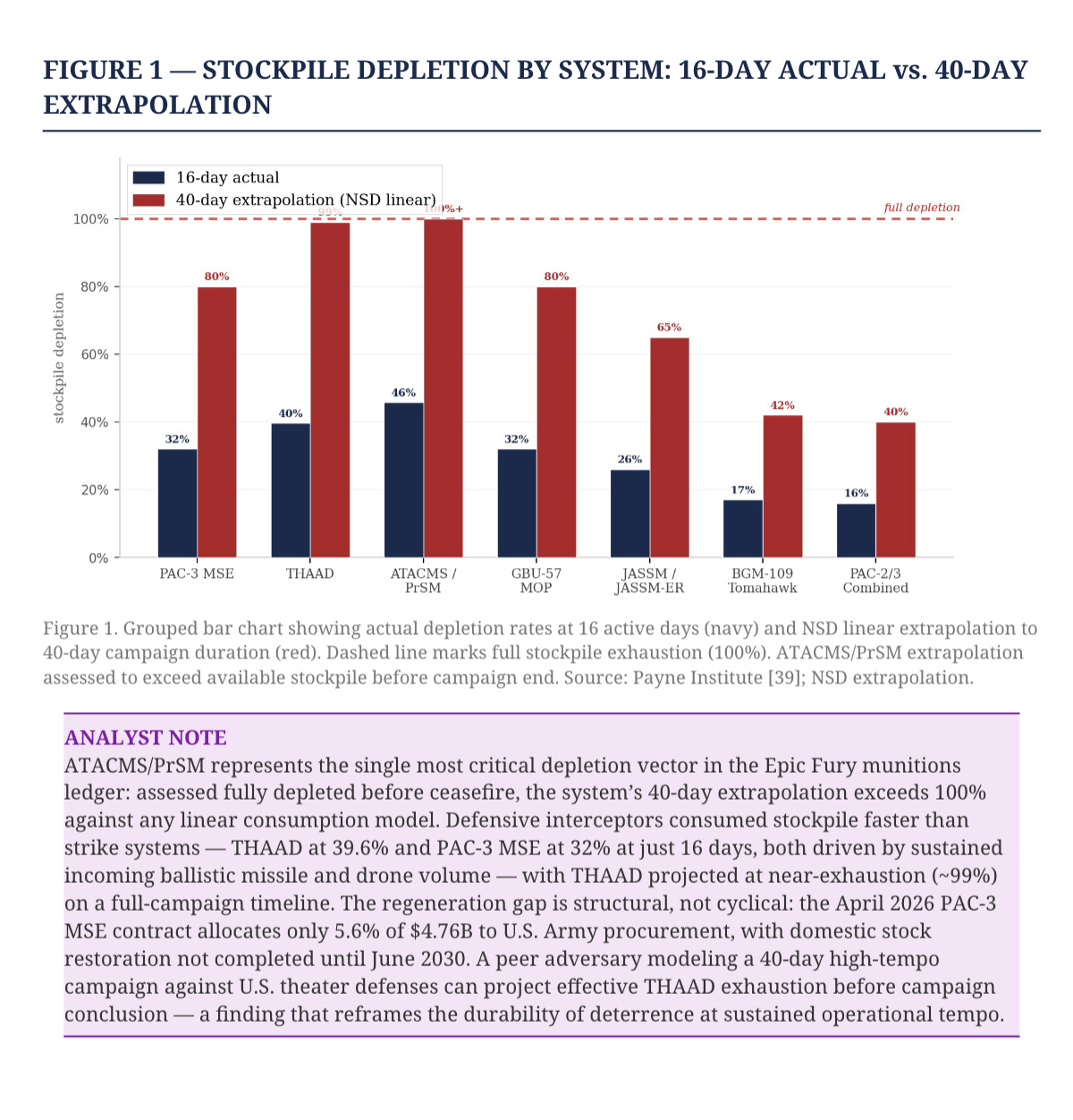
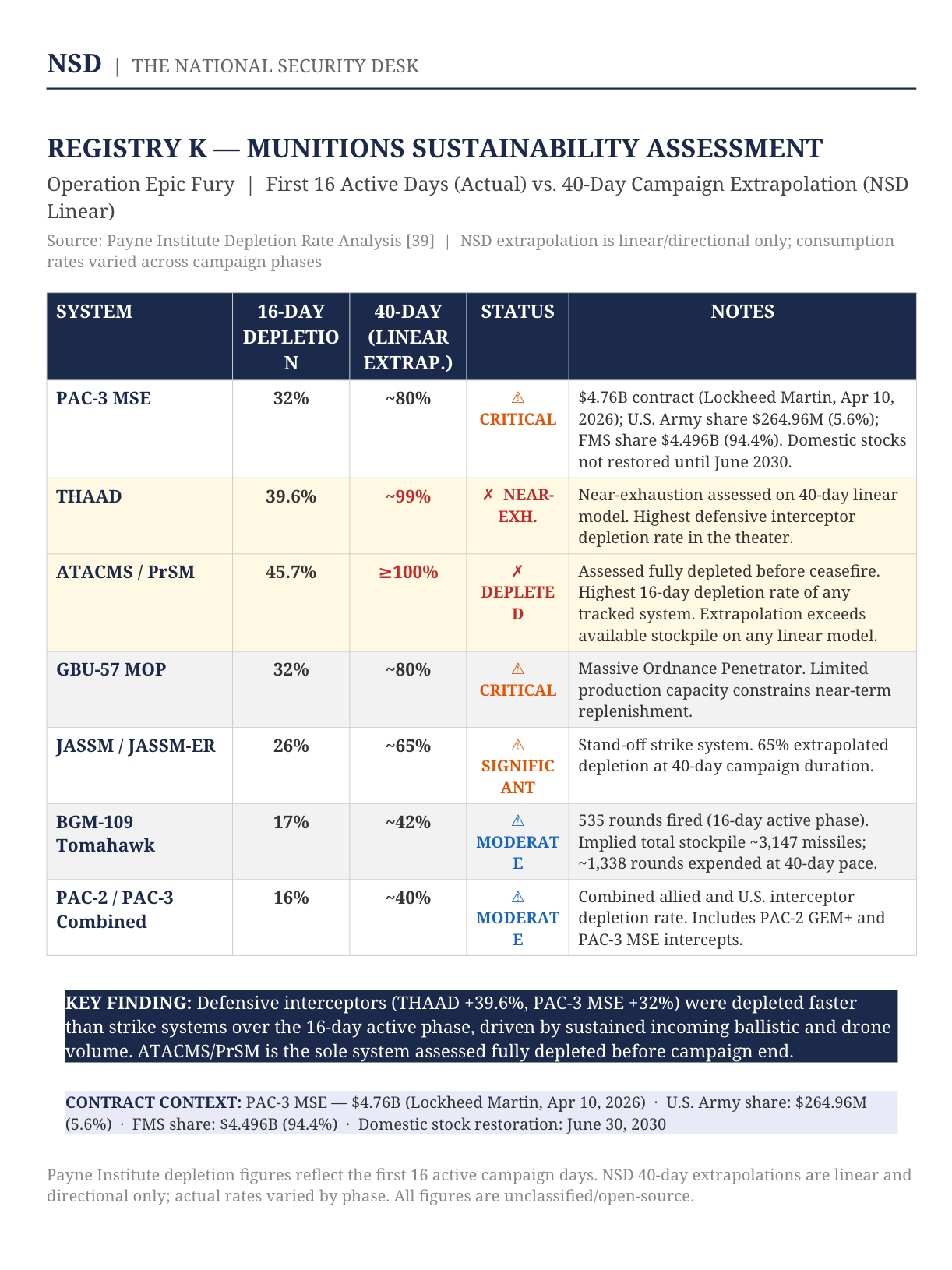
The contract follows Payne Institute analysis revealing the scale of munitions consumption in the war’s first 16 days alone. In those 16 days, allied forces depleted 32% of their PAC-3 stockpile. The U.S. expended 39.6% of its THAAD stockpile. ATACMS and PrSM: 45.7%. GBU-57 Massive Ordnance Penetrator (bunker buster): 32%. AGM-158 JASSM/JASSM-ER air-to-surface missiles: 26%. BGM-109 Tomahawk: 535 rounds fired — 17% of the total stockpile, implying a pre-war inventory of approximately 3,147 missiles. PAC-2/PAC-3 combined: 16%. [39]
The campaign ran for 40 active days, not 16. NSD applies a linear extrapolation to the 16-day rates as an illustrative baseline — noting that consumption rates varied across the campaign, with heavier offensive strikes early and heavier defensive intercept consumption sustained throughout. On that basis: THAAD stocks are assessed at approximately 99% depletion; ATACMS/PrSM likely fully exhausted before the ceasefire; PAC-3 MSE and GBU-57 at approximately 80%; JASSM/JASSM-ER at approximately 65%; Tomahawks at approximately 42% (roughly 1,338 rounds of an implied ~3,147 stockpile). These are illustrative projections. The actual figures are classified. The direction is not in dispute.
NSD applies the Schwarzkopf test. On March 5, Secretary of Defense Hegseth stated: “Our munitions are full up, and our will is ironclad, which means our timeline is ours and ours alone to control as long as it takes.” [39] The Payne Institute analysis, covering only the first 16 days of the campaign, shows that THAAD stocks were already 39.6% depleted and ATACMS/PrSM stocks were 45.7% depleted at the time Hegseth was claiming munitions were “full up.” He provided no stockpile totals, no depletion rates, no resupply timelines, and no production rate data. The gap between what the Schwarzkopf standard requires — specific counts, percentages, measurable outcomes — and what the briefing provided is itself the analytical finding
.
That finding is compounded by what was known before the war began. Weeks before the first bomb fell, Chairman of the Joint Chiefs General Dan Caine briefed the President directly on the campaign’s munitions risk. The New York Times — Haberman and Swan, drawing on reporting from the forthcoming book Regime Change — confirmed that Caine “was sober, laying out the risks and what the campaign would mean for munitions depletion.” The Washington Post reported his warning in 14 words: “We don’t have enough ammunition to win this war. It would not be pretty.” [40] The Times of Israel specifically noted that Caine’s concern extended beyond Iran: burning through air-defense munitions against Tehran would “curtail its ability to counter China in a future conflict.” Trump publicly distorted the warning, claiming on Truth Social that Caine believed the war would be “easily won.” At the April 8 ceasefire press conference — after 40 days of combat — Caine stated publicly that “we have sufficient precision munitions for the task at hand.” The Payne Institute data renders that statement difficult to reconcile with the pre-war assessment Caine himself delivered. Three data points. One arc. The Chairman warned. The Secretary dismissed. The data confirmed the Chairman. [40]
The strategic implication extends well beyond the Iran campaign. This is the key sub-story of Epic Fury that no official briefing has addressed: the United States has consumed the majority of its precision munitions inventory in a war of choice. Any conflict involving Taiwan, the Korean Peninsula, or any comparable theater that begins before June 2030 — a war the United States may be forced to fight rather than one it chooses — will open against already-depleted American magazine depth. THAAD near-exhaustion. ATACMS/PrSM likely fully consumed. PAC-3 MSE and bunker-buster stocks at approximately 80% depletion. Tomahawks at approximately 42% — consumed not by a peer competitor in a contested high-end fight, but by a 40-day campaign against an adversary whose surface navy has been described by the White House as functionally destroyed. If 40 days against Iran consumed THAAD stocks to near-exhaustion, the question Caine’s pre-war warning posed — and that no official statement has since answered — is: what does 40 days against the PLA look like?
DIPLOMATIC TRACK: ISLAMABAD COLLAPSE
The Islamabad talks produced no agreement after 21 hours of negotiations across three rounds, the second and third conducted as direct talks. The U.S. delegation — Vice President Vance, Special Envoy Witkoff, and Jared Kushner, supported by a team of approximately 300 — failed to close on any of the core issues. [5] Three U.S. red lines confirmed by ABC News: (1) ending all uranium enrichment; (2) dismantling all major enrichment facilities; (3) allowing the U.S. to retrieve any highly enriched uranium Iran possesses. [19] Iran refused all three. Tehran also demanded $6 billion in frozen assets, war reparations, a broader ceasefire including Lebanon, and the right to charge Hormuz transit tolls. Iran rejected Trump’s proposal for joint U.S.-Iranian administration of the Strait as incompatible with its sovereignty. [20]
Senior IRGC officials traveled to Islamabad during the negotiations to provide “consultation” to the Iranian delegation — a structural indicator that any deal requiring IRGC buy-in was not achievable at the political level. [5] Iranian FM Araghchi stated Tehran was “inches away from a Memorandum of Understanding” and accused the U.S. delegation of “moving the goalposts and maximalizing.” [21] Ghalibaf’s “if you fight, we will fight” statement on return to Tehran is not diplomatic boilerplate. It is a public restatement of deterrence terms for a domestic audience — and for Washington.
Vance’s departure statement framed the failure as bad news “for Iran much more than for the United States.” [5] Trump’s statement — “whether we make a deal or not makes no difference to me because we’ve won” — is not an analytical conclusion. It is a political claim made in a context where Brent crude is above $100, the Strait remains closed, the blockade is facing immediate allied defection, and the Iranian nuclear stockpile remains sufficiently enriched to be “only a short technical step away” from weapons capability according to multiple independent assessments. [22]
ALLIANCE FRACTURE
The UK and Australian announcements refusing to join the blockade, combined with the France-UK proposal for a separate Hormuz mission, represent a significant allied divergence. [3] The Soufan Center framework, applied by NSD since early in the campaign, assessed Iran’s bilateral passage deals — with Pakistan, India, China, Japan, and others — as designed explicitly to divide any U.S.-led coalition. Today that framework produced its first allied-capital-level confirmation. The divergence between the U.S. blockade and the French-UK “strictly defensive” mission is not merely tactical. It reflects two incompatible theories of how to reopen Hormuz: one through coercive interdiction, one through internationally legitimized navigation protection. Running both simultaneously from nominally aligned capitals produces incoherence that adversaries will exploit.
REGIONAL SPILLOVER
Lebanon (Operation Roaring Lion): IDF 98th Division nearing completion of the capture of Bint Jbeil; approximately 100 Hezbollah fighters killed in the operation, with 150+ confirmed to have been in the town ahead of the assault. [7] Israeli-Lebanese ambassador talks scheduled at the State Department on April 14. Total Lebanon casualties since the campaign began: 2,055+ killed, 4,640+ wounded. [11] Iran’s insistence that any ceasefire cover Lebanon remains unresolved and is likely to be an immediate obstacle in any resumed diplomatic track.
Cyber domain: Handala hacking group conducted what it described as a “significant and successful” cyberattack against UAE critical infrastructure on April 12. [23] No damage assessment available.
Regional economics: The Asian Development Bank assessed that a prolonged Middle East conflict is “the single biggest risk to the region’s outlook,” forecasting Asia-Pacific growth to slow to 5.1% in 2026–2027 with regional inflation rising to 3.6%. [24] Taiwan’s energy vulnerability under sustained Hormuz disruption — power restrictions for non-semiconductor industries — has been flagged by analysts who also noted China could use U.S. blockade logic to justify future Taiwan action as a “law enforcement operation.” [24]
═════════════════════════════════════════
CRISIS MODULE — ELEVATED
UKRAINE / RUSSIAN INVASION — DAY 1510
Both Ukrainian and Russian sources reported limited violations of Russia’s unilateral Easter ceasefire, which entered into force at 1600 local on April 11. ISW assessed the ceasefire as holding at reduced intensity but not fully observed, with a Russian war crime reported in Kharkiv Oblast during the ceasefire period. [25] Ukrainian and Russian forces conducted civilian prisoner and POW exchanges on April 11. [26]
Frontline movement remains incremental: Ukraine advanced in the Kostyantynivka-Druzhkivka area while Russian forces continued pressure near Oleksandrivka. Russia claims full control of Luhansk Oblast as of April 1; ISW assessed 99.84% actual control, with two small Ukrainian positions in the east — Nadiya and Novoyehorivka — unconfirmed as Russian-held. [27] Russia’s twelve-month territorial gain rate averages approximately 160 square miles per month. [28]
Ukraine continued deep strikes on Russian oil infrastructure on April 11. [26] The ISW assessment projects Russian forces will shift their long-range strike campaign toward Ukrainian water supply and logistics targets in the spring-summer period. [29] Russia’s adoption of Iran-style prolonged drone strike patterns — exemplified by the 700-drone two-wave launch on April 1 — reflects direct operational learning from Epic Fury. [30]
═══════════════════════════════
THE HWW ASSESSMENT: HUNGARY AS AXIS REVERSAL
The Hungarian election result is the most significant HWW development since the start of Operation Epic Fury. Under the Four Plus Two framework — Russia, China, Iran, DPRK as the Four, plus domestic authoritarian forces inside Western democracies as the Plus Two — Viktor Orbán has been the clearest example of the Plus Two in operation. His 16-year government maintained Hungary as Putin’s primary blocking agent within both the EU and NATO: vetoing Ukraine aid packages, blocking the €90 billion EU loan to Kyiv, sharing EU deliberations with Moscow, and providing political cover for the broader authoritarian axis inside the bloc’s own structures. [31]
Péter Magyar’s 138-seat supermajority ends all of that. Hungary now moves toward reintegration with EU judicial structures, constructive NATO membership, and the €90 billion Ukraine loan that Orbán’s vetoes have blocked. Magyar has committed to traveling first to Warsaw, then Vienna, then Brussels as his first acts as prime minister — a deliberately sequenced signal of which direction Hungary is pointing. [32]
The implications for the Trump political project are direct and severe. Vance campaigned alongside Orbán in Budapest last week, attacking EU “bureaucrats” and promising American “economic might” behind a Fidesz victory. [33] Trump promised concrete material support if Orbán won. Orbán did not win. Trump has offered no public comment. The absence of comment is the tell. This is not a peripheral alliance that has underperformed — it is the flagship European project of Trumpian politics, collapsed in a single evening by a record 77% voter turnout that punished everything it stood for.
MAGA’s foreign political network is not the only thing fracturing. Marjorie Taylor Greene and other prominent MAGA figures are turning on Trump over the Iran war. His domestic approval is deteriorating. The political mathematics that make the time horizon asymmetry operative — Trump’s need for a quick, clean exit before the midterm cycle — are becoming more acute with every development that is not a clean exit. Consequently, the psychological pressure on Trump’s decision-making in Epic Fury is compounding. Leaders under this configuration of pressures have historically made war decisions that are reactive rather than strategic. NSD is watching.
═════════════════════════════════════════
WATCH ITEMS
TAIWAN STRAIT / INDO-PACIFIC
Analysts flagged on April 13 that the Iran war is diverting U.S. military capability and strategic attention from Asia ahead of a potential Trump-Xi summit. [24] The case is direct: Patriot air defense systems have been redeployed toward the Middle East, the 11th MEU and Boxer ARG were rerouted from Indo-Pacific to Middle East, and magazine depth across the theater has been degraded by 39 days of combat operations. The blockade adds a new dimension: China has already cited the U.S. blockade logic as a potential template for future Taiwan-related “law enforcement operations.” This is not speculation. It is a stated framing from Chinese analysts.
The Payne Institute munitions depletion data elevates this watch item significantly. If THAAD stocks are near-exhaustion, ATACMS/PrSM fully depleted, and PAC-3 MSE at approximately 80% depletion — and the replacement contract does not complete until June 30, 2030 — then any Taiwan Strait contingency beginning before 2030 opens against American magazine depth that has been substantially consumed by the Iran campaign. The resupply timeline is not a logistics footnote. It is the strategic constraint that governs American deterrence credibility across every theater for the next four years. [39] PLAAF Taiwan ADIZ incursions remain near-zero since January 2026. Standing indicators monitored.
KOREAN PENINSULA
No significant new developments in this window. Standing indicators monitored.
CUBA
USS Nimitz SOUTHCOM exercise track ongoing. No new Trump administration statements naming Cuba as a military target beyond existing rhetorical framing. Standing indicators monitored.
═════════════════════════════════════════
ANALYSIS & OPINION
BLOCK 1 — NSD PRIOR ANALYSIS & TRACK RECORD
▸ Trump’s Blockade Makes Everything Worse [PODCAST] — MILab / NSD Podcasts · 12 April 2026 · milab.substack.com/p/trumps-blockade-makes-everything · Published the day before the blockade went live. The central finding — that blockading Iranian ports does not address the operational factors actually keeping Hormuz closed, and that the structural constraints (retired MCM ships, limited DDG magazine depth, Chinese-Russian-Iranian kill chain) make the blockade unsustainable alone — was directly confirmed today as the UK and France refused to join and the IRGC immediately characterized the blockade as a ceasefire violation. The piece introduced Scenario F (opening the Strait for all nations) as the only NSD-originated pathway from strategic defeat to a draw, at 5% probability. Today’s events are evidence that the probability of Scenario F is declining, not rising. [CONFIRMED / STRENGTHENED]
▸ TR-002 — Time Horizon Asymmetry (published Day 1; formalized 11 March 2026) — milab.substack.com/p/leaked-document-tehrans-war-plan · Today’s blockade announcement and Islamabad collapse together constitute the clearest single-day confirmation of TR-002 since Epic Fury began. Trump required a diplomatic off-ramp from Islamabad; Iran used Islamabad to confirm that its terms are unchanged. Trump then escalated to a blockade that his closest allies immediately declined to support. This is not a sequence of unrelated events. It is the time horizon asymmetry expressing itself: Iran prolonging, Trump escalating without a clean exit, the political clock accelerating. [CONFIRMED / STRENGTHENED]
▸ TR-007 — NSD January 2024 Iran Strike Plan (limited maritime strike without triggering Hormuz closure) — milab.substack.com/p/how-to-stop-iran · The blockade announcement, and the coalition fracture it immediately produced, continues to validate the January 2024 counterfactual: the limited maritime strike NSD proposed was designed precisely to avoid the strategic position the United States now occupies — a closed Strait, a fractured coalition, a ceasefire under acute stress, and a blockade that even close allies will not join. The plan that was not executed produced the outcome it warned against. [STANDING REFERENCE]
BLOCK 2 — EXTERNAL ANALYSIS
▸ Reuters · “US blockade of Iran will be major military endeavor, experts say” · Phil Stewart · al-monitor.com/originals/2026/04/us-blockade-iran-will-be-major-military-endeavor-experts-say · 12 April 2026 · Stroul and Roughead assessments align with NSD’s operational sustainability analysis; Roughead’s specific warning about Iranian countermoves against Gulf state infrastructure hosting U.S. forces is directly relevant to the Scenario 4 command-fragmentation track.
▸ JINSA · “Operation Epic Fury: A Work in Progress” · jinsa.org/jinsa_report/operation-epic-fury-a-work-in-progress/ · 11 April 2026 · Benchmark-not-met assessment provides the most granular available challenge to White House claims of decisive degradation; JINSA’s launch table data remains the primary source for NSD’s denominator testing of official metrics.
▸ Time Magazine · “Why the Iran-U.S. Peace Talks Failed” · time.com/article/2026/04/13/iran-US-peace-talks-islamabad-war-nuclear/ · 13 April 2026 · Detail on joint Strait administration rejection and IRGC negotiating stance; confirms Iranian refusal to concede on Strait sovereignty regardless of other potential terms.
═════════════════════════════════════════
NSD ANALYTICAL ASSESSMENT
KEY DRIVING ASSUMPTION — EPIC FURY
The campaign’s decisive terrain is not kinetic. It is the asymmetry between two incompatible time horizons operating simultaneously.
Trump requires a short, concludable war. His constraints are structural and non-negotiable: the 2026 midterm cycle, domestic energy prices (gasoline now at $4.13/gallon and rising with today’s oil shock), a $200 billion supplemental navigating a fractured Congress, and a political brand built on ending wars rather than conducting them. The faster he can declare victory and frame the campaign as concluded, the more of those constraints he neutralizes.
The IRGC requires the opposite. Its victory condition — as NSD’s red-team exercise identified on Day 11 — is not military. It is political: deny Trump a clean, convincing exit. A war that drags into summer, with oil above $100, coalition allies publicly declining to participate in U.S. escalation, and no credible endstate visible, is an Iranian strategic success regardless of how many launchers CENTCOM has destroyed.
Today’s evidence assessed against this assumption: the assumption is holding with increasing strength. The Islamabad collapse, the blockade announcement, the UK-France defection, the Hungary political shock, and Trump’s own acknowledgment of midterm electoral vulnerability [9] all operate on the same axis. The clock is running. Iran is watching it run.
ANTICIPATORY WORST-CASE SCENARIO UPDATES
SCENARIO 1 — PRESIDENTIAL PROXIMITY TO NUCLEAR RELEASE AUTHORITY: Elevated to highest-priority watch status in SITREP 22 and carried forward as the most dangerous scenario in this framework. A president who issued a public genocide threat against 90 million Iranians ten days ago — who has publicly stated the war must not end before the midterms, whose domestic political base is visibly fracturing, whose flagship European political project collapsed overnight, and who has now escalated to a naval blockade his closest allies declined to join — retains sole constitutional authority to authorize nuclear weapons employment. No institutional constraint introduced since Day 1 has materially altered that authority. The structural conditions making this scenario non-trivial have not receded. They have intensified. Today’s developments — Islamabad collapse, blockade announcement, Hungary political shock, MTG and MAGA base turning against him, Trump’s own acknowledgment of midterm electoral vulnerability — all compound on a single axis: a principal with no clean exit, no credible victory declaration, a shrinking support base, a war he cannot end, and unfettered nuclear release authority. The three leaders whose political survival depends on the war’s continuation are the three principals whose agreement is required to end it. That is the pathway to nuclear employment against a non-nuclear adversary, and it is why this scenario remains at Scenario 1. Probability: REMOTE to UNLIKELY — elevated above baseline by compounding structural pressure on the principal with sole release authority. Consequence: CIVILIZATIONAL. 72-hr outlook: Monitor any Trump statement on nuclear use or escalation ceiling; any CENTCOM or STRATCOM command changes; any procedural 25th Amendment development inside Congress or Cabinet. Watch status: ACTIVE — HIGHEST PRIORITY.
SCENARIO 2 — DRONE STRIKE ON CONUS PRINCIPAL: No new drone incursions at Fort McNair or comparable CONUS installations reported in this window beyond the established March baseline. The underlying vulnerability — no arrests, no attributed drones, no structural remediation — is unchanged. The IRGC’s characterization of the blockade as illegal, combined with Rezaei’s assertion that Iran retains “major untouched levers,” maintains the scenario at standing elevated watch status. Probability: LOW. Consequence: CATASTROPHIC. 72-hr outlook: No specific indicator of imminent action; standing vulnerability unresolved. Watch status: ACTIVE.
SCENARIO 3 — SUCCESSFUL CARRIER MISSION-KILL: The blockade announcement increases the probability weight of this scenario. The DDG transit on April 11 established that U.S. surface assets can enter the Strait under current conditions. A carrier transit in support of blockade enforcement, or any visible drawdown of naval assets framed as a “winding down” signal, approaches the trigger condition identified in NSD’s red-team exercise for Iran’s Option X deployment. The Payne Institute munitions data now provides specific quantification of the magazine depth constraint NSD identified in the original red-team exercise: DDG sustainability in a major engagement is constrained by VLS cells that cannot be replenished at the rate they would be consumed in a coordinated Iranian saturation strike. THAAD near-exhaustion means the layered air defense architecture protecting carrier strike groups is operating on depleted stocks. Chinese satellite ISR supporting Iranian targeting architecture remains active per ISW March 26 assessment. Probability: LOW-MEDIUM, ELEVATED from prior assessment. Consequence: CATASTROPHIC. 72-hr outlook: Watch for any carrier repositioning toward Arabian Gulf approaches in support of blockade enforcement. Watch status: ACTIVE.
SCENARIO 4 — RADIOLOGICAL OR ENVIRONMENTAL INCIDENT AT NATANZ: No new strikes on nuclear facilities during the ceasefire period (April 8–13). Independent experts assess Iran’s HEU stockpile as requiring minimal additional technical processing to reach weapons-grade material. [22] IAEA access remains constrained by the conflict environment. The blockade does not directly raise the probability of a radiological incident unless it triggers resumed strikes on nuclear facilities. 72-hr outlook: Monitor resumed strike reporting; any Trump statement ordering air operations against enrichment facilities is the primary trigger indicator. Probability: LOW. Consequence: EXISTENTIAL to campaign’s international legitimacy. Watch status: ACTIVE.
SCENARIO 5 — IRGC COMMAND FRAGMENTATION PRODUCING UNCONTROLLED ESCALATION: Mojtaba Khamenei has now been absent from any confirmed public video, audio, or photograph for 44 days. He is participating in meetings via audio conference only. Sources describe him as “mentally sharp” but recovering from severe facial disfigurement and a significant leg injury. [34] IRGC is assessed as “the dominant voice on strategic decisions during the war.” [35] The IRGC’s autonomous decision to bar two Qatari LNG tankers from Hormuz transit on April 6 — in defiance of the U.S.-Iran Pakistan-brokered passage agreement — is the clearest indicator of autonomous IRGC action exceeding political direction. The blockade will test IRGC restraint further. Probability: LOW-MEDIUM and rising with each day Mojtaba’s command authority remains unconfirmed. Consequence: CATASTROPHIC. 72-hr outlook: Monitor any IRGC operational action in response to the blockade that visibly exceeds political authorization; Mojtaba audio or video appearance would be analytically significant in either direction. Watch status: ACTIVE.
CLOSING ANALYTICAL NOTE
The scenarios above are not predictions. They are the analytical obligations of anticipatory intelligence — named here because naming them before they occur is the purpose of this brief. All are assessed against the time horizon asymmetry framework established on Day 1 and formalized in NSD’s Day 11 red-team exercise. New indicators will be assessed in SITREP 25.
Standing reference: “Trump’s Blockade Makes Everything Worse” — NSD/MILab, 12 April 2026
milab.substack.com/p/trumps-blockade-makes-everything
Standing reference: “The ‘Leaked’ Document: Tehran’s War Plan for Regime Change in Washington” — NSD/MILab, 11 March 2026
milab.substack.com/p/leaked-document-tehrans-war-plan [TR-002]
Standing reference: “A Hybrid World War” — NSD/MILab, 23 October 2023
milab.substack.com [HWW-1]
═════════════════════════════════════════
LEADER LOCATOR — Confirmed Locations as of 13 April 2026
▸ TRUMP, Donald · President, United States · White House, Washington DC · Announced blockade via Truth Social April 12; addressed reporters. · CONFIRMED [12]
▸ VANCE, JD · Vice President / Lead Iran Negotiator · Departed Islamabad April 12; en route to or arrived Washington DC. · CONFIRMED [5]
▸ WITKOFF, Steve · Special Envoy · Islamabad April 11–12; departed with Vance. · CONFIRMED [5]
▸ KUSHNER, Jared · Presidential Adviser · Islamabad April 11–12; departed with Vance. · CONFIRMED [5]
▸ RUBIO, Marco · Secretary of State · Fort McNair / State Department, Washington DC · Assessed based on Vance statement of 21+ hours of consultations. · ASSESSED [5]
▸ HEGSETH, Pete · Secretary of Defense · Pentagon / Fort McNair, Washington DC · Confirmed at April 8 press conference; no new location signal April 13. · CONFIRMED (Apr 8); ASSESSED (Apr 13) [11]
▸ ARAGHCHI, Abbas · Iranian Foreign Minister · Tehran · Returned from Islamabad; spoke with Saudi FM April 13. · CONFIRMED [21]
▸ GHALIBAF, Mohammad Bagher · Iranian Parliament Speaker / Delegation Head · Tehran · Returned from Islamabad; made public deterrence statement to domestic and international audiences. · CONFIRMED [5]
▸ PEZESHKIAN, Masoud · Iranian President · Tehran · Participated in war/ceasefire management; spoke with Putin April 12. · CONFIRMED [36]
▸ MOJTABA KHAMENEI · Supreme Leader, Iran · UNKNOWN · No confirmed video, audio, or photograph in 44+ days; participating via audio conference only; assessed in secure facility; location unknown. · UNKNOWN / ASSESSED [34]
▸ PUTIN, Vladimir · Russian President · Kremlin, Moscow · Phone call with Pezeshkian April 12 on regional stability. · CONFIRMED [36]
▸ NETANYAHU, Benjamin · Prime Minister, Israel · Israel · Military campaign in Lebanon continuing; Lebanon talks scheduled at State Department April 14. · CONFIRMED [7]
▸ MACRON, Emmanuel · French President · Paris · Phone call with Pezeshkian April 12; announced France-UK Hormuz conference April 13. · CONFIRMED [3]
▸ STARMER, Keir · Prime Minister, United Kingdom · London · Stated UK will not join blockade on BBC Radio 4, April 13. · CONFIRMED [3]
▸ MERZ, Friedrich · Chancellor, Germany · Berlin · Announced fuel tax cut April 13. · CONFIRMED [10]
▸ DAR, Ishaq · Pakistan Foreign Minister / Mediator · Islamabad · Remained after U.S. and Iranian delegations departed; called on both sides to maintain ceasefire. · CONFIRMED [37]
▸ XI JINPING · General Secretary / President, China · ASSESSED Beijing · Confirmed Chinese involvement in ceasefire mediation; no specific location signal in 24-hour window. · ASSESSED [38]
▸ KALLAS, Kaja · EU High Representative for Foreign Affairs · UNKNOWN · No confirmed location signal in last 24 hours.
▸ VON DER LEYEN, Ursula · President, European Commission · UNKNOWN · Issued statement on Hungary election result; no specific location confirmed.
▸ RUTTE, Mark · NATO Secretary General · UNKNOWN · No confirmed location signal in last 24 hours.
▸ KIM JONG-UN · Supreme Leader, DPRK · UNKNOWN · No KCNA-confirmed appearance in this window.
═════════════════════════════════════════
The National Security Desk offers these posts freely, but your support is necessary and appreciated. Please subscribe, paid if you’re able, or leave a tip.
Thank you

STANDING DATA ANNEX — REGISTRIES A–M
NSD_EF-20260413-SITREP24 | Sources: Research Engine v1.4 | April 13, 2026
REGISTRY A — DUAL CULMINATION TRACKER
Metric | Value | Source | Date
Iranian BM launchers destroyed/remaining | 450+ destroyed / est. 20–47 remaining (~4–10% of pre-war 470 baseline) | White House | Apr 8
Iranian BMs launched (cumulative) | ~2,131 total; est. ~273 directed at Israel (12.8%) | JINSA 4/7; INSS/JPost | Apr 7; Mar 10
Iranian drone launches (cumulative) | ~5,029; UAE ~2,414 (48%); Kuwait ~562; Israel ~392 | JINSA 4/7 | Apr 7
US targets struck (cumulative) | 13,000+ (2,000+ C2; 1,450+ defense/DIB; 1,500+ air defense; 700+ mine systems; 800+ drone; 600+ naval; 450+ BM targets) | White House/CENTCOM | Apr 8
US combat sorties (cumulative) | 10,200+ (White House); 13,000 TWZ tracking | White House; TWZ | Apr 8; Apr 11
US casualties (cumulative) | 13 KIA, 381 WIA (344 returned to duty; 10 seriously wounded) | Military Times/CENTCOM | Apr 8
White House “85%+ destroyed” claim | “85%+ of ballistic missiles, launcher vehicles, and long-range drones destroyed” | White House | Apr 8
JINSA benchmark assessment | “Many benchmarks not met” | JINSA | Apr 10
US $200B supplemental | Introduced/pending; no new vote found | — | —
Iranian nuclear enrichment | HEU stockpile described as “only a short technical step away” from weapons capability | Multiple independent experts | Apr 13
REGISTRY B — ENERGY / ECONOMIC PRESSURE
Metric | Value | Source | Date
Brent crude | $102.26/barrel (up 6.95% on blockade announcement; range $101.43–$103.88) | OilPriceAPI / Investing.com | Apr 13
WTI crude | $96.57–$104.73/barrel (up ~8%) | OilPriceAPI / Investing.com | Apr 13
US avg retail gasoline (AAA) | $4.125/gallon (national average) | AAA | ~Apr 10–13
RBOB gasoline futures | $3.17/gallon (up 4.52%) | Trading Economics | Apr 13
TTF natural gas | €47.27/MWh (blockade reversing ceasefire-driven decline) | OilPriceAPI | Apr 13
Henry Hub | $2.70/MMBtu (up 2% on day; largely insulated from Middle East risk) | Trading Economics | Apr 13
US inflation | 3.3% March (up from 2.4% February; primarily energy-driven) | — | Apr 13
US SPR level | ~413 million barrels (lowest since mid-1980s) | DOE/World Oil | Apr 10–12
Goldman Sachs warning | 400M barrel SPR release “may be insufficient” to cover Hormuz disruption; potential shortfall >10M bpd | Fox Business; EIA | Apr 2026
EIA forecast | Brent average $103 March; peak Q2 $115/barrel; gasoline peak $4.30/gal April average | EIA STEO | —
Brent since war start | Up 40% since Feb 28; WTI up 50%+ from pre-war ~$70/barrel | OilPriceAPI | Apr 13
REGISTRY C — CONUS / OCONUS DRONE INCURSIONS
Fort McNair (Washington DC): Multiple unidentified drones over Army base housing SecState Rubio and Secretary of Defense Hegseth, mid-to-late March. No arrests. No attribution. No structural remediation confirmed.
MacDill AFB (Tampa, FL — CENTCOM HQ): Two security incidents within one week (~March 18 timeframe): suspicious package (FBI); separate shelter-in-place order.
NORTHCOM FAK deployment: 1 operational; 2 more due April 2026. No new update.
New CONUS incidents (April 11–13): None reported.
REGISTRY D — CARRIER / NAVAL FORCE POSTURE
Asset | Status / Position | Source | Date
USS Gerald R. Ford (CVN-78) | Eastern Mediterranean, SW of Cyprus; primary blockade enforcement asset; approaching ~11-month deployment | TWZ Apr 12 | Apr 12
USS George H.W. Bush (CVN-77) | Lead elements transited Gibraltar early April; estimated arrival CENTCOM AOR mid-to-late April | TWZ Apr 12 | Apr 12
USS Abraham Lincoln (CVN-72) | Arabian Sea; primary blockade enforcement asset; DDG Petersen conducted Hormuz transit April 11 | TWZ Apr 3 | Apr 3
USS Tripoli (LHA-7) / 31st MEU | CENTCOM AOR (~3,500 sailors and Marines) | TWZ Apr 3 | Apr 3
USS Boxer ARG / 11th MEU | Transiting Pacific westbound toward Middle East; estimated arrival mid-to-late April | TWZ Apr 12 | Apr 12
US personnel in region (total) | 50,000+ | CENTCOM | Apr 8
Iranian naval vessels remaining | Functionally zero; 155+ destroyed or damaged; all submarines sunk | White House; CENTCOM | Apr 8
MCM vessels in theater | USS Santa Barbara (LCS-32) + USS Canberra (LCS-30) with MCM packages; USS Petersen + USS Murphy conducting mine-clearing ops; Knifefish UUVs to join; seven guided-missile destroyers in Arabian Sea independently | DefenseScoop; Task & Purpose | Apr 11–12
REGISTRY E — IRANIAN COMMAND AUTHORITY
Mojtaba Khamenei (Supreme Leader): Severe facial disfigurement; significant leg injury (U.S. intel: believed to have lost a leg). Recovering; described as “mentally sharp.” Audio-conferencing only. No public video, audio, or photograph in 44+ days. IRGC dominant voice on strategic decisions. Location: assessed secure facility; unknown. First written statement: March 12 (read by TV anchor). Sources: Reuters/Al-Monitor Apr 11.
Pezeshkian (President): Spoke with Putin April 12. Participating in war/ceasefire management. Statements have diverged from IRGC hardline on occasion.
Araghchi (Foreign Minister): Led Islamabad technical discussions; stated Tehran was “inches away” from MoU. Spoke with Saudi FM April 13. Active on Telegram.
Ghalibaf (Parliament Speaker): Returned to Tehran from Islamabad; “If you fight, we will fight.”
IRGC field commanders: Warned April 12–13 that any blockade violates ceasefire. Restated Bab-el-Mandeb closure threat. Autonomously barred Qatari LNG tankers April 6 in defiance of passage agreement. Demonstrating autonomous action beyond political direction.
Senior Iranian figures killed: JINSA April 7 — no new senior assassinations in reporting period.
REGISTRY F — CIVILIAN IMPACT / POLITICAL SUSTAINABILITY
Metric | Value | Source | Date
Iranian civilian casualties | Iran health ministry: 2,000+ killed, 20,000+ wounded; AP: 3,000+ total dead in Iran | Military Times; AP | Apr 8; Apr 13
Lebanon casualties | 2,055+ killed, 4,640+ wounded (includes Hezbollah fighters) | JINSA 4/7; AP | Apr 7; Apr 13
Israeli casualties | 23 killed since Feb 28 | AP | Apr 13
Gulf Arab state casualties | More than a dozen killed since Feb 28 | AP | Apr 13
US servicemember WIA (non-KIA) | 15 lightly wounded at Ali Al Salem Air Base, Kuwait, April 6 | JINSA 4/7 | Apr 7
REGISTRY G — HWW CROSS-THEATER
Hungary election (April 12): Orbán/Fidesz defeated in historic landslide; Magyar/Tisza wins 138/199 seats (53.6% of vote); record 77% turnout. Orbán conceded. Vance had traveled to Budapest in the days immediately preceding the election to campaign for Orbán; Trump issued no public comment after the result.
HWW implications: Orbán was the Four Plus Two’s most institutionally positioned actor inside the EU and NATO — blocking Ukraine aid, vetoing the €90B EU loan, and providing Russia with an internal EU veto capability. His removal eliminates all of those functions simultaneously. Hungary’s return to constructive EU/NATO membership is assessed as likely under Magyar’s stated commitments.
Russia-Iran ISR nexus: Russian satellites conducted 24+ surveys across 11 Middle East countries March 21–31, covering 46 targets including U.S. bases, airports, and oilfields; Iranian strike targeting followed within days of Russian imagery collection. Russian and Iranian hacker groups coordinating cyberattacks and sharing techniques.
China: Confirmed as involved in Iran ceasefire mediation. Chinese-flagged tanker among first vessels to transit Hormuz post-ceasefire. Analysts flagged China’s potential use of U.S. blockade logic as template for Taiwan action.
REGISTRY H — RUSSIAN ECONOMIC / UKRAINE ENERGY
Russian Urals crude: Assessed well above $59/barrel budget floor due to Epic Fury price spike.
US sanction waiver on Russian oil in transit: Expired April 11; status of extension unclear. No new reporting found.
ISW assessment: Russian forces likely to shift long-range strike campaign toward Ukrainian water supply and logistics targets in spring-summer 2026.
REGISTRY I — JINSA LAUNCH TABLE (FINAL PRE-CEASEFIRE)
Day 36 (Apr 4): 44 BMs, 19 UAE / 31 Kuwait drones. Day 37 (Apr 5): 27 BMs, 50 UAE / 31 Kuwait drones. Day 38 (Apr 6): 44 BMs, 46 Kuwait / 19 UAE drones. Day 39 (Apr 7): 21 BMs (partial), 22+ Saudi drones. Day 40+ (Apr 8–13): CEASEFIRE — zero launches confirmed.
Cumulative (JINSA 4/7 at 11am): ~5,029 drones; ~2,131 ballistic missiles; ~58 cruise missiles.
Trend: Daily BM rate declined from 480 (Day 1) to 21–44 (final active days); down ~92% from Day 1 to Day 10; partial recovery Days 35–38 before ceasefire. “One and two at a time” characterization by Adm. Cooper does not align with 21–44 launches per day in final active period.
REGISTRY J — LNG / GAS CRISIS
QatarEnergy Ras Laffan: Trains 4 and 6 offline; 3–5 year recovery estimate (Rystad Energy); $20B/year revenue loss. Work to restart began April 8 (post-ceasefire). Qatari LNG tankers denied Hormuz transit April 6 by IRGC in defiance of passage agreement.
Stranded vessels: 14 laden LNG cargoes trapped in Gulf (early April); 230 loaded oil tankers waiting inside Gulf (ADNOC CEO, April 9).
JKM (Asian LNG benchmark): Last confirmed high-USD $18s/MMBtu (week of Mar 9–13); war peak ~$43/MMBtu.
Goldman stress scenario: JKM toward $80/MMBtu under extended Hormuz closure.
European storage: AGSI+: 29.0% full as of March 13 (18.5% below year-on-year; 30.4% below 5-year average).
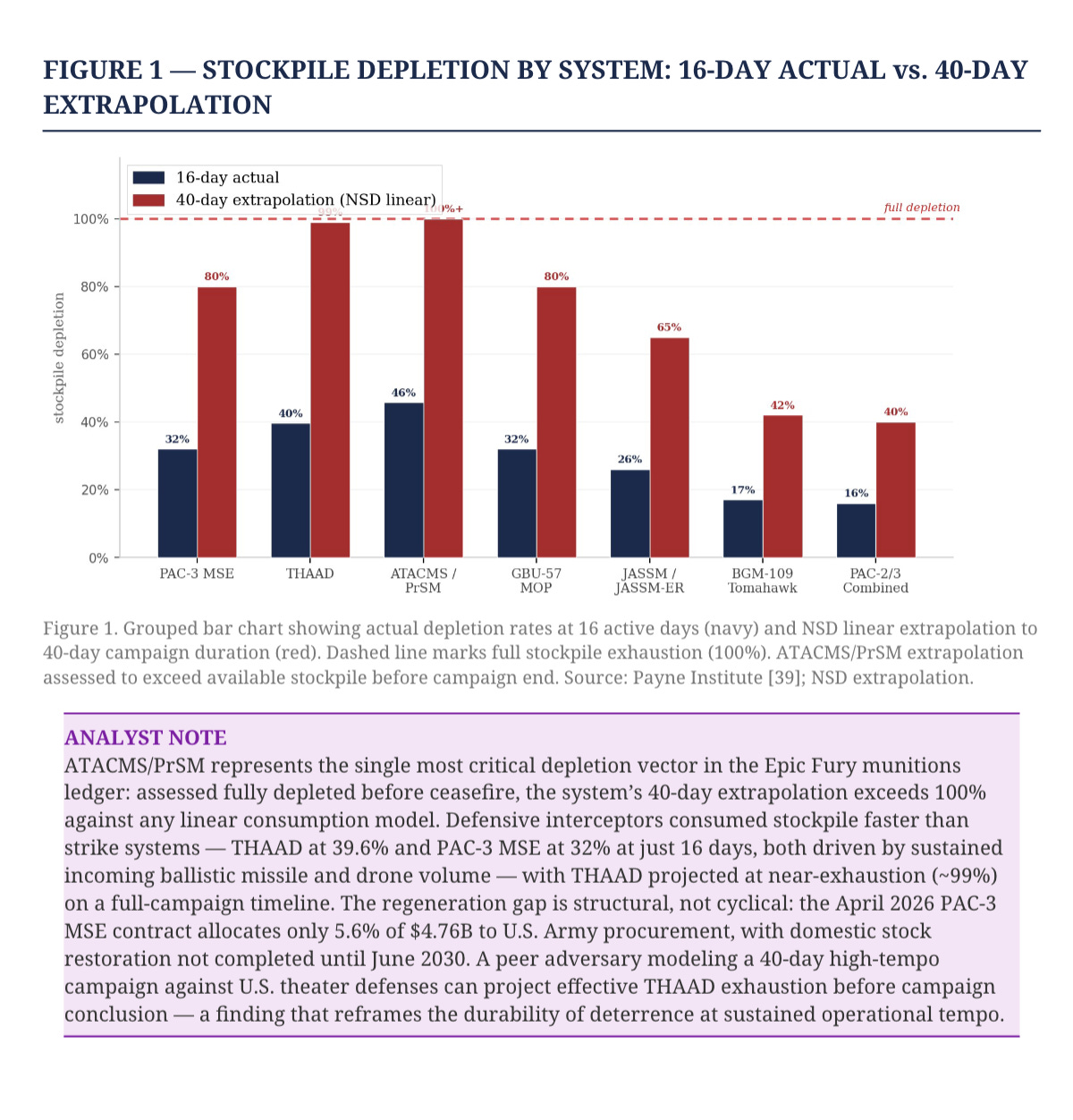
REGISTRY K — EXCHANGE RATIO / MUNITIONS SUSTAINABILITY
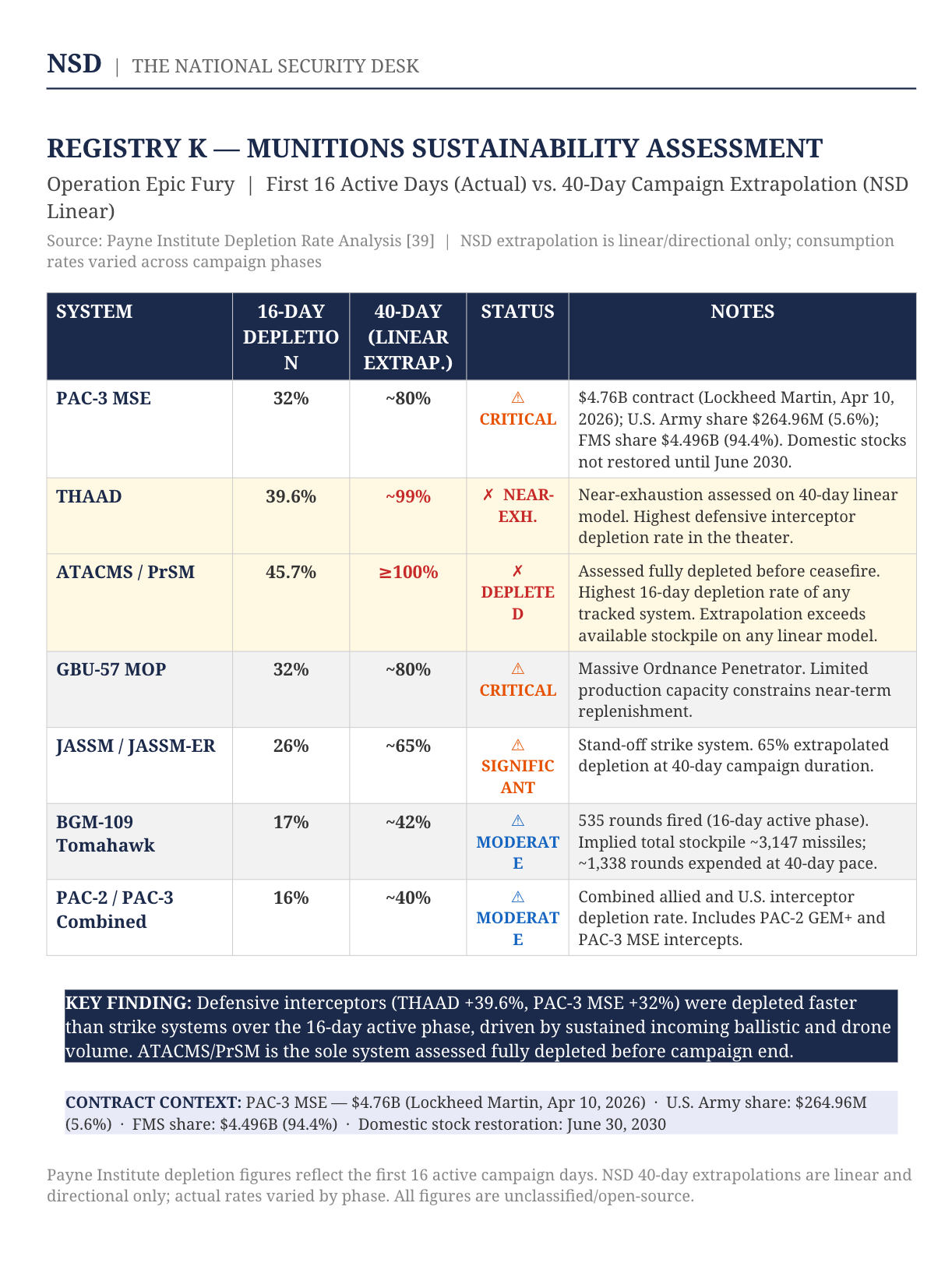
PAYNE INSTITUTE: DEPLETION RATES — FIRST 16 ACTIVE DAYS [39]
PAC-3 MSE: 32% of allied stockpile depleted
THAAD: 39.6% of U.S. stockpile depleted
ATACMS / PrSM: 45.7% of U.S. stockpile depleted
GBU-57 Massive Ordnance Penetrator: 32% depleted
AGM-158 JASSM / JASSM-ER: 26% depleted
BGM-109 Tomahawk: 535 rounds fired = 17% of stockpile (implied total stockpile: ~3,147 missiles)
PAC-2 / PAC-3 combined: 16% depleted
NSD ILLUSTRATIVE EXTRAPOLATION TO 40-DAY CAMPAIGN (linear; note: consumption rates varied; directional only):
THAAD: ~99% (assessed near-exhaustion)
ATACMS / PrSM: ~100%+ (assessed fully depleted before ceasefire)
PAC-3 MSE: ~80%
GBU-57: ~80%
JASSM / JASSM-ER: ~65%
Tomahawk: ~42% (~1,338 rounds expended of ~3,147 implied stockpile)
PAC-2 / PAC-3 combined: ~40%
CONTRACT CONTEXT:
$4.76B PAC-3 MSE contract (Lockheed Martin, awarded April 10, 2026)
U.S. Army FY2026 procurement share: $264.96M (5.6% of contract)
Foreign military sales share: $4.496B (94.4% of contract)
Contract completion: June 30, 2030
Implication: U.S. domestic PAC-3 MSE stocks not restored at scale until 2030
US aircraft losses: 39 destroyed over 39-day campaign; 10 additional damaged. MQ-9 Reapers: 60%+ of losses (up to 24 destroyed). Fighters: 4 F-15E Strike Eagles, 1 A-10 Warthog. KC-135 damaged.
NSD denominator note: 21–44 launches/day in final active period is not consistent with “one and two at a time” characterization or “8% residual capability” language. See Registry A for JINSA benchmark assessment and supplemental status.
REGISTRY L — MINE COUNTERMEASURES
Iranian mines: White House: 97% of pre-war inventory eliminated; 700+ mine systems struck. Pre-war inventory estimated at 2,000–6,000. Iran has lost track of some mines (drifted). NSD denominator flag: “700 mine systems struck” from a 6,000 unit inventory = 88% not yet struck at the high estimate.
MCM assets: USS Santa Barbara (LCS-32) + USS Canberra (LCS-30) with MCM packages. Knifefish UUV (General Dynamics) joining clearance effort. RFA Lyme Bay (Royal Navy) preparing as minehunting mothership for hundreds of undersurface drones (separate from blockade; UK participation on mine clearance track appears distinct from blockade refusal).
Gap: Four Avenger-class dedicated minesweepers departed Bahrain one month before Epic Fury began; two of three LCS replacements subsequently repositioned to Singapore.
REGISTRY M — DRONE PRODUCTION / SUSTAINABILITY
Iran’s Shahed-derivative drone program: Estimated 5,029 total drones launched over 39 active campaign days (~129/day average). No confirmed production rate update in this window.
Russia: Adoption of Iran-style prolonged drone strike patterns confirmed (700-drone two-wave launch April 1). Direct operational learning from Epic Fury assessed.
DPRK: Shahed-derivative drone technology assessed under study by North Korea in Epic Fury context.
═════════════════════════════════════════
The National Security Desk offers these posts freely, but your support is necessary and appreciated. Please subscribe, paid if you’re able, or leave a tip.
Thank you
ENDNOTES
[1] AP / Audacy · “US military says it will blockade Iran’s ports as ship traffic appears to halt in Strait of Hormuz” · https://www.audacy.com/971talk/news/world/iran-us-israel-trump-lebanon-blockade-hormuz-april-13-2026-ed7a6cd4bc61dc47f317a2c82afcc1c9 · April 13, 2026
[2] Al Jazeera (live blog) · “Iran war live: US military says it will block Iranian traffic in Hormuz” · https://www.aljazeera.com/news/liveblog/2026/4/13/iran-war-live-us-military-to-block-iranian-port-traffic-in-hormuz-strait · April 13, 2026
[3] ABC7 LA (live updates) / Times of Israel (live blog) · “Iran war blockade updates — Starmer; Macron defensive mission” · https://abc7.com/live-updates/iran-war-strait-hormuz-ceasefire-trump-stock-market/18847792/ · April 13, 2026
[4] Trading Economics / OilPriceAPI / Investing.com · “Brent crude; WTI; RBOB gasoline futures” · https://tradingeconomics.com/commodity/gasoline · April 13, 2026
[5] AP (via Audacy) · “US military says it will blockade Iran’s ports” (Islamabad talks; Ghalibaf; Vance departure statement) · https://www.audacy.com/971talk/news/world/iran-us-israel-trump-lebanon-blockade-hormuz-april-13-2026-ed7a6cd4bc61dc47f317a2c82afcc1c9 · April 13, 2026
[6] Al Jazeera · “Peter Magyar wins Hungary election, unseating Viktor Orban after 16 years” · https://www.aljazeera.com/news/2026/4/12/hungary-election-early-results-show-magyars-tisza-ahead-of-orbans-fidesz · April 12–13, 2026
[7] Times of Israel (live blog April 13) · “As US military set to blockade Iranian ports, Tehran says move amounts to piracy” · https://www.timesofisrael.com/liveblog-april-13-2026/ · April 13, 2026
[8] DefenseScoop / Task and Purpose · “Navy to use underwater drones to help clear Iranian mines from Strait of Hormuz” · https://defensescoop.com/2026/04/11/strait-of-hormuz-mine-clearance-navy-centcom-underwater-drones/ · April 11–12, 2026
[9] Reuters / Al-Monitor · “US blockade of Iran will be major military endeavor, experts say” · By Phil Stewart · https://www.al-monitor.com/originals/2026/04/us-blockade-iran-will-be-major-military-endeavor-experts-say · April 12, 2026
[10] Times of Israel (live blog April 13) / CNN (live blog) · “Germany fuel tax cut; US inflation March” · https://www.timesofisrael.com/liveblog-april-13-2026/ · April 13, 2026
[11] CENTCOM / White House April 8 press conference · “Operation Epic Fury cumulative statistics; US casualties” · defense.gov/News/Transcripts · April 8, 2026
[12] Trump (Truth Social, cited by Times of Israel live blog) · “Blockade announcement” · https://www.timesofisrael.com/liveblog-april-13-2026/ · April 12, 2026
[13] Reuters / Al-Monitor · “US blockade of Iran will be major military endeavor, experts say” · By Phil Stewart (Dana Stroul; Ret. Adm. Gary Roughead) · https://www.al-monitor.com/originals/2026/04/us-blockade-iran-will-be-major-military-endeavor-experts-say · April 12, 2026
[14] CNN (live blog) · “Iran war news; US to blockade ships from Iranian ports” · https://edition.cnn.com/2026/04/13/world/live-news/iran-us-war-trump-hormuz · April 13, 2026
[15] AP / Audacy · “US military says it will blockade Iran’s ports” (Rezaei statement) · April 13, 2026
[16] Axios · “U.S. warships cross Strait of Hormuz for first time since Iran war began” · https://www.axios.com/2026/04/11/us-iran-navy-strait-of-hormuz · April 11, 2026
[17] Washington Times · “Navy, allies begin mine-clearing operations in Strait of Hormuz as blockade takes shape” · https://www.washingtontimes.com/news/2026/apr/12/us-navy-moving-blockade-strait-hormuz-allies-expected-help-clear/ · April 12, 2026
[18] The National · “Qatar’s Ras Laffan LNG site may not be fully back online for months” · https://www.thenationalnews.com/business/energy/2026/04/09/months-expected-until-qatars-ras-laffan-lng-site-resumes-full-operations/ · April 9, 2026
[19] ABC News / AP (live updates) · “Iran live updates: US official on negotiating red lines” · https://abcnews.com/International/live-updates/iran-live-updates-casualties-reported-missile-strikes-israel/?id=131757074 · April 13, 2026
[20] Time Magazine · “Why the Iran-U.S. Peace Talks Failed” · https://time.com/article/2026/04/13/iran-US-peace-talks-islamabad-war-nuclear/ · April 13, 2026
[21] Reuters / Al-Monitor · “Iran FM Araghchi: inches away from MoU; US moved goalposts” · April 13, 2026
[22] AP (cited in research) · “Iran’s nuclear enriched uranium stockpile described as only a short technical step away from weapons capability” · April 13, 2026
[23] SOF News / open-source reporting · “Handala cyberattack on UAE critical infrastructure” · sof.news · April 12, 2026
[24] CNN (live blog) · “Taiwan energy risk; China blockade precedent; ADB forecast” · https://edition.cnn.com/2026/04/13/world/live-news/iran-us-war-trump-hormuz · April 13, 2026
[25] ISW · “Russian Offensive Campaign Assessment April 12, 2026” · understandingwar.org · April 12, 2026
[26] ISW · “Russian Offensive Campaign Assessment April 11, 2026” · understandingwar.org · April 11, 2026
[27] ISW · “Russian Offensive Campaign Assessment April 11, 2026 — Luhansk Oblast” · understandingwar.org · April 11, 2026
[28] Russia Matters / ISW · “Russia gained 17 sq mi March 10–April 7” · April 8, 2026
[29] ISW · Spring-summer 2026 strike campaign projection · understandingwar.org · April 11, 2026
[30] ISW (cited in research) · “Russia launches 700 drones in two waves April 1” · understandingwar.org · April 2026
[31] Al Jazeera · “Peter Magyar wins Hungary election” · https://www.aljazeera.com/news/2026/4/12/hungary-election-early-results-show-magyars-tisza-ahead-of-orbans-fidesz · April 12–13, 2026
[32] CNN · “Hungary election results: Péter Magyar wins, Trump ally Viktor Orbán concedes landmark defeat” · https://www.cnn.com/2026/04/12/world/live-news/hungary-election-orban-magyar · April 12–13, 2026
[33] CBS News · “Hungarian Prime Minister Viktor Orbán concedes defeat in key election, ending 16 years in power” · https://www.cbsnews.com/news/hungary-general-election-viktor-orban-peter-magyar-results/ · April 12–13, 2026
[34] Reuters / Al-Monitor · “Iran’s new supreme leader has severe and disfiguring wounds” · https://www.al-monitor.com/originals/2026/04/irans-new-supreme-leader-has-severe-and-disfiguring-wounds-sources-say · April 11, 2026
[35] Reuters / Al-Monitor · “Iran’s supreme leader — IRGC dominant voice on strategic decisions” · April 11, 2026
[36] Reuters (cited in research) · “Putin-Pezeshkian call on regional security” · April 12, 2026
[37] AP / Reuters (cited in research) · “Pakistan FM Dar calls on both sides to maintain ceasefire; will facilitate new dialogue” · April 12, 2026
[38] White House / Karoline Leavitt (cited in research) · “Chinese involvement in truce negotiations confirmed” · April 13, 2026
[39] Investors Business Daily / Department of Defense · “Pentagon Awards $4.76 Billion Missile Contract As Iran War Dents Supplies” (Harrison Miller; Payne Institute analysis; Lockheed Martin PAC-3 MSE contract; Hegseth March 5 statement) · https://www.investors.com/news/lockheed-martin-stock-pac-3-missiles-department-of-defense-contract-4-76-billion-iran-war-missile-munitions/ · April 10, 2026
[40] Washington Post · “Gen. Dan Caine foresees risks in any Iran attack ordered by Trump” (first report of munitions warning; “lack of munitions and support from allies could mean greater danger for U.S. troops”) · https://www.washingtonpost.com/national-security/2026/02/23/dan-caine-iran-risk-trump/ · February 23, 2026; confirmed by New York Times (Haberman and Swan, drawing on Regime Change forthcoming) · February 2026; The Mirror US · “US general’s alarming 14-word warning to Trump before he bombed Iran” · https://www.themirror.com/news/politics/generals-alarming-14-word-warning-1720392 · March 5, 2026
════════════════════════════════════════════════════════════════
NSD SITREP is published by the National Security Desk. All sources open-source.
ICD-203 analytic standards applied throughout.
National Security Desk · https://nationalsecuritydesk.com
The National Security Desk offers these posts freely, but your support is necessary and appreciated. Please subscribe, paid if you’re able, or leave a tip.
Thank you