
SITREP 6


WASHINGTON DC 21 MAR2026
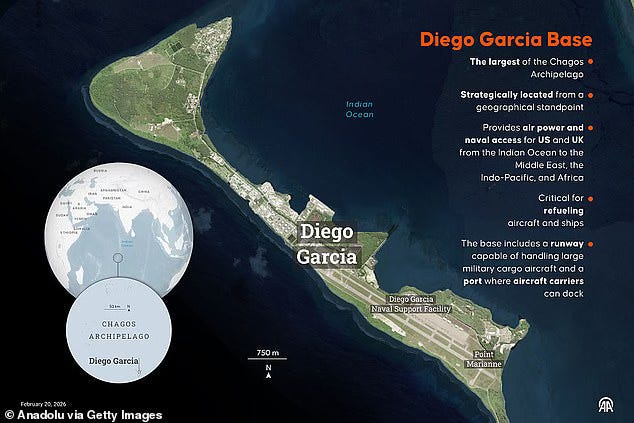
On Day 22 of Operation Epic Fury and the Persian New Year, two incompatible clocks are running simultaneously — and one of them is winning. Iran fired two intermediate-range ballistic missiles at Diego Garcia, the joint U.S.-U.K. Indian Ocean base housing the B-2 bombers that have been executing this campaign, approximately 4,000 kilometers from Iran. Neither struck the base. The attempt matters for a reason that transcends the outcome: Foreign Minister Araghchi had publicly stated Iran’s missiles are range-limited to 2,000 kilometers. The shot doubled that figure and arrived within hours of the United Kingdom authorizing U.S. use of British bases for Hormuz strikes. Iran answered a basing decision by demonstrating it can reach the basing network. Meanwhile CNN reported Trump is privately considering winding the war down. Those two events in the same 24-hour window are not a coincidence. They are the structure of this conflict made visible. Trump needs the war short and concludable before the midterm clock and the gasoline price clock strike together. The Islamic Revolutionary Guard Corps needs it long and unresolved. Every Iranian operational decision since Day 1 has been an instrument of that asymmetry. Every Trump wind-down signal is not a message to Tehran. It is evidence that Iranian strategy is working.
Update Summary
Key Developments
· Iran fired two intermediate-range ballistic missiles at Diego Garcia — the joint U.S.-U.K. Indian Ocean base housing B-2 bombers, approximately 4,000 kilometers from Iran — hours after the U.K. authorized U.S. use of British bases for Hormuz strikes; one missile failed in flight, a U.S. warship fired an SM-3 interceptor at the second; the U.K. MoD confirmed the attack was “unsuccessful” and directly linked it to the basing authorization. [24]
· Iran’s demonstrated IRBM range of 4,000 kilometers directly contradicts Araghchi’s public statement that Tehran had limited its missiles to 2,000 kilometers, exposing either deliberate deception or a previously undisclosed capability; the distance places multiple European capitals within assessed Iranian missile range. [25]
· Russia offered to halt intelligence sharing with Iran — including precise coordinates of U.S. military installations in the Middle East — in exchange for Washington cutting intelligence support to Ukraine; the offer was conveyed by Kremlin envoy Kirill Dmitriev to Steve Witkoff and Jared Kushner in Miami; the United States rejected it; European diplomats called the proposal “outrageous.” [1]
· U.S. and Israeli forces struck the Natanz nuclear facility area again on March 21, extending the nuclear-adjacent target set already hit at Isfahan, Fordow, and supporting infrastructure; Iranian state media confirmed; the nuclear render-safe question identified in SITREP 5 remains unresolved. [26]
· The U.S. Treasury authorized delivery of Iranian oil already loaded onto tankers before March 20 to continue to market until April 19, easing sanctions on the country the U.S. is actively bombing in order to cool energy prices above $100 per barrel — the campaign’s defining strategic contradiction. [27]
· CNN reported Trump is privately considering “winding down” the Iran war; Israeli Defense Minister Katz stated the same day that attacks on Iran will “increase significantly” in the coming week; the principal-agent gap between Washington and Jerusalem is the coalition’s most dangerous open seam. [28]
· The $200 billion Pentagon war supplemental has triggered visible bipartisan Congressional concern, with Republican and Democratic members raising questions about strategy, duration, and cost; Hegseth said “that number could move.” [29]
· Mojtaba Khamenei delivered his Nowruz address in writing only — 22 days into the war, no video, no audio; the CIA and Mossad are actively assessing whether photographs published by his Telegram channel are recent; a U.S. official described the Nowruz silence as “a big red flag.” [5]
· France and the U.K. jointly seized Russian shadow fleet tanker Deyna in the Western Mediterranean on March 20; President Macron posted the seizure on social media with explicit dual-theater framing: “The war involving Iran will not deflect France from its support for Ukraine, where Russia’s war of aggression continues unabated.” [6]
· Ukraine’s delegation arrived in Washington on March 20 with a proposal for expanded Shahed counter-drone cooperation, offering production of 2,000 interceptor drones per day at $3,000 per unit; Trump characterized the initiative as political PR. [10]
· CENTCOM Commander Adm. Cooper’s March 21 video update stated Iranian “combat capability is on a steady decline,” described destruction of an underground coastal facility storing anti-ship cruise missiles with multiple 5,000-pound bombs, and confirmed U.S. forces have struck more than 6,000 targets to date. [73]
· An Iranian cluster munition from a ballistic missile struck a daycare in Rishon Lezion, central Israel, on March 21 causing structural damage; the UAE intercepted three ballistic missiles and eight drones on March 21; Iran’s IRGC announced phases 65 and 66 of Operation True Promise 4. [87]
· The F-35A combat damage story has new open-source analytical development: The Aviationist and 19FortyFive are assessing an IRGC claim of passive infrared or optically-cued detection — a mode that emits no radar signature — as the potential kill chain against a low-observable platform; investigation ongoing. [30]
· ISW assessed on March 20 that Russian forces are conducting escalating mechanized assaults consistent with preparation for a Spring-Summer 2026 offensive, imposing competing tactical dilemmas across multiple frontline axes. [11]
IRAN / OPERATION EPIC FURY — Day 22
Crisis Module - Active
Situation Summary
The Diego Garcia strike attempt is the campaign’s most strategically significant single event since the Ras Laffan ballistic missile strike. Iran has now demonstrated willingness and assessed capability to engage a nuclear-capable, strategic bomber-hosting logistics hub 4,000 kilometers from its territory. The shot was not operationally successful. It was strategically communicative. It arrived as a direct, named response to a British basing decision — Araghchi had warned publicly within hours of the U.K. announcement — and it exposed Iranian IRBM range as double what Tehran had publicly acknowledged. Every European government now calculating the cost of supporting the coalition has a new data point: joining the coalition means entering Iranian missile range.
The Natanz re-strike compounds the nuclear dimension. U.S. and Israeli forces have now struck Natanz, Fordow, Isfahan, and supporting nuclear-adjacent infrastructure across multiple campaign phases. The nuclear render-safe problem identified in SITREP 5 — approximately 200-plus kilograms of 60-percent enriched uranium whose physical location cannot be confirmed by the IAEA — has not been resolved by additional strikes. Without a ground component, the nuclear pathway is complicated but not closed.
The sanctions relief on Iranian oil is the campaign’s most visible strategic contradiction to date. Washington is bombing Iran’s military and attempting to destroy its economic leverage — including the structural three-to-five-year wound already inflicted on Qatari LNG capacity [2][3] — while simultaneously authorizing Iranian oil delivery to market to prevent domestic gasoline prices from consuming the Republican midterm position. This is not an oversight. It is an explicit policy choice that confirms the war’s political clock is running on energy prices, not military objectives. [27]
Air Operations
CENTCOM’s March 21 update reported strikes on an underground facility along Iran’s coastline that stored anti-ship cruise missiles, mobile launchers, and missile radar relays used to monitor ship movements — all destroyed simultaneously with 5,000-pound bombs. Over 6,000 combat flights have been executed since Day 1. The campaign has shifted, per Adm. Cooper’s stated intent, from degrading existing stockpiles toward destroying Iran’s ability to regenerate offensive capacity.
The F-35A combat damage story continues to develop analytically. The aircraft landed safely and is assessed as repairable — the first confirmed state-adversary combat damage to an F-35, not its first loss. Open-source defense analysis is now focused on the IRGC claim of passive infrared or optical cueing as the detection mode: a sensor that emits no signal and provides no warning to the aircraft’s radar warning receiver. If confirmed, this represents a meaningful erosion of the assumption that stealth equals impunity over defended airspace. The investigation is ongoing. This must be held as assessment — but it cannot be dismissed. [30][73]
Maritime and Hormuz
The Strait of Hormuz remains functionally closed to U.S. and Israeli-linked vessels. Iran has conducted at least 21 confirmed attacks on merchant shipping. The March 17 strike on LPG tanker Gas Al Ahmadiah near Fujairah and the March 18 strike on chemical tanker Parimal near Khor Fakkan (one crew member still missing) represent continued systematic targeting of commercial shipping irrespective of flag. On March 19 Qatari offshore vessel Halul 69 sustained debris damage near Ras Laffan.
Iran’s parliament is advancing a legal framework to convert the wartime closure into a permanent toll-and-sovereignty regime — an attempt to reframe any future Western reopening operation as interference with Iranian revenue enforcement rather than opposition to military blockade. The IEA’s 400-million-barrel strategic reserve release has exerted some price impact; Brent is trading around $108, with Citigroup warning of $130 average in Q2/Q3 if energy infrastructure attacks continue. [17][18]
Drone and Missile
The Diego Garcia IRBM attempt is Iran’s first confirmed operational use of an intermediate-range ballistic missile in this conflict and its longest-range strike to date. One missile failed; a U.S. Navy warship fired an SM-3 interceptor at the second; intercept outcome unconfirmed. On Day 22 within Iranian territory: IRGC phases 65 and 66 of Operation True Promise 4 targeted West Jerusalem and Haifa. An Iranian cluster munition struck a daycare in Rishon Lezion. The UAE intercepted three ballistic missiles and eight drones. Iranian published satellite imagery confirmed a successful hit on a U.S. Patriot air defense system in Bahrain.
The sustained launch rate — despite CENTCOM’s assessed 70-plus percent launcher attrition — continues. IRGC spokesman Naeini, hours before his death on Day 21, stated that many current launches use missiles produced a decade ago and that production continues under wartime conditions. The discrepancy between attrition claims and observed launch volumes has not been resolved by open-source reporting. [87][25]
Ground Fires
Marines and Army units continue employing HIMARS, ATACMS, and PRISMS against Iranian ground targets; ATACMS strikes have sunk multiple Iranian vessels including a submarine. Kurdish opposition forces in western Iran remain positioned but are assessed as unable to act while Iran retains residual capability to strike their base areas. [9]
Regional Threat
Lebanon: Hezbollah continues sporadic missile and drone fire; Israeli forces from the 91st Division maintain their southern buffer zone; Israeli Defense Minister Katz stated attacks on Iran will “increase significantly” in the coming week, signaling potential northern escalation. The RAF Cyprus base remains a named Iranian target following the March 2 Hezbollah drone strike and London’s subsequent basing authorization. Iraq: Kata’ib Hezbollah commander Abu Ali al-Askari was killed in a Baghdad airstrike on March 14; the Green Zone hotel strike near an EU-Saudi delegation meeting remains unattributed. Yemen: Houthi posture remains subdued; the 2025 U.S.-Houthi ceasefire is assessed as containing the threat at current tempo. [20][87]
UKRAINE — Day 1,487
Crisis Module - Elevated
The Russia-Iran intelligence trade offer — confirmed by multiple sourced reports from the Dmitriev-Witkoff-Kushner Miami meeting — is the week’s most strategically significant single development in the Ukraine theater and the clearest single-day HWW axis convergence of the campaign. The Kremlin used the Iran war as explicit leverage against Ukraine: halt intelligence sharing with Iran, including precise coordinates of U.S. bases in the Middle East, in exchange for Washington cutting intelligence support to Ukraine. The U.S. rejected it. The structure of the offer confirms what CIA Director Ratcliffe told Congress on March 18: Russia is actively sharing targeting intelligence with Iran. Witkoff’s earlier assurance that he took Moscow “at their word” on non-sharing has been overtaken by events and by the Director’s own testimony. [1][13]
The offer also contains a secondary signal: Russia assessed that Washington might accept the trade. The fact that they made the proposal is itself an intelligence product about what Moscow believes the Trump administration’s Ukraine commitment is worth.
On the battlefield, ISW’s March 20 assessment identifies escalating Russian mechanized assaults as preparation indicators for a Spring-Summer 2026 offensive. Ukrainian FPV operators downed Russia’s 350th helicopter of the war — a Ka-52 in Donetsk. Russian launch volumes on March 20 remained at full operational tempo: 92 airstrikes dropping 257 guided aerial bombs, 8,273 kamikaze drones, and 3,844 shelling attacks. Ukrainian forces reported 1,610 Russian personnel casualties. [11][12]
France seized the shadow fleet tanker Deyna with British support. Macron’s explicit framing — Iran war will not deflect France from Ukraine — is a direct counter-signal to Russian narrative operations and to the Miami intel trade offer simultaneously: the European anchor of the anti-Axis coalition is holding and saying so publicly. The EU Brussels summit failed to unlock Hungary’s €90 billion veto. Lukashenko’s simultaneous engagement with Washington on sanctions relief — and his public linkage of Belarus-Russia-Iran cooperation — is a coordinated HWW axis maneuver: Belarus signals its hinge value between the Axis and U.S. deal-making, while Hungary produces the financing effect. [6][7][22]
Ukraine’s counter-drone cooperation proposal to Washington — 2,000 battle-tested interceptor drones per day at $3,000 per unit against Iran’s $50,000 Shaheds — is strategically sound: Zelensky is offering the U.S. military something it demonstrably needs in the current theater while deepening the bilateral relationship at maximum U.S. distraction. Trump’s “political PR” characterization is the immediate obstacle. [10]
Fort McNair / CONUS Drones. SITREP 5 provided the full analytical treatment of the Fort McNair drone incursion, the legal counter-UAS authority gap, the IRGC waterborne attack threat on record since January 2021, and the force protection failure. No new confirmed development in this cycle. Standing assessment: the incursion confirmed a pre-existing vulnerability. Remediation is a relocation problem, not a review problem. Primary indicator to watch: any repeat drone activity or new attribution. See SITREP 5 full Watch Item for complete analytical record.
USS Gerald R. Ford. NCIS investigation into the March 12 laundry fire as potential deliberate arson, running parallel to confirmed plumbing sabotage, is ongoing. Ford transiting to Souda Bay for repairs; Bush deploying as relief carrier. No new confirmed development beyond SITREP 5 treatment. Standing indicator: NCIS conclusion. Re-escalation trigger: confirmation of deliberate arson would elevate this from readiness issue to command climate crisis with no modern precedent during an active major combat operation.
Iran Hormuz Toll Legislation. Iran’s parliament is advancing a legal toll-and-sovereignty framework for Hormuz transits. Passage or formal IRGC enforcement announcement against non-U.S. commercial vessels would reframe any Western reopening operation legally and constitute a permanent escalation of the economic warfare dimension.
Taiwan Strait. Chinese surveillance of USS Tripoli ARG transit through the South China Sea monitored. Beijing’s pro-ceasefire posture is energy-market driven. Re-escalation trigger: PLA military action during U.S. theater distraction; any confrontation with the Tripoli ARG.
Korean Peninsula. No new KCNA reporting. Re-escalation trigger: DPRK test activity exploiting U.S. Gulf distraction; confirmed weapons transfer to Iran.
ANALYSIS & OPINION
NSD Prior Analysis
“The ‘Leaked’ Document: Tehran’s War Plan for Regime Change in Washington” — The National Security Desk / Military Innovation Lab · 11 March 2026 · milab.substack.com/p/leaked-document-tehrans-war-plan [Standing reference: not subject to 72-hour rule per Section 5 and Section 16 of the NSD Master Spec v3.1.] The red-team exercise published on Day 11 identified the time horizon asymmetry now operating in plain daylight as the campaign’s decisive strategic terrain. Its precise formulation: “Trump needs this war short and forgettable. We need it long, ugly, and unforgettable.” On Day 22, Trump signals wind-down; the IRGC fires IRBMs at his basing network. The document did not predict the specific instrument. It predicted the logic. The logic is confirmed. [RT-1]
“Dangerous Garbage: The 2026 Threat Assessment” — Military Innovation Lab · 19 March 2026 · milab.substack.com/p/dangerous-garbage-the-2026-threat The Ras Laffan damage locked in at three to five years remains the operational consequence of the intelligence synthesis failure this piece documented: every component needed to assess Gulf LNG infrastructure as Iran’s highest-impact retaliation vector was available before the war began. The structural wound to global gas markets is now confirmed. The policy lever — commercial satellite licensing — that the piece identified as enabling Iranian targeting of U.S. forces remains unexercised. The Diego Garcia IRBM shot raises the same question the piece was written to ask: how did Iran acquire accurate targeting data for a 4,000-kilometer strike? [30][NSD-2]
“America’s Satellites Helped Iran Target U.S. Forces” — Military Innovation Lab · 1 March 2026 · milab.substack.com/p/americas-satellites-helped-iran-targ [Editorial gate: beyond 72-hour rule; included as directly relevant.] The F-35 passive IR cueing story and the Diego Garcia IRBM targeting question both turn on the same problem this piece identified: commercial AI-ISR and satellite imagery services are a central enabler of Iranian fires against Western platforms and distant bases. The policy lever remains unexercised. [NSD-1]
External Analysis
The week’s sharpest open-source analytical thread is the one mainstream coverage has not yet named explicitly: the divergence between Trump’s political time horizon and the IRGC’s strategic time horizon is not a backdrop to the campaign — it is the campaign’s decisive terrain. Bloomberg characterized the Diego Garcia shot as a “show of missile capability” regardless of outcome. The Aviationist noted that 4,000 kilometers places multiple European capitals within assessed Iranian range. The Washington Examiner reported the launches are “likely to exert considerable pressure on Europe to begin devoting forces to reopen the Strait of Hormuz.” The seven-nation statement expressing readiness for Hormuz action preceded the Diego Garcia strike; what posture those governments hold after it is the immediate diplomatic question. The strategic contradiction between bombing Iran and easing its oil sanctions is drawing mainstream commentary from Reuters, the New York Times, and the BBC, all framing it as evidence that the campaign’s political clock is running on domestic energy prices, not military objectives. The two senior allied generals whose verdict on Epic Fury NSD reported in SITREP 5 — French General Yakovleff and British General Shirreff — have not been publicly refuted by any NATO official or defense ministry. Their assessment stands as the most rigorous public strategic critique of the campaign’s architecture. [24][27][RT-1]
HWW Lens
The Four Plus Two axis is operating at full tempo across every theatre simultaneously. Russia is confirmed sharing targeting intelligence with Iran while simultaneously offering to halt that sharing as a bargaining chip against Ukraine — the Miami offer is HWW axis mechanics made explicit. Moscow receives strategic distraction value at zero cost: the U.S. is simultaneously bombing Iran, managing Gulf energy markets, and being asked whether it will trade Ukraine for relief. Ukraine provides counter-drone expertise to U.S. Gulf partners against Iranian systems Russia helped develop and deploy. Hungary vetoes the Ukrainian loan at the EU summit while European leaders simultaneously manage a Gulf energy shock that strains fiscal and political bandwidth for Ukrainian support. Lukashenko’s public linkage of Belarus-Russia-Iran cooperation names the Axis deliberately. France’s dual-theater shadow fleet seizure — Iran war will not deflect France from Ukraine — is the clearest European counter-signal to axis narrative management this campaign has produced. Standing reference: “A Hybrid World War” — NSD/MILab, 23 October 2023, milab.substack.com [HWW-1]
NSD ANALYTICAL ASSESSMENT
Key Driving Assumption
The campaign’s decisive terrain is not kinetic. It is the asymmetry between two incompatible time horizons operating simultaneously.
Trump requires a short, concludable war. His constraints are structural: the 2026 midterm cycle, domestic energy prices, a $200 billion supplemental navigating a bipartisan Congress that is already asking what the objective is, and a political brand built on ending wars rather than starting them.
The IRGC requires the opposite. Its victory condition is not military. It is political: deny Trump a clean, convincing exit. A war that drags into the summer, with oil above $100, Marines in the region, Congressional hearings multiplying, and no credible endstate visible, is an Iranian strategic success regardless of how degraded their surface fleet and missile inventory are.
These objectives are structurally irreconcilable. The IRGC does not need to defeat the U.S. military. It needs to ensure Trump cannot credibly claim to have won.
Every Iranian operational decision is legible as an instrument of this asymmetry. Every Trump statement about “winding down” is not a signal to Tehran. It is evidence that Iranian strategy is working.
This assumption does not change unless one of two conditions is met: Trump commits to a war timeline that structurally removes the midterm clock as a constraint; or Iran’s command authority produces a credible, IRGC-endorsed ceasefire offer on terms that permit Trump a genuine, marketable victory declaration. Neither is currently assessed as likely.
72-Hour Trajectory
The next 72 hours are shaped by the asymmetry above. Katz’s explicit statement that attacks will “increase significantly” in the coming week is a near-certain escalation indicator. Highly likely (>85%) that U.S.-Israeli airstrikes intensify, including additional Natanz-area and nuclear-adjacent targeting.
Having demonstrated IRBM range to Diego Garcia without decisive immediate consequence, Iran’s IRGC will assess whether to normalize such shots. Likely (55-70%) that Iran conducts additional long-range missile activity — a repeat Diego Garcia attempt, a shot toward a European base hosting U.S. forces, or a threat-signaling IRBM launch — within 72-96 hours. The strategic purpose is to prevent Trump’s wind-down signal from becoming a narrative fact.
Highly likely (>85%) that oil remains above $100 through end of March regardless of ceasefire developments, given the structural Ras Laffan damage. Roughly even (45-55%) that meaningful Congressional conditions are attached to the $200 billion supplemental in April, potentially constraining operational freedom. Unlikely (<30%) that any substantive ceasefire dialogue opens before April 1.
On Ukraine: Russia’s Miami probe of U.S. commitment architecture was rejected this time. It will be repeated in different form.
Anticipatory Worst-Case Scenarios (Standing — see Section 16, NSD Master Spec v3.1 for full framework)
These scenarios are assessed against today’s indicators:
Scenario 1 — Drone Strike on CONUS Principal
Unattributed drone activity over Fort McNair confirmed (SITREP 5). No new development since. No attribution, no arrests, no structural remediation. Current indicators unchanged. Probability: LOW. Watch status: ACTIVE.
Scenario 2 — Successful Carrier Mission-Kill
New indicators since SITREP 5: F-35 passive cueing investigation ongoing; Chinese surveillance of Tripoli ARG transit confirmed; Russian-Iranian ISR sharing confirmed by CIA Director Ratcliffe. Probability modifier: if Trump begins visible naval drawdown as a wind-down signal, probability moves upward rapidly — the red-team exercise identified this as Iran’s optimal trigger timing. Probability: LOW-MEDIUM. Watch status: ACTIVE.
Scenario 3 — Radiological or Environmental Incident at Natanz
New indicator: Natanz struck a second time on March 21. IAEA access constrained. No credible open-source damage assessment of residual fissile material at struck sites. Probability: LOW. Watch status: ACTIVE — elevated by second Natanz strike.
Scenario 4 — IRGC Command Fragmentation Producing Uncontrolled Escalation
New indicator: Mojtaba Khamenei — written Nowruz address only, Day 22, CIA calling absence of video “a big red flag.” Larijani eliminated. Pezeshkian commitments reversed by IRGC in real time. Probability: LOW-MEDIUM and rising. Watch status: ACTIVE.
Critical Unknowns
1. Who authorized the Diego Garcia IRBM launch — Mojtaba Khamenei’s leadership or an IRGC operational command acting with delegated or independent authority. A unified command decision indicates strategic discipline and legible deterrence logic. IRGC operational freelancing indicates command fragmentation that makes any ceasefire harder to enforce than to negotiate.
2. Iran’s undersea drone and UUV capability and capacity to threaten Hormuz shipping from subsurface platforms after the surface fleet has been functionally destroyed. Open-source dataset has no reliable visibility on this. If Iran can hold the strait at strategic risk from subsurface platforms, no Trump victory declaration can be made to hold economically — the war continues by other means regardless of what is announced from a podium.
3. Whether Trump’s “winding down” signal reflects a genuine strategic pivot, a domestic messaging exercise for energy price management, or a negotiating posture not coordinated with Jerusalem. The gap between Trump’s public posture and Katz’s escalation pledge is the coalition’s most dangerous principal-agent seam. Iran is calibrating against it.
Analyst’s Note
Iran has now fired intermediate-range ballistic missiles at a base housing B-2 bombers in the Indian Ocean. It has struck the world’s largest LNG export facility. It has fired at every Gulf state with a U.S. military presence. It is sustaining these operations on Day 22 of a campaign that was framed, by some accounts, as concludable in four weeks. The new Supreme Leader has not appeared on camera. The CIA cannot confirm whether his photographs are recent. The IRGC is running the war.
And the United States is simultaneously bombing Iran and easing sanctions on Iranian oil.
CENTCOM says Iranian “combat capability is on a steady decline.” That may be true as a statement about aggregate launcher inventory. It is not a statement about Iran’s ability to sustain politically meaningful operations at the frequency required to keep Trump’s political clock running. Those are not the same metric.
The red-team exercise NSD published on Day 11 stated the Iranian theory of victory with precision: “Trump can declare victory whenever he likes. He needs this war to be short and forgettable. We need it to be long, ugly, and unforgettable.” On Day 22, the evidence is in. The Diego Garcia shot was not aimed at a runway. It was aimed at a political timeline.
Standing reference: “A Hybrid World War” — NSD/MILab, 23 October 2023, milab.substack.com [HWW-1] Red-team reference: “The ‘Leaked’ Document: Tehran’s War Plan for Regime Change in Washington” — NSD/MILab, 11 March 2026, milab.substack.com/p/leaked-document-tehrans-war-plan [RT-1]
LEADER LOCATOR — Confirmed Locations as of Saturday, 21 March 2026
U.S. PRINCIPALS
Donald Trump · President · Mar-a-Lago, Florida — departed South Lawn March 20; operating Iran war from resort Situation Room · NBC News / AP pool · ASSESSED (medium confidence)
Steve Witkoff · Special Envoy · Location post-Miami unknown · UNKNOWN
Marco Rubio · Secretary of State · Fort McNair, Washington D.C. (residence) — no confirmed operational travel signal; 6th in presidential line of succession; drone incursion over installation unresolved · ASSESSED
Pete Hegseth · Secretary of Defense · Fort McNair / Pentagon — no confirmed travel signal; 4th in presidential line of succession; drone incursion over installation unresolved · ASSESSED
ADVERSARY PRINCIPALS
Mojtaba Khamenei · Supreme Leader, Iran · UNKNOWN · Written Nowruz statement only; no video or audio Day 22; CIA assessing whether photographs are recent; “big red flag” per U.S. official; Hegseth assessed “wounded and likely disfigured” · UNKNOWN. Standing assessment since Day 1: written statements only, no video.
Mohammad Javad Araghchi · Foreign Minister, Iran · Active public profile — Face the Nation March 20; X post warning on U.K. bases March 21; phone call with UK FM Cooper confirmed · Araghchi Telegram / NBC News · CONFIRMED
Vladimir Putin · President, Russia · Moscow — Kremlin readouts confirm ongoing engagement; RFE/RL Systema unit unable to confirm actual location from office backdrop · kremlin.ru · ASSESSED (medium confidence; body double use documented; first confirmed Kremlin footage in 160-plus days as of SITREP 5)
Xi Jinping · General Secretary / President, China · Beijing — special envoy dispatched to region; no confirmed Xi travel · Xinhua · ASSESSED
Kim Jong-un · Supreme Leader, DPRK · No KCNA confirmed appearance · UNKNOWN
ALLIED / EUROPEAN PRINCIPALS
Benjamin Netanyahu · Prime Minister, Israel · Israel — confirmed via live press briefings, Katz statement issued under his government; stated Israel holding further South Pars strikes at Trump’s request · Times of Israel · CONFIRMED. ANALYTICAL NOTE: Netanyahu’s strike decisions — South Pars, Natanz — are frequently not pre-coordinated with Washington (”we knew nothing about it”). Track as an independent escalation variable, not a subordinate U.S. decision node.
Keir Starmer · Prime Minister, United Kingdom · London — confirmed via MoD basing authorization statement and Diego Garcia MoD response · Downing Street / MoD · CONFIRMED. ANALYTICAL NOTE: Starmer’s authorization of U.S. use of U.K. bases triggered the Diego Garcia IRBM response within hours. The U.K. has now been directly targeted by Iranian ballistic missiles as a consequence of a declared policy decision.
Emmanuel Macron · President, France · Paris — confirmed via X post on Deyna seizure March 20 · @EmmanuelMacron · CONFIRMED. ANALYTICAL NOTE: Macron’s dual-theater framing on March 20 — Iran war will not deflect France from Ukraine — delivered simultaneously with the shadow fleet seizure is a deliberate strategic communication, not a routine press statement.
Friedrich Merz · Chancellor, Germany · Brussels — EU summit March 20 · DPA pool · ASSESSED
Kaja Kallas · EU High Representative · Brussels — EU summit March 20 · @kajakallas / EEAS · CONFIRMED
Ursula von der Leyen · President, European Commission · Brussels — EU summit March 20 · EC press releases · CONFIRMED
Mark Rutte · NATO Secretary General · No confirmed location signal in last 24 hours · UNKNOWN
The National Security Desk offers these posts freely, but your support is necessary and appreciated. Please subscribe, paid if you’re able, or leave a tip.
Thank you

ENDNOTES
[1] Kyiv Independent / The Defense News / Politico Europe · Russia-Iran intel trade offer; Dmitriev-Witkoff-Kushner Miami meeting; U.S. rejection; European reaction · kyivindependent.com / thedefensenews.com · 20 March 2026
[2] Reuters · QatarEnergy CEO confirms 17% LNG capacity offline, 3-5 year repair, force majeure · reuters.com · 19 March 2026
[3] Bloomberg / CNBC · Ras Laffan damage; energy price surge; helium export curtailment 14% · bloomberg.com / cnbc.com · 18-19 March 2026
[5] Axios · The Mojtaba mystery; CIA assessing photographs; “big red flag” · axios.com · 21 March 2026
[6] Euromaidan Press / Reuters · France seizes tanker Deyna; Macron dual-theater statement · euromaidanpress.com / reuters.com · 20 March 2026
[7] Ukrinform / Pravda USA · EU Brussels summit; Hungary blocks €90B Ukraine loan · 20 March 2026
[9] SOF News · USS Tripoli ARG, 31st MEU, 2,500 Marines en route; ATACMS ship kills · sof.news · 15 March 2026
[10] Kyiv Independent / Al Jazeera · Ukraine counter-drone delegation to Washington; 2,000 interceptors/day offer at $3,000 per unit; Trump “political PR” response · kyivindependent.com · 20 March 2026
[11] ISW / Kyiv Post · Russian mechanized assault escalation; Spring-Summer 2026 offensive prep; shadow fleet tanker seizure · kyivpost.com · 20 March 2026
[12] EMPR Media / Ukrainian General Staff · 201 combat engagements; 1,610 Russian casualties; 8,273 drones launched March 20 · empr.media · 20 March 2026
[13] Kyiv Independent · CIA Director Ratcliffe congressional testimony on Russia-Iran intel sharing · kyivindependent.com · 18-20 March 2026
[17] 2026 Strait of Hormuz Crisis / TIME · Strait closure; 21 confirmed ship attacks; tanker incidents; IEA 400-million-barrel release · ongoing
[18] CNBC / Bloomberg · Brent above $108; Citigroup $130 Q2/Q3 scenario · 19-21 March 2026
[20] Wikipedia / Flashpoint / Britannica · Lebanon front; Hezbollah; Iraq proxy activity · March 2026
[22] Ukrinform / Pravda USA · Lukashenko U.S. engagement; Belarus-Russia-Iran cooperation · 20 March 2026
[24] CNBC / The Hill / ITV News / Washington Examiner · Iran fires two IRBMs at Diego Garcia; SM-3 engagement; U.K. MoD confirms “unsuccessful” · cnbc.com / thehill.com / itv.com · 20-21 March 2026
[25] Ynet News / The Aviationist / Israel Hayom · 4,000km IRBM range vs Araghchi’s stated 2,000km limit; European capitals within range · ynetnews.com / theaviationist.com · 21 March 2026
[26] Times of Israel / DW · Natanz struck again by U.S.-Israeli forces; Iranian media confirms · timesofisrael.com / dw.com · 21 March 2026
[27] BBC / New York Times · U.S. Treasury eases sanctions on Iranian oil already at sea; delivery authorized until April 19 · bbc.com / nytimes.com · 19-20 March 2026
[28] CNN · Trump considering “winding down” Iran war; Katz “increase significantly” pledge · cnn.com · 21 March 2026
[29] TIME / Politico / CBS News · $200B Pentagon supplemental; bipartisan Congressional concern · time.com / politico.com · 19-20 March 2026
[30] CNN / 19FortyFive / The Aviationist · F-35A combat damage; passive IR cueing analysis; safe emergency landing confirmed · cnn.com / 19fortyfive.com · 19-21 March 2026
[73] Stars and Stripes / C-SPAN · CENTCOM Cooper March 21 video update; underground anti-ship facility; 5,000-pound bombs; 6,000+ combat flights · stripes.com · 21 March 2026
[87] Times of Israel liveblog / Zee News / Pravda USA · Rishon Lezion daycare cluster munition; UAE intercepts March 21; IRGC phases 65-66 · timesofisrael.com · 21 March 2026
[NSD-1] MILab · “America’s Satellites Helped Iran Target U.S. Forces” [editorial gate: beyond 72-hour rule; included as directly relevant] · milab.substack.com/p/americas-satellites-helped-iran-targ · 1 March 2026
[NSD-2] MILab · “Dangerous Garbage: The 2026 Threat Assessment” · milab.substack.com/p/dangerous-garbage-the-2026-threat · 19 March 2026
[RT-1] NSD / Military Innovation Lab · “The ‘Leaked’ Document: Tehran’s War Plan for Regime Change in Washington” [standing reference: not subject to 72-hour rule per Section 5 and Section 16 of the NSD Master Spec v3.1] · milab.substack.com/p/leaked-document-tehrans-war-plan · 11 March 2026
[HWW-1] NSD / MILab · “A Hybrid World War” [standing reference] · milab.substack.com · 23 October 2023
NSD SITREP is published by the National Security Desk. All sources open-source. ICD-203 analytic standards applied throughout. National Security Desk · https://substack.com/@milab